When Should You Take Digestive Enzymes?
The right timing depends on what your enzyme is meant to digest and the directions for the exact product you have.
If an enzyme is meant to help digest a food, taking it on an empty stomach is usually not the point: the enzyme needs to meet that food. Prescription pancreatic enzymes are used with meals, while one lactase product directs use with the first bite or sip of dairy and one alpha-galactosidase product gives its own meal-related window. Follow your prescription or product label rather than applying either example to every enzyme.234
Start with the enzyme, not a fasting rule
“Digestive enzymes” describes products with different jobs. Some are intended to help break down a particular part of a meal. Others are prescription treatment for pancreatic exocrine deficiency, a condition in which the pancreas doesn’t supply enough digestive enzymes. Their timing instructions aren’t interchangeable.234
The useful question is: What food or meal is this product supposed to work on? Then check the directions for the exact formulation in your hand. An empty stomach isn’t a better default just because it sounds more efficient. For the meal-dependent products below, the aim is to bring the enzyme and the relevant food together.234
If it’s prescription pancreatic enzymes
Pancreatic enzyme replacement is used for people with pancreatic exocrine deficiency, including people with chronic pancreatitis or cystic fibrosis. The clinical reason for meal timing is clear: enzymes delivered into the small intestine alongside food can help reduce nutrient malabsorption and fatty stools. A review describes that goal as getting sufficient enzyme activity into the intestine simultaneously with meals.2
That explains why taking these enzymes while fasting isn’t a substitute for taking them as directed around food. It does not tell you how to schedule every prescription product. If you’ve been prescribed pancreatic enzymes, use your prescription directions. If a meal or snack doesn’t seem to fit those directions, ask the prescriber or pharmacist about that situation rather than borrowing timing from an over-the-counter bottle.
If it’s lactase for dairy
Lactase helps break down lactose, the sugar in dairy. One example, LACTAID dietary supplements, directs users to take the product with the first bite or sip of dairy. Its manufacturer says taking it too early or too late can make it less effective and notes that instructions differ among its formulations.3
So if your product is meant for lactose, connect its directions to the dairy you’re actually eating or drinking. For example, a coffee with milk and a dairy-free breakfast pose different questions. The LACTAID directions are useful evidence of how that brand’s products are intended to be used, not a timing guarantee for every lactase formulation.3
If it’s alpha-galactosidase for certain foods
Alpha-galactosidase products are aimed at complex carbohydrates in foods such as beans and some vegetables, rather than lactose in dairy. Beano tablets, for example, direct use right before the first bite or shortly after starting a meal containing those carbohydrates. That is a product-specific window, not a reason to take all digestive enzymes after eating.4
Notice the practical difference: a lactase product is tied to dairy, while this alpha-galactosidase product is tied to particular carbohydrate-containing foods. If a meal doesn’t contain the food the product targets, taking the enzyme on an empty stomach doesn’t address that mismatch.34
If the bottle says “digestive enzyme blend”
A blend may contain several enzymes and other ingredients. Don’t infer its timing from the word enzyme or from directions for a single-ingredient product. Read the ingredient list, intended use, and directions together. If those directions are unclear, a pharmacist can help you interpret the label. Directions for prescription pancreatic enzymes, LACTAID, or Beano can’t tell you when to take an unspecified blend.234
This check is especially worthwhile if you’re pregnant or breastfeeding. Read the whole formulation, including additional ingredients, rather than assuming all enzyme products are alike. Beano tablets specifically tell pregnant or nursing users to ask a doctor before use; that wording belongs to that product and shouldn’t be treated as a rule for every enzyme.4
If you’re using an enzyme because bloating, diarrhea, or abdominal pain keeps returning, timing may not be the whole answer. Food intolerance can cause those symptoms, but they have other possible explanations too. Recurrent symptoms are worth discussing with a clinician instead of repeatedly changing when you take a supplement.1
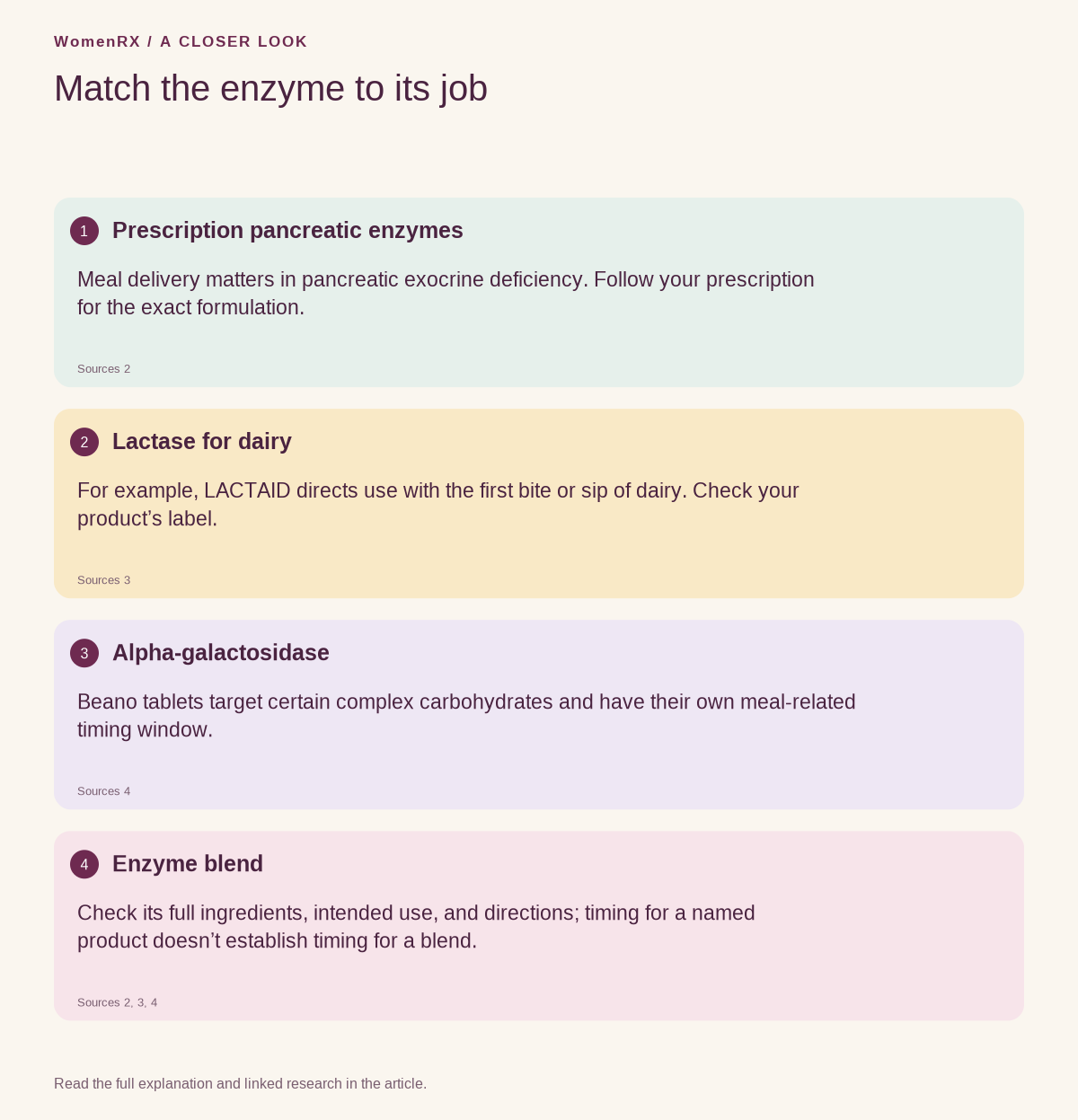
Match the enzyme to its job
Prescription pancreatic enzymes: Meal delivery matters in pancreatic exocrine deficiency. Follow your prescription for the exact formulation.2
Lactase for dairy: For example, LACTAID directs use with the first bite or sip of dairy. Check your product’s label.3
Alpha-galactosidase: Beano tablets target certain complex carbohydrates and have their own meal-related timing window.4
Enzyme blend: Check its full ingredients, intended use, and directions; timing for a named product doesn’t establish timing for a blend.234
Read the figure as text
Identify the product type first, then use its own directions to decide how it relates to food.- Prescription pancreatic enzymes: Meal delivery matters in pancreatic exocrine deficiency. Follow your prescription for the exact formulation.2
- Lactase for dairy: For example, LACTAID directs use with the first bite or sip of dairy. Check your product’s label.3
- Alpha-galactosidase: Beano tablets target certain complex carbohydrates and have their own meal-related timing window.4
- Enzyme blend: Check its full ingredients, intended use, and directions; timing for a named product doesn’t establish timing for a blend.234
More questions, answered
Should I take a digestive enzyme before every meal?
Not necessarily. The examples here are tied to the food they’re meant to help digest, and prescription pancreatic enzymes have their own directions. Check the exact product or prescription rather than using an every-meal rule.234
Is lactase the same as a lactose-free dairy product?
No. A lactase supplement is taken in connection with dairy you eat or drink. In LACTAID lactose-free dairy products, lactase has already been used to break down the lactose; there’s no supplement-timing step for that product.3
Sources you can check
- Food intolerance - NHSAccessed 2026-09-25Return to first citation
- Pancreatic enzyme pharmacotherapy.Ferrone M, Raimondo M, Scolapio JS. · Pharmacotherapy · 2007Return to first citation
- Frequently Asked Questions | LACTAID®Accessed 2026-09-25Return to first citation
- Beano® Tablets - Alpha-D-Galactosidase Anti-Gas PillsAccessed 2026-09-25Return to first citation