When to Take Digestive Enzymes Depends on the Food
Pancreatic enzymes, lactase, and alpha-galactosidase have different jobs, so the meal matters more than the clock.
There’s no single morning-or-night rule for digestive enzymes. Prescribed pancreatic enzyme replacement therapy is taken during meals and with food-containing snacks.3 Lactaid’s lactase supplements are taken with the first bite or sip of dairy, while Beano’s alpha-galactosidase tablets have their own directions for meals containing certain complex carbohydrates.45 Check the exact product before applying another enzyme’s timing rule.
Start with what the enzyme is meant to digest
If you’re looking at a bottle of digestive enzymes and wondering whether to take it at breakfast or bedtime, turn the question around: What food is this product meant to help digest? The answer determines when its directions matter. A lactase supplement for dairy, an alpha-galactosidase product for certain complex carbohydrates, and prescribed pancreatic enzyme replacement therapy (PERT) are not interchangeable.345
Prescribed pancreatic enzymes go with meals
Prescribed pancreatic enzyme replacement therapy (PERT) treats exocrine pancreatic insufficiency (EPI). In EPI, the pancreas does not deliver enough digestive enzymes to the intestine to digest nutrients properly. Conditions associated with EPI include chronic pancreatitis, cystic fibrosis, and previous pancreatic surgery. Its possible signs include fatty stools, diarrhea, weight loss, and bloating.3
For adults with diagnosed EPI, American Gastroenterological Association guidance says to take PERT during the meal, with treatment also tied to snacks. The amount may be adjusted according to the meal’s size and fat content. Follow your own prescription rather than using a supplement bottle to set a PERT routine.3 A systematic review of trials in people with chronic pancreatitis and EPI found that PERT improved fat absorption compared with placebo; its authors also identified administration during food as a way treatment may be improved.2
This is why a bedtime reminder, on its own, misses the point. PERT is meant to accompany the food it helps digest, whether that food is breakfast, dinner, or a snack.3 If you’ve been prescribed it and are unsure how its directions apply to a particular meal, ask your prescribing team or pharmacist rather than changing the schedule yourself.
Lactase is for dairy containing lactose
Lactase breaks down lactose, the sugar in dairy. Lactose intolerance means having difficulty digesting that sugar; it is not the same thing as a food allergy.14 For Lactaid dietary supplements specifically, the manufacturer says to take the product with the first bite or sip of dairy. It says taking it too soon or too late makes it less effective, and that instructions differ among its formulations.4
For example, if your lunch contains milk or a dairy-based sauce, that first bite or sip is the relevant moment for this product, not the time you woke up. Check your own lactase product’s label rather than borrowing Lactaid’s directions for every brand.4 Lactase also targets lactose, so its timing directions don’t make it a general answer to discomfort after any meal.14
Alpha-galactosidase follows a different food cue
Beano tablets contain alpha-galactosidase, which the manufacturer describes as helping digest gas-causing complex carbohydrates in foods such as legumes, grains, and cruciferous vegetables. Its tablet directions say to take it right before the first bite of a meal containing those foods. Unlike the Lactaid directions above, Beano’s directions also allow use immediately after a meal, up to 30 minutes after the first bite.5
That difference is a good reason not to memorize one rule for all enzymes. For example, a meal of beans may be the occasion to check an alpha-galactosidase label; a glass of milk points instead to a lactase label. Neither product’s directions replace those for prescribed PERT.345
What about pregnancy or menopause?
The timing directions here are organized around food and the specific product, not a morning-or-night schedule for cycling years, perimenopause, or postmenopause.345 That does not establish that every enzyme product has been studied equally across those life stages. If you’re pregnant or nursing, check the product in your hand: Beano tablets specifically say to ask a doctor before use in pregnancy or nursing.5 Keep that product-specific caution separate from the meal-timing instructions for other enzymes.
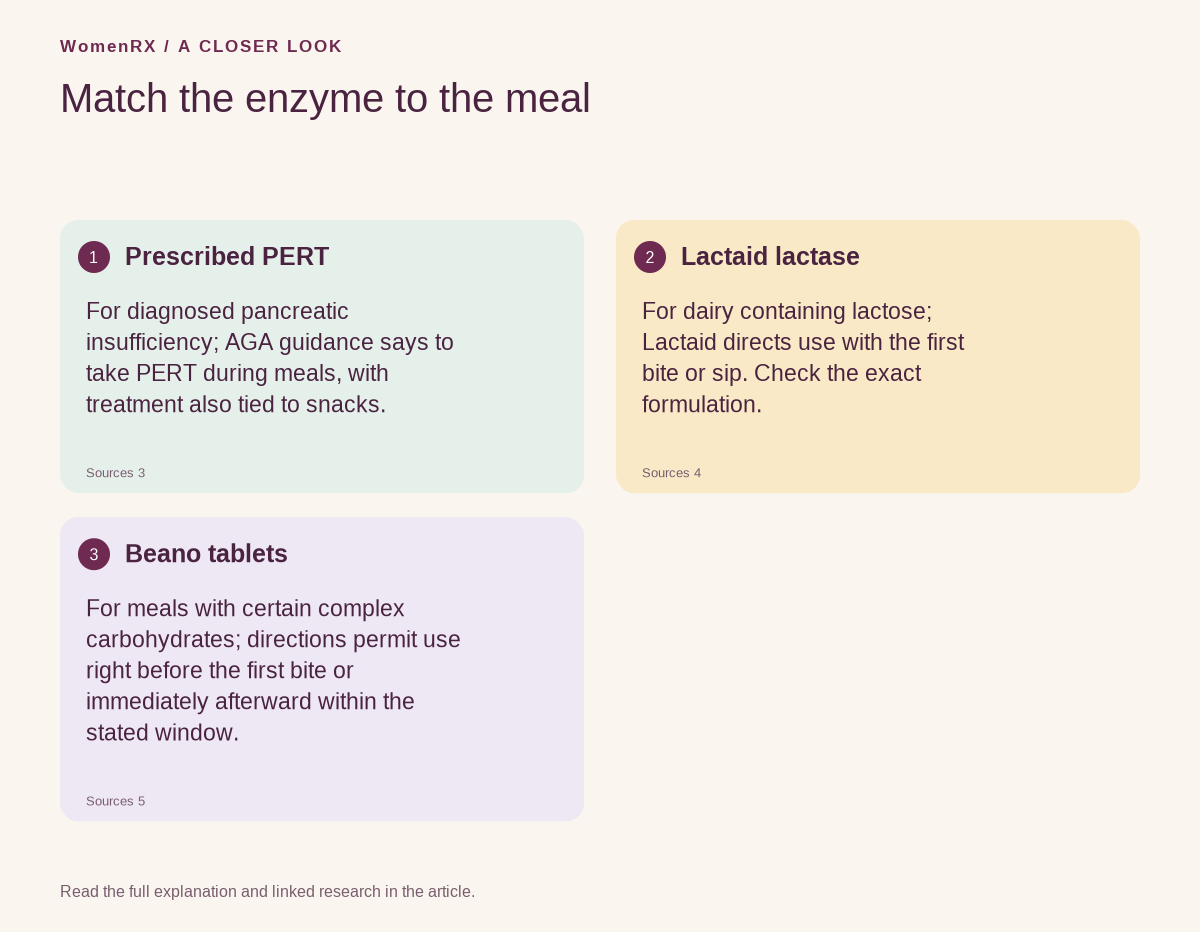
Match the enzyme to the meal
Prescribed PERT: For diagnosed pancreatic insufficiency; AGA guidance says to take PERT during meals, with treatment also tied to snacks.3
Lactaid lactase: For dairy containing lactose; Lactaid directs use with the first bite or sip. Check the exact formulation.4
Beano tablets: For meals with certain complex carbohydrates; directions permit use right before the first bite or immediately afterward within the stated window.5
Read the figure as text
Compare the food each enzyme is meant for with the timing stated in its guidance or product directions.- Prescribed PERT: For diagnosed pancreatic insufficiency; AGA guidance says to take PERT during meals, with treatment also tied to snacks.3
- Lactaid lactase: For dairy containing lactose; Lactaid directs use with the first bite or sip. Check the exact formulation.4
- Beano tablets: For meals with certain complex carbohydrates; directions permit use right before the first bite or immediately afterward within the stated window.5
Sources you can check
- Food intolerance - NHSAccessed 2026-09-25Return to first citation
- Efficacy of pancreatic enzyme replacement therapy in chronic pancreatitis: systematic review and meta-analysis.de la Iglesia-García D, Huang W, Szatmary P, Baston-Rey I, Gonzalez-Lopez J, Prada-Ramallal G, Mukherjee R, Nunes QM, Domínguez-Muñoz JE, Sutton R, NIHR Pancreas Biomedical Researc... · Gut · 2017Return to first citation
- AGA Clinical Practice Update on the Epidemiology, Evaluation, and Management of Exocrine Pancreatic Insufficiency: Expert Review.Whitcomb DC, Buchner AM, Forsmark CE. · Gastroenterology · 2023Return to first citation
- Frequently Asked Questions | LACTAID®Accessed 2026-09-25Return to first citation
- Beano® Tablets - Alpha-D-Galactosidase Anti-Gas PillsAccessed 2026-09-25Return to first citation