When to Take Digestive Enzymes Depends on the Job
Prescription pancreatic enzymes work alongside meals for diagnosed insufficiency; a lactase product and a general enzyme blend serve different purposes.
For exocrine pancreatic insufficiency (EPI), prescribed pancreatic enzyme replacement is used with food because the enzymes need to meet the nutrients in meals and snacks. Follow your prescription’s directions for the details. Lactase targets the lactose in dairy, so check that product’s directions for timing. A general over-the-counter blend isn’t a substitute for pancreatic enzyme replacement or a way to identify what’s causing symptoms. 1 2
Start with the food the enzyme is meant to digest
The useful question isn’t simply “before or after a meal?” It’s which enzyme, for which problem? Pancreatic enzyme replacement therapy (PERT) addresses EPI, a condition in which too few pancreatic enzymes reach food in the intestine to meet nutritional needs. Lactase has a narrower job: it breaks down lactose, the sugar in milk. Those are different reasons to use an enzyme, even though both products may sit under the heading “digestive enzymes.” 1 2
Prescribed pancreatic enzymes: keep them connected to meals
PERT is a mainstay of treatment for EPI. Its purpose is to replace enzymes where they’re needed, in connection with the food you eat, including meals and snacks. Taking it at an unrelated time misses that purpose. Follow the meal-related directions for your prescription rather than using instructions from a supplement bottle. 1 2
Pancreatic enzyme products also differ in formulation. A clinical review describes acid-resistant, delayed-release preparations and an uncoated, immediate-release preparation. That distinction matters to how the enzymes are protected and released; it does not, by itself, establish a different meal-timing rule for each product. If the directions on your prescription don’t make sense for the way you eat, ask your pharmacist or prescriber to clarify them. 2
EPI is especially worth discussing if you have a condition linked to it, such as chronic pancreatitis or a history of pancreatic surgery. Oily stools, weight loss, or otherwise unexplained nutritional deficiencies may also prompt an evaluation. Bloating alone is less specific: EPI symptoms overlap with those of other digestive conditions, including irritable bowel syndrome and celiac disease. 1 2
Lactase: a targeted enzyme, not pancreatic replacement
Lactase helps digest lactose. If lactose-containing food is what you’re trying to address, that’s the relevant match; lactase does not replace the pancreatic enzymes used to treat EPI. Follow the directions on the particular lactase product for when to use it with that food. 1 2
Other enzyme deficits have other targets. For example, sucrase-isomaltase helps digest carbohydrates including sucrose, starch, and isomaltose. The word “enzyme” on a label cannot tell you whether a product addresses the reason for your symptoms. 1
What about an over-the-counter blend?
A blend marketed for “general digestion” may sound like a catch-all, but the established role of prescribed PERT in EPI does not demonstrate that a broad blend treats unexplained bloating or replaces pancreatic enzyme therapy. If symptoms keep recurring, matching them to a cause is more useful than repeatedly changing enzyme products. A response to a supplement wouldn’t, on its own, diagnose EPI. 1 2
If you’re pregnant or breastfeeding, review the exact nonprescription product and its ingredients with a pharmacist or your pregnancy care team before using it. Don’t assume that information about prescribed treatment for EPI establishes the suitability of a different enzyme blend for you.
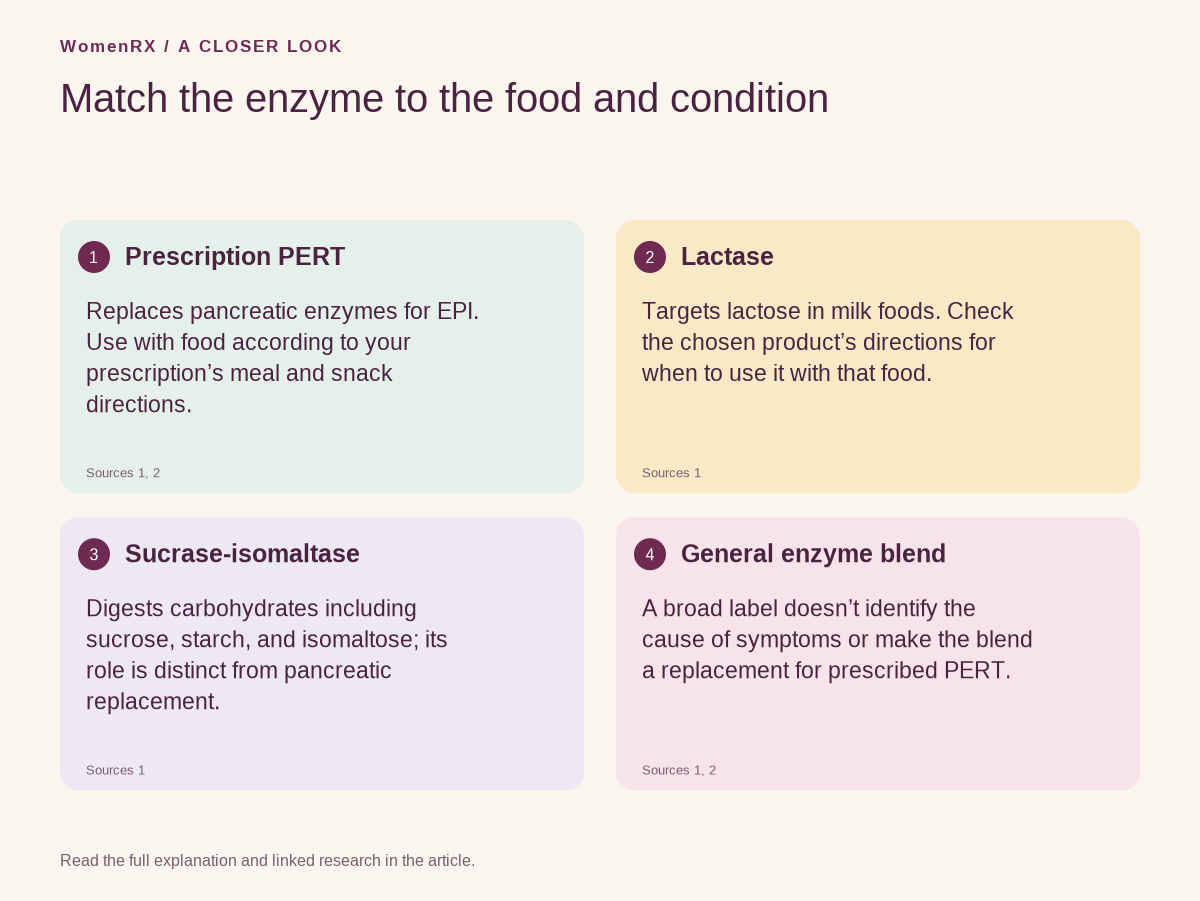
Match the enzyme to the food and condition
Prescription PERT: Replaces pancreatic enzymes for EPI. Use with food according to your prescription’s meal and snack directions.12
Lactase: Targets lactose in milk foods. Check the chosen product’s directions for when to use it with that food.1
Sucrase-isomaltase: Digests carbohydrates including sucrose, starch, and isomaltose; its role is distinct from pancreatic replacement.1
General enzyme blend: A broad label doesn’t identify the cause of symptoms or make the blend a replacement for prescribed PERT.12
Read the figure as text
Meal-related use makes sense only in the context of the enzyme’s specific job.- Prescription PERT: Replaces pancreatic enzymes for EPI. Use with food according to your prescription’s meal and snack directions.12
- Lactase: Targets lactose in milk foods. Check the chosen product’s directions for when to use it with that food.1
- Sucrase-isomaltase: Digests carbohydrates including sucrose, starch, and isomaltose; its role is distinct from pancreatic replacement.1
- General enzyme blend: A broad label doesn’t identify the cause of symptoms or make the blend a replacement for prescribed PERT.12
More questions, answered
Does bloating mean I need pancreatic enzymes?
No. EPI can involve digestive discomfort, but its symptoms overlap with several other conditions. Bloating by itself doesn’t identify an enzyme deficiency. 1 2
Sources you can check
- AGA-PancreasFest Joint Symposium on Exocrine Pancreatic Insufficiency.Whitcomb DC, Duggan SN, Martindale R, Lowe M, Stallings VA, Conwell D, Barkin JA, Papachristou GI, Husain SZ, Forsmark CE, Kaul V. · Gastro hep advances · 2023Return to first citation
- Exocrine pancreatic insufficiency: prevalence, diagnosis, and management.Capurso G, Traini M, Piciucchi M, Signoretti M, Arcidiacono PG. · Clinical and experimental gastroenterology · 2019Return to first citation