When Do Digestive Enzymes Actually Help?
Enzymes are most useful when they address a specific digestive problem, not when a label promises to fix bloating in general.
Digestive enzymes have a clear role in diagnosed exocrine pancreatic insufficiency: prescription pancreatic enzyme replacement improves fat and protein absorption. Lactase may help when lactose is the specific trigger. Neither finding shows that an over-the-counter enzyme blend treats unexplained bloating. Persistent diarrhea, weight loss, or signs of poor nutrition make it worth looking for a cause rather than guessing at an enzyme. 125
Match the enzyme to the problem
A digestive enzyme isn’t one all-purpose ingredient. The pancreas releases enzymes that help digest fat, protein, and carbohydrates. In exocrine pancreatic insufficiency, or EPI, too little effective pancreatic enzyme activity leaves food poorly digested and can affect nutrition. Lactose intolerance is a different problem: lactose in dairy isn’t digested well, so the relevant enzyme is lactase. These conditions call for different decisions, even though both can involve uncomfortable digestion. 23
That’s the useful question to bring to an enzyme label: What problem is this meant to address, and is there reason to think I have it? Evidence that one enzyme helps people with a defined condition doesn’t establish that a blend helps someone whose symptoms have no clear cause. 15
When pancreatic enzymes are treatment, not a wellness add-on
EPI is more likely to enter the picture when symptoms occur alongside a pancreatic condition, such as chronic pancreatitis, pancreatic cancer, or pancreatic surgery. Possible signs include diarrhea, fatty stools, bloating, abdominal discomfort, weight loss, and nutritional deficiencies. Bloating alone is much less informative than that fuller picture. 2
For people diagnosed with EPI, pancreatic enzyme replacement therapy, often called PERT, has evidence behind it. A systematic review of 14 randomized trials involving 684 people with EPI found better measures of fat and protein absorption with PERT than with placebo. The review reported improvements in the groups with chronic pancreatitis-related and cystic fibrosis-related EPI. These results do not establish a women-specific benefit. This is evidence for treating EPI, not for taking pancreatic enzymes whenever a meal feels heavy. 1
Assessment puts the symptoms in context. A fecal elastase test measures the concentration of pancreatic elastase in stool and is commonly used first. It has limits: watery stool can produce a falsely low result, and a test result doesn’t directly measure how well you digest a meal. A clinician may weigh the result alongside your health history, symptoms, and signs of nutritional problems rather than treating one number as the whole answer. 2
If you have persistent diarrhea or weight loss, especially with a pancreatic condition or signs of poor nutrition, that’s a stronger reason to seek an assessment than to try a broad enzyme blend. 2
When one food is the clearer clue
Suppose, for example, symptoms repeatedly follow milk or another lactose-containing food. Lactose intolerance offers a more specific question than “Do I need digestive enzymes?” A lactose breath test may be used when lactose intolerance is suspected, and reducing the food that causes symptoms is another approach. Recurring symptoms still deserve attention because a suspected food trigger isn’t a diagnosis by itself. 3
Lactase has some direct clinical evidence. In a randomized trial of 60 people with lactose intolerance, the group given the lactase preparation tilactase before a lactose breath test had improved breath-test results and symptom scores compared with placebo after lactose exposure. That supports a targeted use for lactose, not a claim that lactase helps digest every food or treats unexplained bloating. The trial does not establish whether the benefit differs for women. 5
A reaction to food isn’t always an intolerance. Itchy skin, wheezing, or swelling of the lips, face, or eyes points toward a possible food allergy instead, which is a different issue from difficulty digesting lactose. 3
What if you’re pregnant, postpartum, or past menopause?
Your reproductive stage alone doesn’t identify an enzyme to take. The practical distinction remains whether there’s a specific food-linked problem or reason to investigate maldigestion, such as persistent symptoms with weight loss or a pancreatic condition. The EPI treatment review and lactase trial don’t establish separate treatment pathways for pregnancy, postpartum, perimenopause, or postmenopause. 125
Pregnancy does add a nutritional consideration. If avoiding dairy because of suspected lactose intolerance, make sure your calcium intake is addressed; NIH guidance notes that calcium supplements can help pregnant women who don’t regularly consume dairy or calcium-fortified foods reach recommended intake. That guidance does not establish the safety or usefulness of a general digestive-enzyme blend in pregnancy. 4
The bottom line is more specific than “try enzymes” or “never take them.” Pancreatic enzyme replacement has a defined role in EPI, and lactase may help with lactose-related symptoms. If the pattern doesn’t point to either problem, a multi-enzyme product can’t tell you what’s causing the symptoms. 125
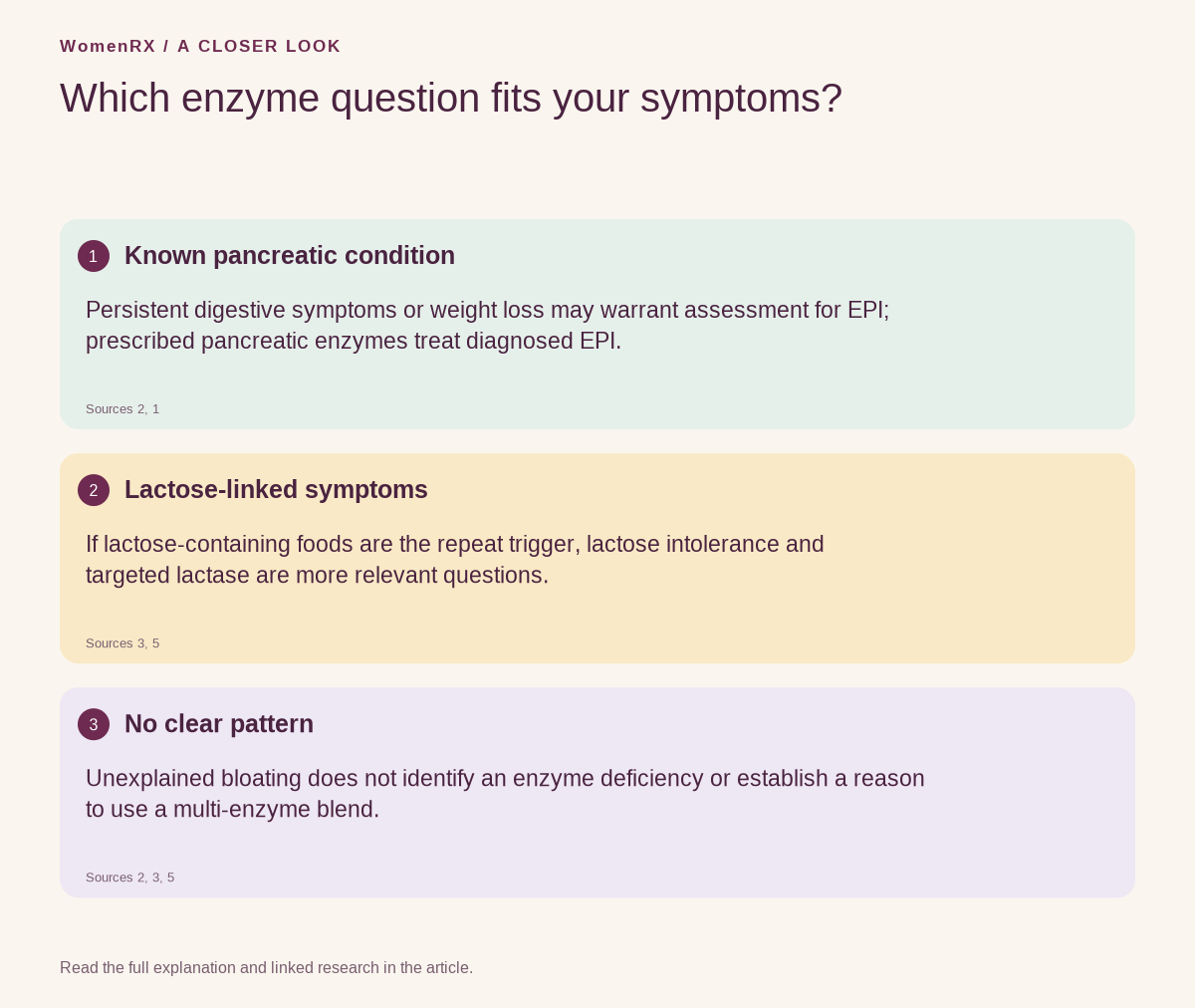
Which enzyme question fits your symptoms?
Known pancreatic condition: Persistent digestive symptoms or weight loss may warrant assessment for EPI; prescribed pancreatic enzymes treat diagnosed EPI.21
Lactose-linked symptoms: If lactose-containing foods are the repeat trigger, lactose intolerance and targeted lactase are more relevant questions.35
No clear pattern: Unexplained bloating does not identify an enzyme deficiency or establish a reason to use a multi-enzyme blend.235
Read the figure as text
Start with the pattern or known condition, rather than choosing a blend by its ingredient list.- Known pancreatic condition: Persistent digestive symptoms or weight loss may warrant assessment for EPI; prescribed pancreatic enzymes treat diagnosed EPI.21
- Lactose-linked symptoms: If lactose-containing foods are the repeat trigger, lactose intolerance and targeted lactase are more relevant questions.35
- No clear pattern: Unexplained bloating does not identify an enzyme deficiency or establish a reason to use a multi-enzyme blend.235
More questions, answered
Can a fecal elastase test be done if I’m already taking pancreatic enzymes?
The fecal elastase test is unaffected by pancreatic enzyme replacement therapy. Tell the clinician interpreting the result if the sample was watery, though, because watery stool can produce a falsely low reading. 2
Sources you can check
- Efficacy of pancreatic enzyme replacement therapy on exocrine pancreatic insufficiency: a systematic review and meta-analysis.Yang X, Yang L, Zhang W, Zhong L, Zheng Y. · European journal of gastroenterology & hepatology · 2026Return to first citation
- Pancreatic exocrine insufficiency.Iglesia D, Vujasinovic M, Löhr JM, Dominguez-Muñoz JE. · EClinicalMedicine · 2026Return to first citation
- Food intolerance - NHSAccessed 2026-09-25Return to first citation
- Dietary Supplements and Life Stages: Pregnancy - Health Professional Fact SheetAccessed 2026-09-25Return to first citation
- The effect of oral supplementation with Lactobacillus reuteri or tilactase in lactose intolerant patients: randomized trial.Ojetti V, Gigante G, Gabrielli M, Ainora ME, Mannocci A, Lauritano EC, Gasbarrini G, Gasbarrini A. · European review for medical and pharmacological sciences · 2010Return to first citation