Digestive Enzymes: How to Read the Label
The useful question isn’t how many enzymes a product contains, but whether its ingredients match the food and symptoms you’re trying to address.
Start with your reason for considering an enzyme. Lactase is aimed at lactose in dairy; alpha-galactosidase products are marketed for gas associated with certain complex carbohydrates. For example, Beano Tablets list 800 GALU per two tablets and give meal-specific directions and cautions. That label can help you assess Beano, but it can’t supply a dose for a different enzyme or replace assessment of recurring symptoms.461
Match the enzyme to the food first
A label full of enzyme names can look reassuring, but more ingredients don’t necessarily make a product better suited to your problem. Start with a specific situation. For example, do symptoms tend to follow milk or ice cream, or do they follow meals with beans? Those patterns point to different label questions, and neither one proves the cause on its own.146
Lactase helps break down lactose, the sugar in dairy. When your small intestine doesn’t make enough lactase, undigested lactose can reach the colon and contribute to gas and other symptoms. If dairy is the clear concern, a lactase-only product is easier to assess than a long ingredient list: you can see whether it addresses the food you’re eating and follow that product’s directions. Lactose-free dairy is another option.45
Alpha-galactosidase is a different enzyme. One alpha-galactosidase tablet product is marketed for gas associated with complex carbohydrates in foods such as legumes and grains. Its maker lists the enzyme amount in GALU and gives directions tied to eating those foods. Those details describe that particular formulation, not every alpha-galactosidase product or a dose to borrow for a different label.6
Here’s that product reviewed as a whole. Beano Tablets are presented as an option for gas and bloating with meals containing complex carbohydrates, such as beans. The maker lists 800 GALU of alpha-galactosidase, derived from Aspergillus niger, per two tablets; other ingredients include mannitol and potato starch. Its directions say to chew or swallow two tablets right before the first bite or immediately after the meal, up to 30 minutes after the first bite. The same product page tells people who are pregnant or nursing to ask a doctor before use, says to stop if a rare sensitivity occurs, and directs people with galactosemia to check with their doctor. Those are the ingredients, directions and cautions for these tablets, not a recommendation to use them for unexplained bloating or a schedule for another product.61
Pancreatic enzymes belong in a separate conversation. Pancreatic exocrine insufficiency can cause poor digestion and absorption, with symptoms that include diarrhea, bloating and oily stools. Medical pancreatic enzyme replacement contains enzymes including lipase, amylase and protease; its purpose is to improve both symptoms and nutrition in people with pancreatic insufficiency. A store-bought “complete digestive enzyme” blend shouldn’t be treated as an equivalent just because some enzyme names overlap.2
Read amounts and directions together
Find the amount per serving, then check what the package calls one serving and when it says to use it. Enzyme labels don’t share one universal amount or schedule. For a concrete example, the maker of LACTAID says its lactase supplement formulations have different directions and advises checking the specific package. A Beano tablet label expresses alpha-galactosidase in GALU and gives its own meal-related directions. Neither manufacturer’s instructions establish directions for another brand or enzyme.56
Pay attention to which enzyme an activity number describes. The GALU on an alpha-galactosidase label and the lipase units discussed in research on pancreatic enzyme replacement describe different enzymes used for different purposes. Don’t compare the numbers as though the larger one means a stronger digestive-enzyme product, and don’t use pancreatic-enzyme treatment amounts to dose an over-the-counter blend.62
For a multi-enzyme product, read past the front-of-package promise. Identify each enzyme, its listed amount if provided, the other ingredients, and the actual directions and warnings. Then ask whether the blend addresses a recognizable food-related problem. If you can’t tell what an ingredient adds, the label alone can’t establish that the whole blend will help your symptoms. This matters especially when it includes an extra ingredient such as bromelain, a pineapple-derived group of protein-breaking enzymes. Oral bromelain may cause stomach upset or diarrhea, and research does not establish its benefit for most promoted uses.3
Check the cautions against your situation
Read the exact product’s warning panel rather than assuming all enzymes have the same safety profile. For example, the Beano tablet label tells people who are pregnant or nursing to ask a doctor before use and notes a rare sensitivity warning. The LACTAID manufacturer’s pregnancy-and-nursing information discusses diet, including dairy; it is not a safety finding for every lactase supplement. For bromelain, little is known about safety during pregnancy or breastfeeding. These are ingredient- and product-specific questions, not a blanket reason to use or avoid all digestive enzymes.653
If your blend contains bromelain and you take medication, raise that specific ingredient and product with your pharmacist or prescribing clinician before using it. The National Center for Complementary and Integrative Health advises checking medicine use before taking bromelain or other herbal products, but its guidance does not establish a particular drug interaction for every enzyme blend.3
When a label won’t answer the bigger question
Recurring bloating, pain or diarrhea deserves more than repeated experiments with new blends. Food intolerance can cause these symptoms, but they have other possible causes too. If symptoms keep coming back, ask for an assessment rather than relying on an enzyme product to identify the cause. If you have swelling of the lips, mouth or throat, wheezing, or trouble breathing after eating, treat that as a possible serious allergic reaction and seek emergency care. Food allergy is different from food intolerance.1
If the concern is ongoing diarrhea, oily stools or unexplained weight loss, the question isn’t simply which bottle has the most lipase. Pancreatic insufficiency can affect nutrient absorption, and medical enzyme replacement is assessed for nutritional benefit as well as symptom relief. That’s a reason to discuss the pattern with a clinician, particularly if you have a pancreatic condition or a history of pancreatic surgery.2
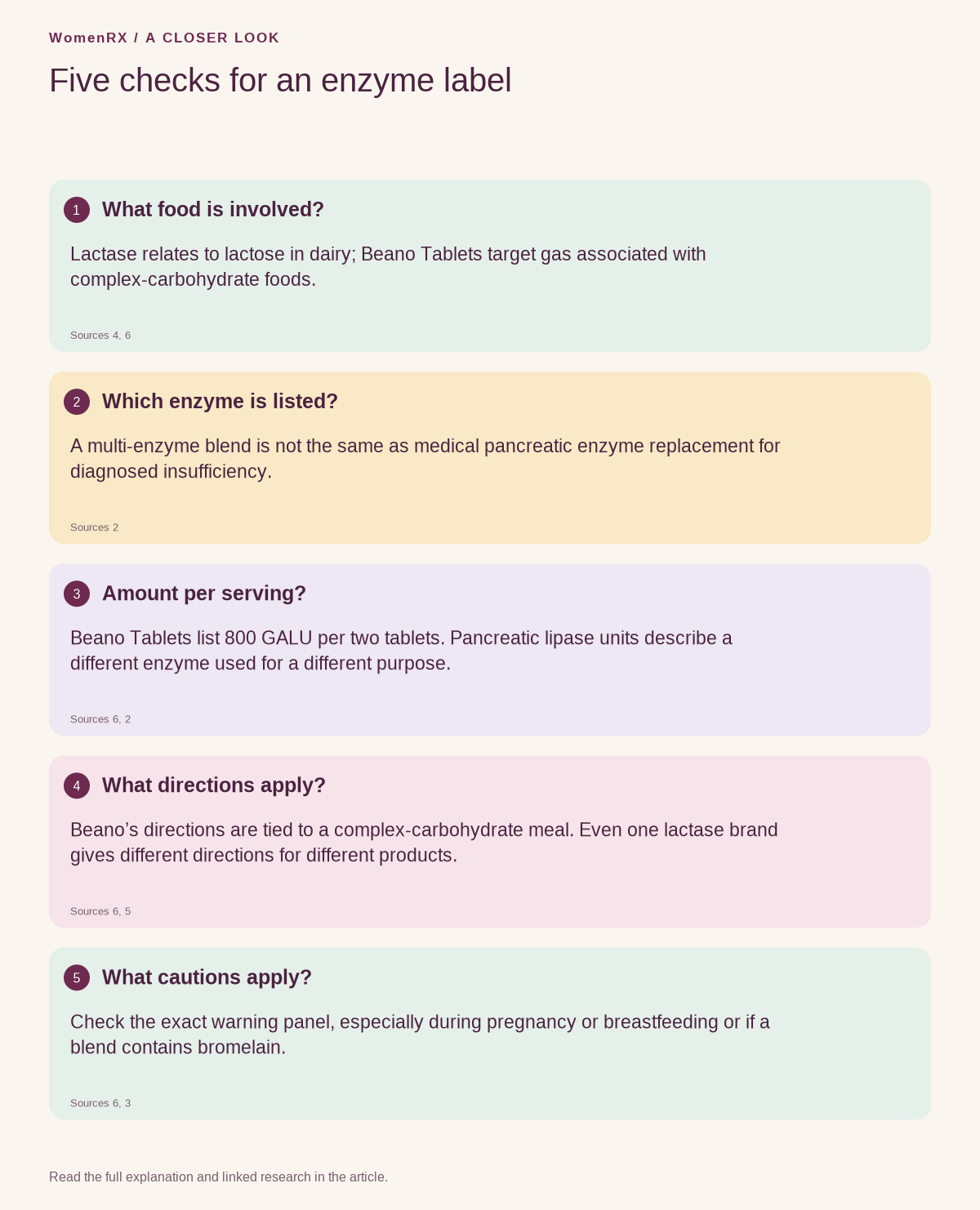
Five checks for an enzyme label
What food is involved?: Lactase relates to lactose in dairy; Beano Tablets target gas associated with complex-carbohydrate foods.46
Which enzyme is listed?: A multi-enzyme blend is not the same as medical pancreatic enzyme replacement for diagnosed insufficiency.2
Amount per serving?: Beano Tablets list 800 GALU per two tablets. Pancreatic lipase units describe a different enzyme used for a different purpose.62
What directions apply?: Beano’s directions are tied to a complex-carbohydrate meal. Even one lactase brand gives different directions for different products.65
What cautions apply?: Check the exact warning panel, especially during pregnancy or breastfeeding or if a blend contains bromelain.63
Read the figure as text
Use these questions to review the product in your hand, not to score or diagnose your symptoms.- What food is involved?: Lactase relates to lactose in dairy; Beano Tablets target gas associated with complex-carbohydrate foods.46
- Which enzyme is listed?: A multi-enzyme blend is not the same as medical pancreatic enzyme replacement for diagnosed insufficiency.2
- Amount per serving?: Beano Tablets list 800 GALU per two tablets. Pancreatic lipase units describe a different enzyme used for a different purpose.62
- What directions apply?: Beano’s directions are tied to a complex-carbohydrate meal. Even one lactase brand gives different directions for different products.65
- What cautions apply?: Check the exact warning panel, especially during pregnancy or breastfeeding or if a blend contains bromelain.63
More questions, answered
Does an enzyme supplement tell me whether I have a food intolerance?
No. A food-and-symptom pattern may offer a clue, but recurring symptoms can need assessment. Lactose intolerance, for example, may be evaluated with a breath test; a product label or your response to a supplement isn’t a diagnosis.14
Sources you can check
- Food intolerance - NHSAccessed 2026-09-25Return to first citation
- Pancreatic Enzyme Replacement Therapy in Pancreatic Exocrine Insufficiency-Real-World's Dosing and Effectiveness: A Systematic Review.Kadaj-Lipka R, Monica M, Stożek-Tutro A, Ryś P, Rydzewska G. · Digestive diseases and sciences · 2025Return to first citation
- Bromelain: Usefulness and Safety | NCCIHAccessed 2026-09-25Return to first citation
- Lactose intolerance and probiotics: from pathophysiological mechanisms to clinical applications.Perets TT, Gingold-Belfer R, Dickman R. · Antonie van Leeuwenhoek · 2026Return to first citation
- Frequently Asked Questions | LACTAID®Accessed 2026-09-25Return to first citation
- Beano® Tablets - Alpha-D-Galactosidase Anti-Gas PillsAccessed 2026-09-25Return to first citation