How to Read a Digestive Enzyme Label
The useful comparison starts with the food you’re trying to digest, then the enzyme named on the label and the activity listed per serving.
Match the enzyme to a specific food-related problem before comparing numbers: lactase is relevant to lactose in dairy, while alpha-galactosidase is marketed for certain gas-producing carbohydrates. Check whether an activity amount applies to one tablet or a larger serving. A bigger number, especially in a different unit, doesn’t establish better symptom relief. Recurring or unexplained symptoms deserve assessment rather than a broader enzyme blend. 157
Start with the food, not the size of the blend
A digestive enzyme label is most useful when you have a specific question. For example, do bloating and diarrhea repeatedly follow dairy? Or does gas seem tied to meals containing beans? Those patterns point to different ingredients. Bloating on its own doesn’t establish an enzyme deficiency: gas, swallowed air, constipation, food intolerance, celiac disease and irritable bowel syndrome can all be involved. Bloating can also occur around a period. 12
Lactase helps break down lactose, the sugar in dairy. 6 In a randomized trial of 60 people with lactose intolerance, a lactase preparation called tilactase improved breath-test results and a gastrointestinal symptom score compared with placebo during a lactose challenge. That supports a targeted use for lactase; it doesn’t show that an all-purpose blend will help with unexplained bloating. 5
Alpha-galactosidase is a different enzyme. One product containing it is marketed for gas associated with certain complex carbohydrates, including those in legumes. Its label states 800 GALU per two-tablet serving. That figure tells you what the manufacturer lists for that particular serving, not how much relief you personally can expect or whether it outperforms another product. 7
Lipase, protease and amylase appear together in pancreatic enzyme replacement therapy, which addresses impaired digestion in people with pancreatic exocrine insufficiency. This is a distinct medical use, not a reason to treat an over-the-counter blend as interchangeable with pancreatic enzyme replacement. A review of randomized trials in people diagnosed with the condition found that pancreatic enzyme replacement improved measured fat and protein absorption compared with placebo. 34
Compare what the numbers actually describe
First find the serving size. An amount printed for two tablets isn’t an amount for one tablet. Then look for an activity figure beside the enzyme you care about, rather than relying on a large number for the blend as a whole. The alpha-galactosidase example lists its activity in GALU; pancreatic enzyme replacement research commonly reports lipase units. Those are labels for different enzyme activities, not competing scores on one scale. 73
If two labels name the same enzyme, check whether both give an activity amount in the same unit and for the same serving size. That lets you compare what they state. It still doesn’t establish that the products work equally well or that the larger figure will relieve symptoms better. The lactase trial tested a particular preparation in people with lactose intolerance; the pancreatic-enzyme studies involved people with diagnosed pancreatic exocrine insufficiency. Neither is a head-to-head test of over-the-counter blends. 54
A missing activity amount is worth noticing. It leaves you with less information for comparing the stated enzyme activity. Similarly, directions from one brand belong to that formulation, not to every product with the same enzyme. The manufacturer of one lactase line says its products have different directions depending on their strength, while the alpha-galactosidase figure above applies specifically to that product’s two-tablet serving. 67
Know when a label isn’t the answer
If symptoms keep coming back, affect you after many different foods, or persist despite changes you’ve tried, a food-related pattern is worth discussing with a clinician rather than guessing your way through more blends. Assessment may distinguish lactose intolerance from another cause; a breath test is one possible test when lactose intolerance is suspected. Persistent bloating, unintended weight loss or blood in the stool also calls for medical assessment. 12
Seek prompt care for bloating with vomiting, a fever, a swollen abdomen or an inability to pass stool or gas. If bloating comes with a swollen stomach and sudden, severe abdominal pain or vomiting blood, seek emergency care. These symptoms aren’t questions a supplement label can settle. 2
If you’re pregnant and considering an enzyme product for new digestive symptoms, bring the symptoms and the exact product label to your prenatal care team. The alpha-galactosidase product described above specifically tells pregnant or nursing users to ask a doctor before use; that warning belongs to that product and shouldn’t be read as pregnancy advice for every enzyme. The studies described here don’t establish a separate label-reading rule or treatment benefit for women. 754
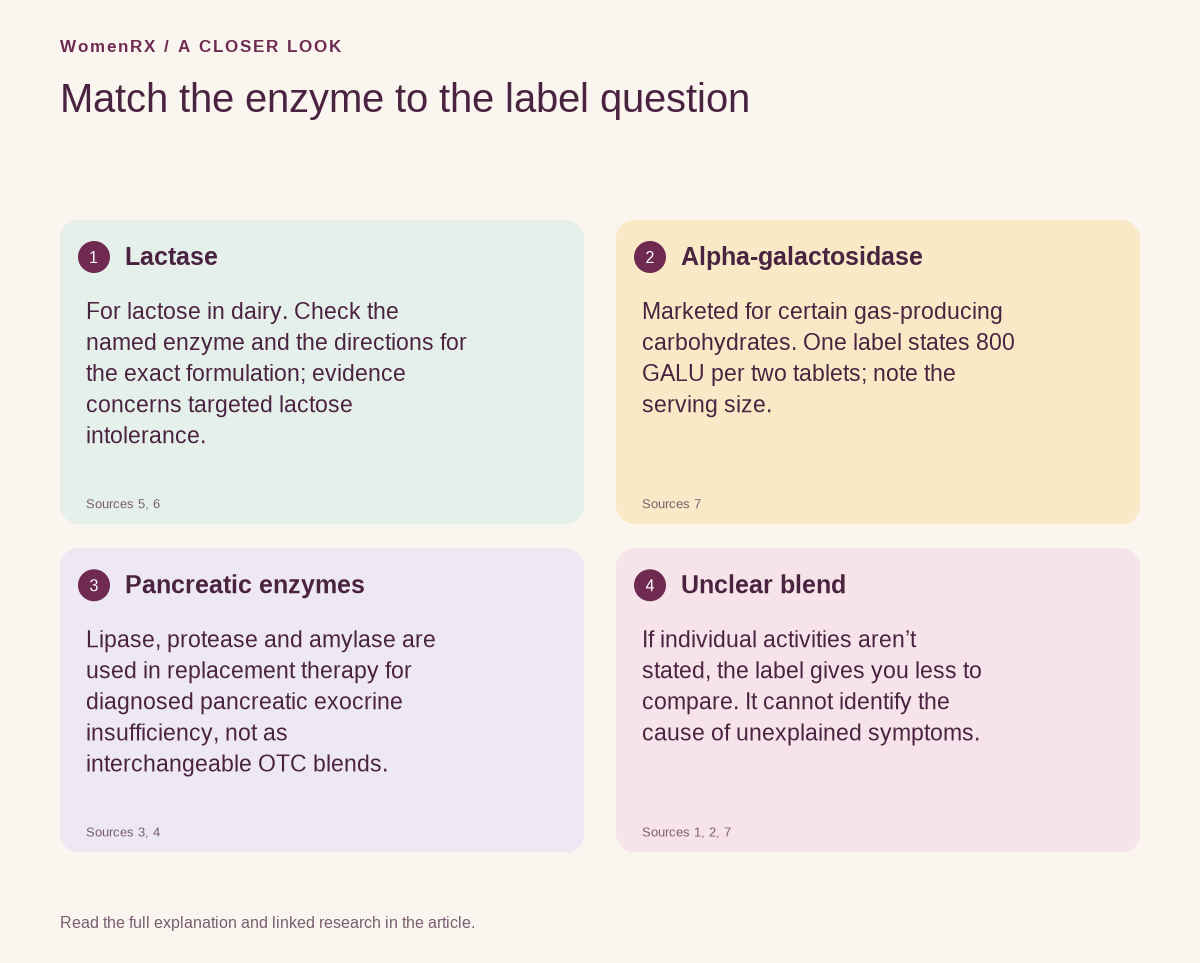
Match the enzyme to the label question
Lactase: For lactose in dairy. Check the named enzyme and the directions for the exact formulation; evidence concerns targeted lactose intolerance.56
Alpha-galactosidase: Marketed for certain gas-producing carbohydrates. One label states 800 GALU per two tablets; note the serving size.7
Pancreatic enzymes: Lipase, protease and amylase are used in replacement therapy for diagnosed pancreatic exocrine insufficiency, not as interchangeable OTC blends.34
Unclear blend: If individual activities aren’t stated, the label gives you less to compare. It cannot identify the cause of unexplained symptoms.127
Read the figure as text
These entries have different intended uses and cannot be ranked by a single activity number.- Lactase: For lactose in dairy. Check the named enzyme and the directions for the exact formulation; evidence concerns targeted lactose intolerance.56
- Alpha-galactosidase: Marketed for certain gas-producing carbohydrates. One label states 800 GALU per two tablets; note the serving size.7
- Pancreatic enzymes: Lipase, protease and amylase are used in replacement therapy for diagnosed pancreatic exocrine insufficiency, not as interchangeable OTC blends.34
- Unclear blend: If individual activities aren’t stated, the label gives you less to compare. It cannot identify the cause of unexplained symptoms.127
More questions, answered
Does bloating after dairy always mean I need lactase?
No. Lactose intolerance is one possibility, but bloating has several causes. If the pattern keeps recurring or the cause isn’t clear, an assessment can be more useful than assuming dairy is the whole explanation. 12
Sources you can check
- Food intolerance - NHSAccessed 2026-09-25Return to first citation
- Bloating - NHSAccessed 2026-09-25Return to first citation
- Pancreatic Enzyme Replacement Therapy in Pancreatic Exocrine Insufficiency-Real-World's Dosing and Effectiveness: A Systematic Review.Kadaj-Lipka R, Monica M, Stożek-Tutro A, Ryś P, Rydzewska G. · Digestive diseases and sciences · 2025Return to first citation
- Efficacy of pancreatic enzyme replacement therapy on exocrine pancreatic insufficiency: a systematic review and meta-analysis.Yang X, Yang L, Zhang W, Zhong L, Zheng Y. · European journal of gastroenterology & hepatology · 2026Return to first citation
- The effect of oral supplementation with Lactobacillus reuteri or tilactase in lactose intolerant patients: randomized trial.Ojetti V, Gigante G, Gabrielli M, Ainora ME, Mannocci A, Lauritano EC, Gasbarrini G, Gasbarrini A. · European review for medical and pharmacological sciences · 2010Return to first citation
- Frequently Asked Questions | LACTAID®Accessed 2026-09-25Return to first citation
- Beano® Tablets - Alpha-D-Galactosidase Anti-Gas PillsAccessed 2026-09-25Return to first citation