How to Choose a Digestive Enzyme Supplement
The clearest reason to consider an enzyme is a specific digestive target, not a promise to fix unexplained symptoms.
Match an enzyme to the food or diagnosed condition it is meant to address. Lactase, for example, breaks down lactose; a FODMAP-targeting blend has only early evidence from one uncontrolled IBS study. Persistent greasy stools, diarrhea, or weight loss call for assessment rather than repeated supplement trials, especially if you have a condition linked to pancreatic insufficiency. 1 2
Start with the target, not the word “digestive”
A useful enzyme claim names what the enzyme acts on. Lactase breaks down lactose, while alpha-galactosidase targets certain oligosaccharides. If a product is meant to help with a food-related symptom, check whether its named enzyme matches the specific carbohydrate in the claim. “Digestive support” by itself doesn’t tell you what the product is intended to digest. 2
That match still doesn’t show that an enzyme will resolve your symptoms. Bloating or discomfort after eating can have more than one cause, and an enzyme aimed at one food component won’t address every possible explanation.
One IBS blend is not proof for enzyme blends generally
A single-arm, open-label study followed people with diagnosed or strongly suspected irritable bowel syndrome (IBS) who used a FODMAP-targeting enzyme blend. There was no comparison group. Among the 118 participants included in the analysis, 86.4% were women. After four weeks, 78% reported improvement in bloating and flatulence, and 65.3% reported improvement in abdominal pain. 2
Those are self-reported before-and-after results. They’re a reason to study that particular approach further, not proof that the blend caused improvement or that a general-purpose product, another formula, or an enzyme for unexplained symptoms will work. The reported results also don’t show whether response differed by sex. 2
When symptoms deserve a closer look
Greasy stools, diarrhea, weight loss, bloating, and excessive gas can occur with exocrine pancreatic insufficiency (EPI), a condition in which the pancreas doesn’t deliver enough digestive enzymes to the intestine. EPI is more likely to be considered with certain histories, including chronic or recurrent pancreatitis, cystic fibrosis, pancreatic surgery, celiac or Crohn’s disease, intestinal surgery, or longstanding diabetes. Symptoms alone don’t diagnose it. 1
When EPI is suspected, the American Gastroenterological Association identifies fecal elastase testing on a semi-solid or solid stool sample as the most appropriate initial test. Feeling better during a trial of pancreatic enzymes is not a reliable way to diagnose EPI. Once EPI is diagnosed, pancreatic enzyme replacement therapy (PERT) is required; a retail blend shouldn’t be treated as a substitute for that prescribed treatment. 1
If greasy stools, ongoing diarrhea, or unexplained weight loss persist, focus on finding the cause rather than cycling through supplements. Assessment is especially worth discussing if you also have one of the health conditions or surgical histories linked with EPI. 1
A practical route from symptom to next step
- A clear food-related target: Check that the named enzyme matches the product’s claim, such as lactase for lactose. 2
- IBS symptoms: Treat the findings for one FODMAP-targeting blend as preliminary and specific to that study, not as proof for enzyme blends overall. 2
- Persistent greasy stools or weight loss: Ask about assessment for possible maldigestion; symptoms alone can’t establish EPI. 1
- Diagnosed EPI: Discuss prescribed PERT, rather than replacing it with an over-the-counter product. 1
If you’re discussing a product alongside medicines, bring the exact label and ask whether any ingredient matters for your current treatment. That’s a product-specific question, not a claim that a particular interaction is established.
Digestive enzyme needs aren’t shown here to differ by sex. Although most participants in the IBS blend study were women, its reported outcomes don’t establish a women-specific benefit or a difference in response between women and men. 2
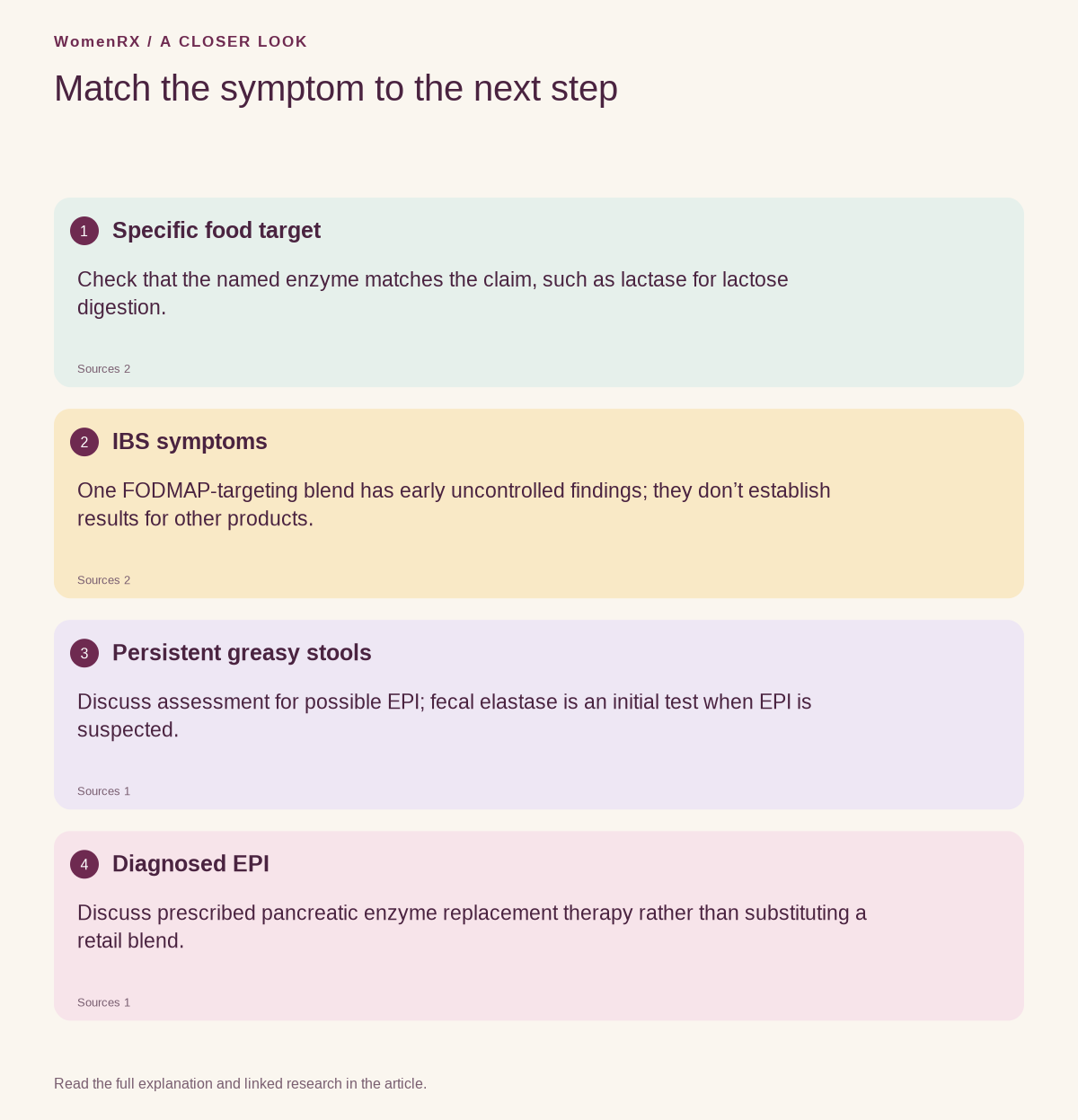
Match the symptom to the next step
Specific food target: Check that the named enzyme matches the claim, such as lactase for lactose digestion.2
IBS symptoms: One FODMAP-targeting blend has early uncontrolled findings; they don’t establish results for other products.2
Persistent greasy stools: Discuss assessment for possible EPI; fecal elastase is an initial test when EPI is suspected.1
Diagnosed EPI: Discuss prescribed pancreatic enzyme replacement therapy rather than substituting a retail blend.1
Read the figure as text
This guide separates a specific food target from preliminary IBS findings and symptoms that may warrant assessment for EPI.- Specific food target: Check that the named enzyme matches the claim, such as lactase for lactose digestion.2
- IBS symptoms: One FODMAP-targeting blend has early uncontrolled findings; they don’t establish results for other products.2
- Persistent greasy stools: Discuss assessment for possible EPI; fecal elastase is an initial test when EPI is suspected.1
- Diagnosed EPI: Discuss prescribed pancreatic enzyme replacement therapy rather than substituting a retail blend.1
More questions, answered
Can taking pancreatic enzymes tell me whether I have EPI?
No. Improvement during an enzyme trial is not a reliable way to diagnose EPI. The AGA identifies fecal elastase testing on a semi-solid or solid stool sample as the initial test when EPI is suspected. 1
Does the IBS blend study apply to every digestive enzyme product?
No. It studied one FODMAP-targeting blend in people with diagnosed or strongly suspected IBS. Its uncontrolled results don’t establish that general-purpose blends or other formulations work. 2
Sources you can check
- AGA Clinical Practice Update on the Epidemiology, Evaluation, and Management of Exocrine Pancreatic Insufficiency: Expert Review.Whitcomb DC, Buchner AM, Forsmark CE. · Gastroenterology · 2023Return to first citation
- FODMAP-Targeting Digestive Enzyme Blend for Management of Gastrointestinal Symptoms: A "Real-World" Pre-Post Intervention Cohort Study.Kaye AJ, Meyers SR, Hachuel D, Wells J, Wallach T, Thor S. · Gastro hep advances · 2026Return to first citation