Digestive Enzymes: Match the Product to the Problem
An enzyme only acts on particular substances, so the evidence depends on what it contains and why you’re considering it.
Digestive enzymes aren’t one interchangeable treatment. Pancreatic enzyme replacement is used for diagnosed exocrine pancreatic insufficiency, while products such as lactase and alpha-galactosidase target particular food carbohydrates. A small trial and an uncontrolled IBS study have explored broader blends, but that evidence doesn’t make an enzyme supplement a reliable way to diagnose or treat unexplained symptoms. 1 2 3
Start with the enzyme’s target
“Digestive enzymes” can mean very different things. Lactase breaks down lactose, and alpha-galactosidase acts on some oligosaccharides. A blend targeting FODMAPs may contain several enzymes aimed at different carbohydrates. Pancreatic enzyme replacement therapy (PERT), by contrast, replaces pancreatic enzymes when the pancreas doesn’t deliver enough of them to digest nutrients. The product’s target and your reason for taking it matter more than the broad label on the bottle. 2 3
That distinction helps sort three common situations: a diagnosed enzyme deficiency, symptoms that seem tied to a particular food, and persistent symptoms without a clear cause.
When pancreatic enzymes match the diagnosis
Exocrine pancreatic insufficiency (EPI) means the pancreas isn’t delivering enough digestive enzymes to the intestine, which can interfere with digestion and nutrient absorption. It’s more likely in people with certain pancreatic conditions or surgeries, and can also be considered in some people with celiac or Crohn’s disease, previous intestinal surgery, or longstanding diabetes. Possible signs include greasy stools, diarrhea, weight loss, bloating, excessive gas, and nutritional deficiencies. These symptoms have other possible causes, so they don’t confirm EPI by themselves. 3
The American Gastroenterological Association’s expert review identifies a stool test for fecal elastase as the most appropriate initial test. The sample should be semi-solid or solid; a result below 100 micrograms per gram provides good evidence of EPI, while 100-200 is indeterminate. The review also says that feeling better during a trial of pancreatic enzymes is not a reliable way to diagnose the condition. 3
If EPI is diagnosed, the guidance says treatment with PERT is required. That is a different decision from trying an over-the-counter “digestive enzyme” blend for general bloating or discomfort. 3
When a food-specific enzyme may fit
If symptoms seem to follow a particular carbohydrate, an enzyme that acts on that substance may be a more relevant question than a broad blend. Lactase targets lactose; alpha-galactosidase targets some oligosaccharides. The FODMAP-targeting blend cohort study explains the rationale for matching enzymes to specific carbohydrates and notes that people with IBS may react to more than one FODMAP group. That doesn’t establish that a blend will help any one person, or that symptoms prove an intolerance. 2
The human evidence for a multi-enzyme blend in IBS is preliminary. In a single-arm, open-label study, people who had purchased a FODMAP-targeting product completed surveys before and after four weeks of use. Many reported improvement in symptoms, but without a comparison group the study can’t show how much change was caused by the enzymes rather than other factors, including expectations or changes in behavior. The findings are a reason for further study, not proof that these products reliably treat IBS. 2
What broader blends have, and haven’t, shown
A randomized, double-blind, placebo-controlled trial assigned 120 adults with functional dyspepsia to a fungal-derived multi-enzyme blend or placebo for two months. The researchers reported improvements in quality-of-life, pain, and sleep scores in the enzyme group, with no side effects reported in the abstract. But it was one trial of one particular blend, and the abstract doesn’t provide the size of the improvements. It can’t establish that enzyme supplements as a category work for indigestion, or that this blend is suitable for other digestive symptoms. 1
So far, the evidence points to specific contexts rather than a universal fix: prescribed pancreatic enzymes for diagnosed EPI; food-targeted enzymes for particular carbohydrates; and early, limited research on broader blends for certain symptoms. A product that helps one kind of symptom doesn’t identify its cause.
A practical decision path
- You have diagnosed EPI: Ask about prescribed PERT and how your symptoms and nutrition will be monitored. Don’t substitute an unverified general blend for treatment. 3
- A specific food seems to trigger symptoms: Check whether the enzyme targets that food component. If the pattern is unclear or symptoms continue, don’t assume the supplement has confirmed the cause. 2
- Symptoms persist or you’re losing weight: Ask about evaluation rather than relying on a trial of enzymes. Weight loss and signs of poor nutrient absorption can occur with EPI, but they don’t diagnose it. 3
- You’re pregnant, breastfeeding, or recently postpartum: Ask a clinician or pharmacist about the specific product and its ingredients before using it. The adult dyspepsia trial and IBS study don’t establish outcomes for pregnancy or breastfeeding. 1 2
The useful question isn’t simply “Do digestive enzymes work?” It’s “Which enzyme, for which substance or diagnosed condition, and what evidence supports using it for my symptoms?”
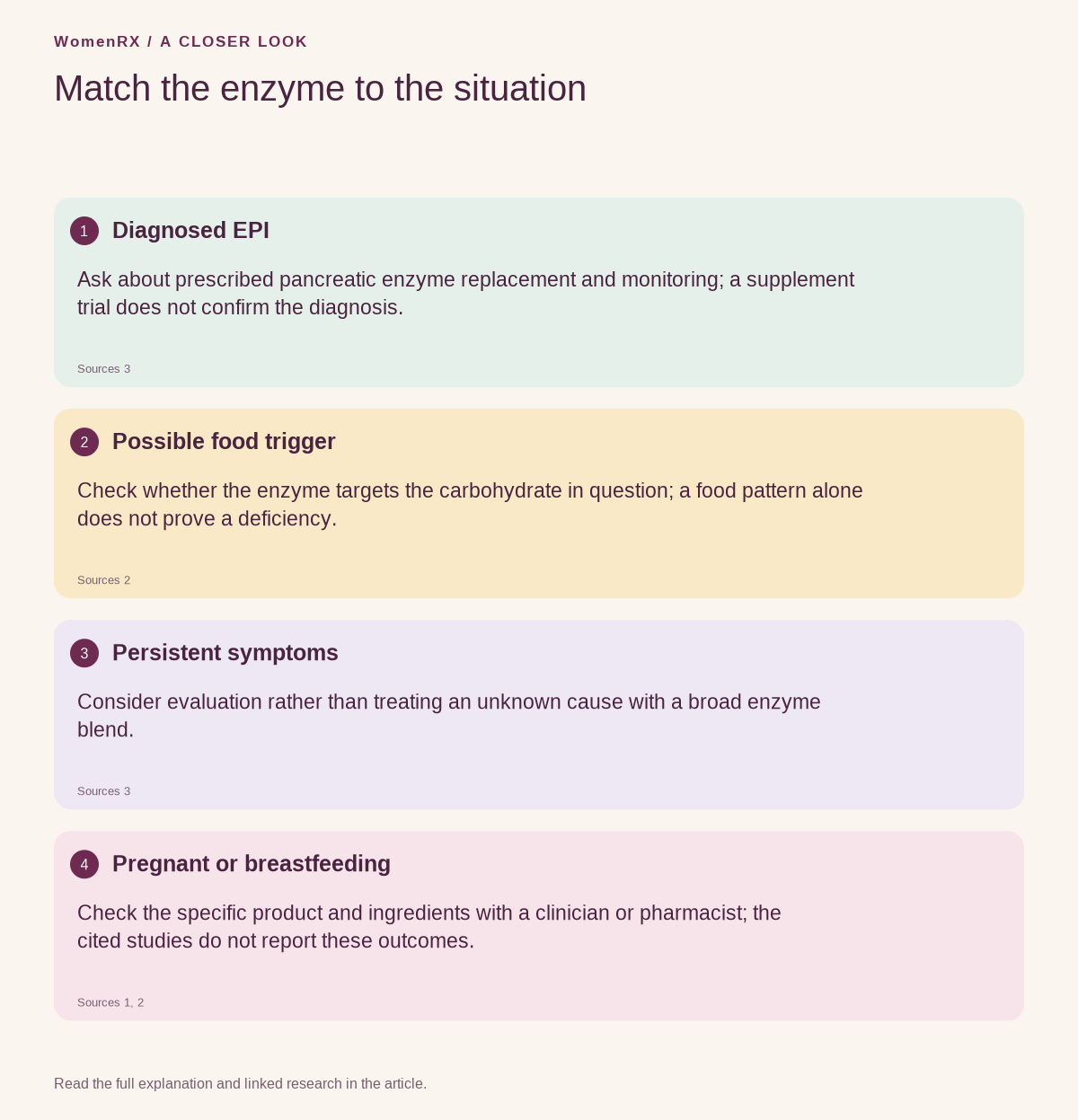
Match the enzyme to the situation
Diagnosed EPI: Ask about prescribed pancreatic enzyme replacement and monitoring; a supplement trial does not confirm the diagnosis.3
Possible food trigger: Check whether the enzyme targets the carbohydrate in question; a food pattern alone does not prove a deficiency.2
Persistent symptoms: Consider evaluation rather than treating an unknown cause with a broad enzyme blend.3
Pregnant or breastfeeding: Check the specific product and ingredients with a clinician or pharmacist; the cited studies do not report these outcomes.12
Read the figure as text
A quick route from the reason you’re considering enzymes to the kind of evidence or follow-up that fits.- Diagnosed EPI: Ask about prescribed pancreatic enzyme replacement and monitoring; a supplement trial does not confirm the diagnosis.3
- Possible food trigger: Check whether the enzyme targets the carbohydrate in question; a food pattern alone does not prove a deficiency.2
- Persistent symptoms: Consider evaluation rather than treating an unknown cause with a broad enzyme blend.3
- Pregnant or breastfeeding: Check the specific product and ingredients with a clinician or pharmacist; the cited studies do not report these outcomes.12
More questions, answered
Can feeling better on enzymes confirm an enzyme deficiency?
No. The AGA review says that response to a trial of pancreatic enzymes is unreliable for diagnosing EPI; evaluation, including fecal elastase testing, is used instead. 3
Are all digestive enzyme products interchangeable?
No. Different enzymes act on different substances, and pancreatic enzyme replacement for EPI is not the same as a food-targeted or multi-enzyme over-the-counter blend. 2 3
Sources you can check
- Efficacy of digestive enzyme supplementation in functional dyspepsia: A monocentric, randomized, double-blind, placebo-controlled, clinical trial.Ullah H, Di Minno A, Piccinocchi R, Buccato DG, De Lellis LF, Baldi A, El-Seedi HR, Khalifa SAM, Piccinocchi G, Xiao X, Sacchi R, Daglia M. · Biomedicine & pharmacotherapy = Biomedecine & pharmacotherapie · 2023Return to first citation
- FODMAP-Targeting Digestive Enzyme Blend for Management of Gastrointestinal Symptoms: A "Real-World" Pre-Post Intervention Cohort Study.Kaye AJ, Meyers SR, Hachuel D, Wells J, Wallach T, Thor S. · Gastro hep advances · 2026Return to first citation
- AGA Clinical Practice Update on the Epidemiology, Evaluation, and Management of Exocrine Pancreatic Insufficiency: Expert Review.Whitcomb DC, Buchner AM, Forsmark CE. · Gastroenterology · 2023Return to first citation