Digestive Enzymes: What Helps, and What Doesn’t?
Enzymes can help when they replace a specific missing digestive enzyme, but bloating alone doesn’t show that you need them.
Prescription pancreatic enzyme replacement therapy (PERT) is used for diagnosed exocrine pancreatic insufficiency (EPI). For food-related symptoms, the enzyme needs to match the food: lactase breaks down lactose, the sugar in milk. That biological match alone doesn’t show that an over-the-counter lactase product will relieve symptoms. Bloating by itself doesn’t diagnose EPI. 4 5 2
Enzymes aren’t interchangeable
Digestive enzymes break down particular nutrients. Pancreatic enzyme replacement contains enzymes that help digest fats, proteins, and carbohydrates; lactase acts on lactose, the sugar in milk. That specificity matters: a product containing one enzyme is not a general fix for every meal or digestive symptom. 3 5
When prescription pancreatic enzymes are useful
Exocrine pancreatic insufficiency, or EPI, means the intestine isn’t receiving enough active pancreatic enzymes to digest nutrients properly. It is more likely with certain conditions, including chronic pancreatitis, repeated acute pancreatitis, pancreatic cancer, cystic fibrosis, or previous pancreatic surgery. Clinicians may also consider it with some intestinal diseases, previous intestinal surgery, or longstanding diabetes. 4
Possible signs include greasy stools, diarrhea, weight loss, bloating, excessive gas, and deficiencies of fat-soluble vitamins. These symptoms can raise suspicion, but they don’t prove EPI. An American Gastroenterological Association review identifies a stool test for pancreatic elastase as the usual initial test. The sample should be semi-solid or solid; a result below 100 micrograms per gram provides good evidence of EPI, while 100-200 is indeterminate. 4
When EPI is diagnosed, prescription pancreatic enzyme replacement therapy (PERT) is the treatment. It contains pancrelipase, a combination of pancreatic enzymes, and is used to replace what the body isn’t supplying adequately. The AGA guidance recommends PERT for diagnosed EPI; a general-purpose enzyme blend is not a substitute for that treatment. 3 4
One useful distinction: feeling better after taking enzymes doesn’t establish that you had EPI. The AGA review says a trial of pancreatic enzymes is unreliable as a diagnostic test. 4
When a particular food seems to be the trigger
If milk or dairy repeatedly seems linked to symptoms, lactose intolerance is one possibility. It’s a common food intolerance, and a breath test may be used to assess it. Lactase acts on lactose, so it has a specific target; keep the question focused on whether lactose is the issue rather than assuming you need a broad enzyme blend. 1 5
A food and symptom diary can help you notice whether the same food is linked to symptoms. Avoid cutting out many foods without guidance: unnecessary restrictions can make it harder to get a balanced diet, and home intolerance tests may be inaccurate and encourage avoiding multiple foods. 1
If bloating has no clear food pattern
Bloating is common and can result from gas, constipation, food intolerance, or conditions such as celiac disease. A single symptom, especially bloating by itself, doesn’t identify an enzyme deficiency. For occasional bloating, practical steps include chewing with your mouth closed to avoid swallowing air and noticing which foods or drinks seem to trigger it. 2
If bloating is frequent or doesn’t go away, or comes with unintentional weight loss or blood in your stool, seek medical evaluation rather than trying to diagnose the cause with an enzyme supplement. 2
A quick way to choose your next step
- You have a pancreatic condition or surgery history, plus ongoing diarrhea, greasy stools, or weight loss: ask whether evaluation for EPI is appropriate. Symptoms alone can’t confirm it. 4
- One particular food seems to trigger symptoms: consider whether a specific intolerance fits. Lactose intolerance is one possibility when milk or dairy is the suspected trigger. 1
- Bloating is frequent or doesn’t go away: there are several possible causes, so persistent symptoms deserve evaluation rather than a guess based on an enzyme supplement. Seek prompt care if bloating comes with unintentional weight loss or blood in your stool. 2
The useful distinction is the cause: diagnosed EPI calls for prescription enzyme replacement, while symptoms linked to a particular food call for a food-specific question. Unexplained bloating alone doesn’t point to a particular enzyme. 1 4
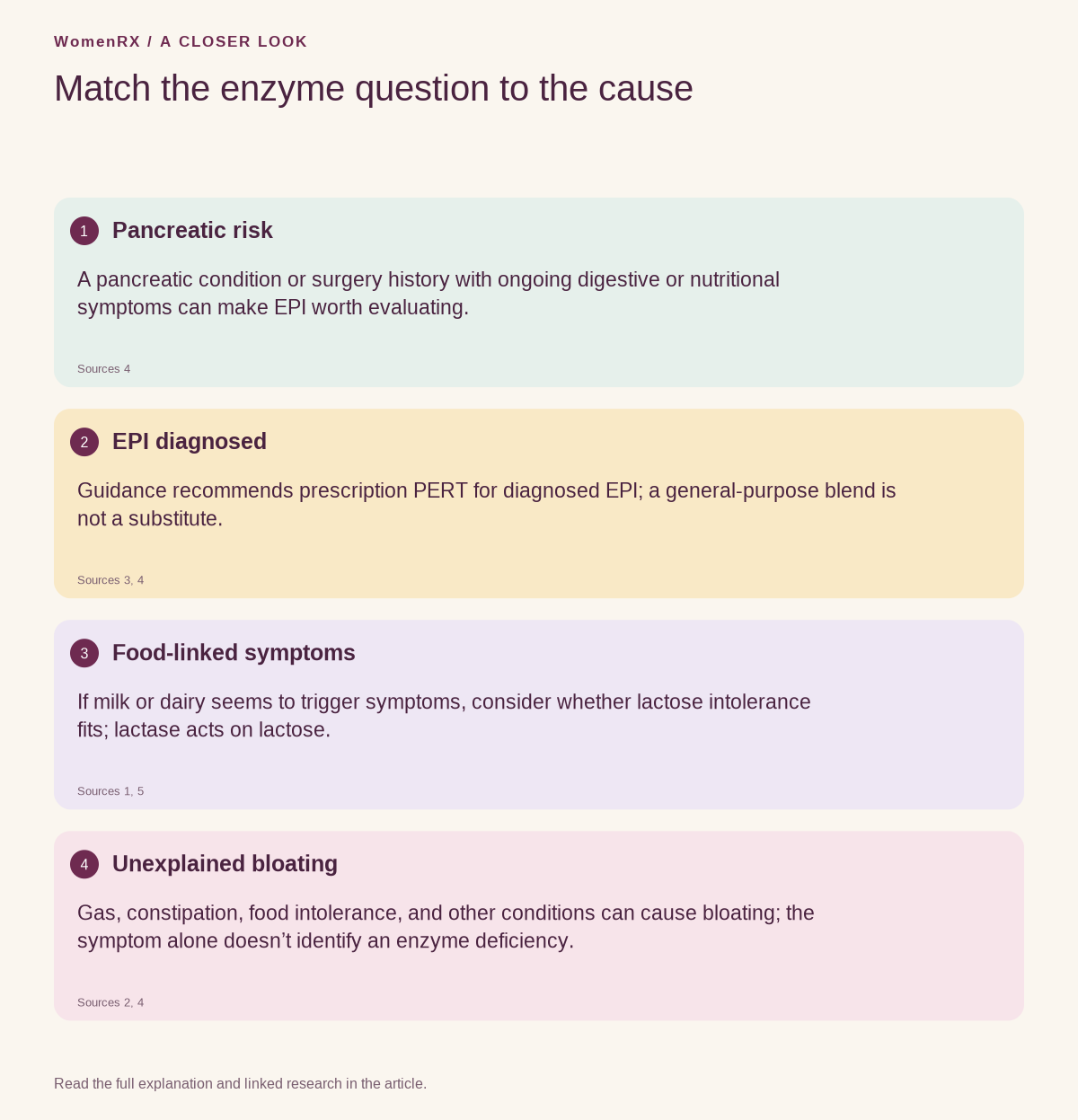
Match the enzyme question to the cause
Pancreatic risk: A pancreatic condition or surgery history with ongoing digestive or nutritional symptoms can make EPI worth evaluating.4
EPI diagnosed: Guidance recommends prescription PERT for diagnosed EPI; a general-purpose blend is not a substitute.34
Food-linked symptoms: If milk or dairy seems to trigger symptoms, consider whether lactose intolerance fits; lactase acts on lactose.15
Unexplained bloating: Gas, constipation, food intolerance, and other conditions can cause bloating; the symptom alone doesn’t identify an enzyme deficiency.24
Read the figure as text
Use the symptom pattern and relevant diagnosis to distinguish a specific food question from possible EPI or unexplained bloating.- Pancreatic risk: A pancreatic condition or surgery history with ongoing digestive or nutritional symptoms can make EPI worth evaluating.4
- EPI diagnosed: Guidance recommends prescription PERT for diagnosed EPI; a general-purpose blend is not a substitute.34
- Food-linked symptoms: If milk or dairy seems to trigger symptoms, consider whether lactose intolerance fits; lactase acts on lactose.15
- Unexplained bloating: Gas, constipation, food intolerance, and other conditions can cause bloating; the symptom alone doesn’t identify an enzyme deficiency.24
More questions, answered
Can I take pancreatic enzymes to see if I have EPI?
Feeling better or not feeling better during a trial of pancreatic enzymes can’t reliably diagnose EPI. Evaluation may include a stool pancreatic elastase test, interpreted in context. 4
Does bloating mean I’m missing digestive enzymes?
No. Bloating can come from gas, constipation, food intolerance, or other digestive conditions. The symptom alone doesn’t identify an enzyme deficiency. 2 4
Sources you can check
- Food intolerance - NHSAccessed 2026-09-25Return to first citation
- Bloating - NHSAccessed 2026-09-25Return to first citation
- Prescribing Patterns and Perceptions of Pancreatic Enzyme Replacement Therapy among Healthcare Providers: A Prospective United States Healthcare Providers Survey.Ashkar M, Geremia J, Baldwin Z, Edwards ML, Zhang Y, Garcia-Horton V, Yang M, Shen E, Dylla DE, Sanchez Gonzalez Y, Barkin JA. · Advances in therapy · 2026Return to first citation
- AGA Clinical Practice Update on the Epidemiology, Evaluation, and Management of Exocrine Pancreatic Insufficiency: Expert Review.Whitcomb DC, Buchner AM, Forsmark CE. · Gastroenterology · 2023Return to first citation
- Non-Pancreatic Digestive Enzymes.Borowitz D. · Biomolecules · 2025Return to first citation