Digestive Enzymes and Weight: What’s the Link?
Pancreatic enzymes may help restore weight lost through a diagnosed deficiency, but that’s different from using enzymes to lose weight.
Digestive enzymes aren’t established as a weight-loss aid by guidance on pancreatic enzyme treatment. In exocrine pancreatic insufficiency (EPI), too few pancreatic enzymes reach the intestine, which can lead to poor digestion and weight loss. For someone with diagnosed EPI, successful treatment may include weight gain as nutrition improves. That’s weight restoration, not evidence that enzyme supplements cause weight loss in someone without a deficiency. 3
Better digestion isn’t the same as weight loss
A product can affect digestion without changing body weight. That distinction matters when an enzyme supplement promises to help you lose weight: evidence that food is broken down more effectively, or that digestive symptoms improve, doesn’t answer what happens on the scale.
Body weight itself includes muscle, bone, fat, and water. Even a measured change in weight wouldn’t, on its own, show a change in body fat. 1 A persuasive weight-loss claim would need human research that follows weight over time, compares an enzyme product with an appropriate control, and makes clear who was studied. If the product is a blend, the research also needs to identify what was tested. The NIH Office of Dietary Supplements notes that studies of multi-ingredient weight-loss supplements can make it difficult to isolate one ingredient’s effect. 2
Why treating an enzyme deficiency is a different question
EPI is a condition in which the pancreas doesn’t deliver enough digestive enzymes to the intestine. Nutrients may not be properly digested, and symptoms can include greasy stools, diarrhea, bloating, excessive gas, and weight loss. 3
For someone diagnosed with EPI, pancreatic enzyme replacement treats that shortage. The American Gastroenterological Association (AGA) lists less greasy stool and fewer associated digestive symptoms, as well as gains in weight, muscle mass, and muscle function, among measures of successful treatment. 3 In that setting, gaining weight may mean recovering from poor digestion and nutrition. It doesn’t show that enzymes promote weight gain in everyone, and it certainly doesn’t demonstrate weight loss.
EPI also isn’t something you can confirm by trying an enzyme product and seeing how you feel. The AGA says a response to a trial of pancreatic enzymes is unreliable for diagnosis; it identifies a stool test called fecal elastase as the appropriate initial test. 3
How to judge a claim aimed at you
Ask what the study actually measured. Was it nutrient digestion or digestive comfort, or was it body weight? Did it compare the advertised product with a control? Were participants being treated for a diagnosed deficiency, or were they taking enzymes for weight management? An outcome in people with EPI can’t answer the same question for people without EPI.
If a claim says enzymes work differently for women, look for weight results reported for women. A claim about pregnancy, postpartum, perimenopause, or postmenopause would need research relevant to that stage. The AGA’s guidance on treating EPI does not establish whether enzymes affect weight differently by sex or reproductive stage. 3
If your weight is changing without you trying, the more useful next step is to find out why, rather than assume an enzyme supplement is the answer. Digestive disease is one possible cause of unexpected weight loss, but it isn’t the only one. 1 Persistent greasy stools alongside weight loss, especially if you have a condition such as chronic pancreatitis or have had pancreatic surgery, make a discussion about EPI particularly relevant. 3
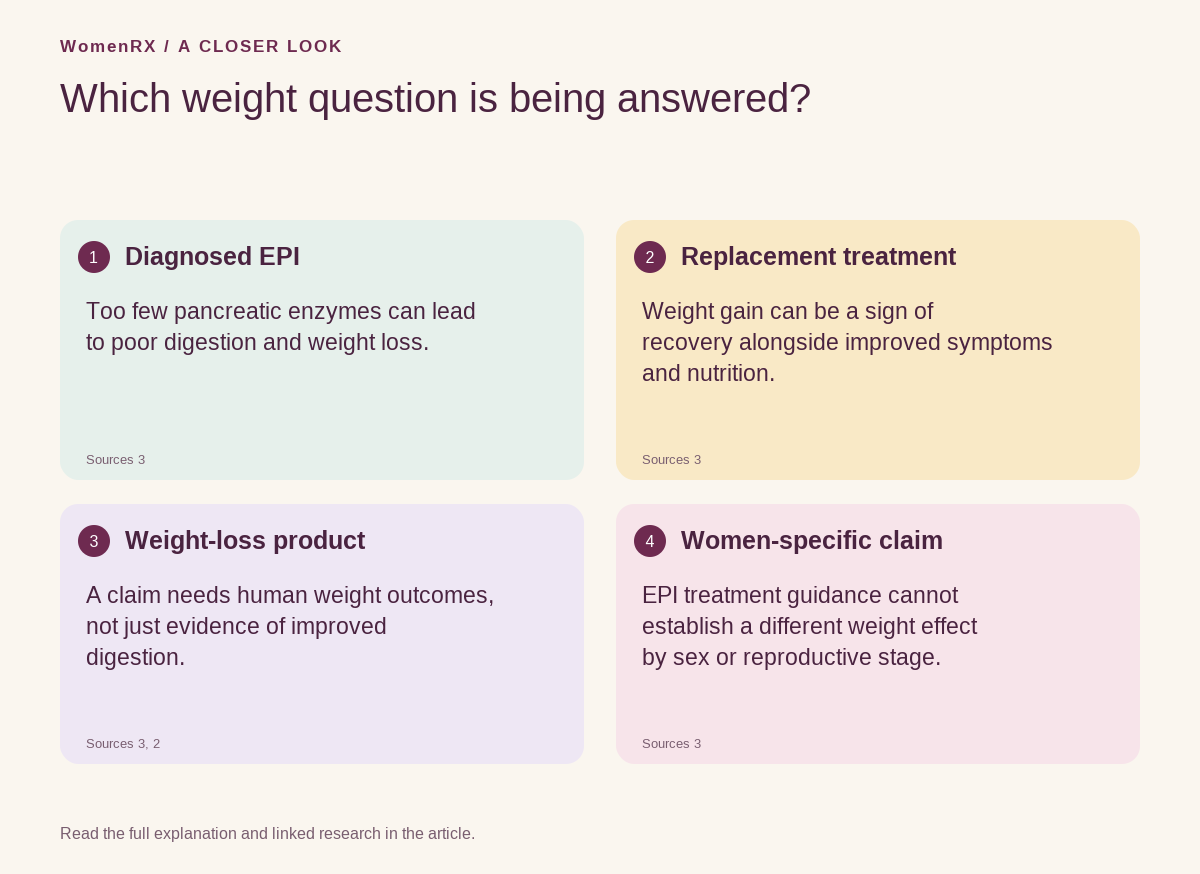
Which weight question is being answered?
Diagnosed EPI: Too few pancreatic enzymes can lead to poor digestion and weight loss.3
Replacement treatment: Weight gain can be a sign of recovery alongside improved symptoms and nutrition.3
Weight-loss product: A claim needs human weight outcomes, not just evidence of improved digestion.32
Women-specific claim: EPI treatment guidance cannot establish a different weight effect by sex or reproductive stage.3
Read the figure as text
The reason for taking enzymes changes what a weight result could mean.- Diagnosed EPI: Too few pancreatic enzymes can lead to poor digestion and weight loss.3
- Replacement treatment: Weight gain can be a sign of recovery alongside improved symptoms and nutrition.3
- Weight-loss product: A claim needs human weight outcomes, not just evidence of improved digestion.32
- Women-specific claim: EPI treatment guidance cannot establish a different weight effect by sex or reproductive stage.3
More questions, answered
If I gain weight while taking pancreatic enzymes, does that prove I have EPI?
No. Weight gain can be one sign of treatment success in diagnosed EPI, but a response to pancreatic enzymes is not a reliable way to diagnose the condition. 3
Sources you can check
- Body Weight: MedlinePlusAccessed 2026-09-25Return to first citation
- Dietary Supplements for Weight Loss - Health Professional Fact SheetAccessed 2026-09-25Return to first citation
- AGA Clinical Practice Update on the Epidemiology, Evaluation, and Management of Exocrine Pancreatic Insufficiency: Expert Review.Whitcomb DC, Buchner AM, Forsmark CE. · Gastroenterology · 2023Return to first citation