Digestive Enzymes After 40: When Do They Help?
Turning 40 or reaching menopause isn’t, by itself, a reason to start digestive enzymes; the useful question is whether a particular enzyme matches a diagnosed problem or a repeatable food-related symptom.
Age alone doesn’t establish a need for digestive enzymes. Enzymes can have a specific role, such as lactase for lactose-related symptoms or clinician-directed pancreatic enzyme replacement for pancreatic exocrine insufficiency. Persistent symptoms deserve attention to their pattern and possible cause, rather than an age-based supplement trial. Menopause itself isn’t established here as a reason to take enzymes. 1 3
Age isn’t the diagnosis
A supplement marketed for digestion can sound like a sensible midlife add-on, especially if bloating or changes in bowel habits have appeared. But digestive enzymes aren’t one interchangeable treatment: different enzymes act on different parts of digestion. The relevant question is whether a particular enzyme matches a specific problem, not whether you’ve passed 40.
Being over 40 or going through menopause, on its own, is not an established reason to take enzyme supplements. A review of pancreatic insufficiency lists aging among several associated contexts, but that does not show that healthy older adults benefit from routinely taking enzymes. 4
When an enzyme has a defined job
Lactase helps digest lactose, the sugar in milk. Lactose-related symptoms can be assessed and managed in different ways. A 2026 clinical guideline describes options including selective reduction of lactose, lactase enzymes, and fermented dairy products, and highlights the value of avoiding unnecessary dietary restrictions. 1
Symptoms after dairy don’t prove lactose intolerance. In a systematic review of six studies involving 845 adults with IBS, people’s self-reported lactose intolerance had variable, moderate accuracy compared with testing; the authors cautioned against routine lactose-free diets or routine breath testing in IBS without a clear indication. That’s a reason to notice whether there’s a consistent food-and-symptom pattern, not to assume that every digestive symptom comes from lactose. 2
Pancreatic enzymes are a different case. Pancreatic exocrine insufficiency (PEI) means the pancreas’s digestive enzyme activity is too low for normal digestion. It can lead to malabsorption and nutritional problems, and may be associated with symptoms such as greasy stools, bloating, abdominal discomfort, and excess gas. Clinician-directed pancreatic enzyme replacement is used when this condition is present; it isn’t the same as taking a general digestive-enzyme blend for ordinary bloating. 3
A practical route from symptoms to next steps
If symptoms are persistent, start with their context: do they repeatedly follow a particular food, or are they ongoing regardless of meals? Note changes such as greasy stools, unintentional weight loss, or signs of nutritional problems, which can make pancreatic malabsorption worth assessing. These features do not diagnose PEI, but they are more meaningful than age alone. 3
For suspected lactose-related symptoms, a clinician may consider the pattern and whether testing is useful. The guideline identifies the lactose breath test as a noninvasive diagnostic tool and describes individualized management, rather than recommending the same restriction or enzyme product for everyone. 1
For suspected PEI, fecal elastase-1 is a commonly used, noninvasive test. A 2025 meta-analysis of 13 studies with 888 patients found that, at a cutoff of 200 μg/g, it had pooled sensitivity of 0.94 and specificity of 0.69 against reference tests. In plain terms, it can help screen for PEI, but a low result can require careful interpretation, especially when the person’s likelihood of PEI is low. A test result needs to be considered alongside symptoms and nutritional status. 3
The takeaway: don’t let an age-based claim decide for you. A specific, repeatable food trigger may point toward a targeted question such as lactose intolerance; signs of malabsorption may warrant assessment for pancreatic insufficiency. If neither applies, a general enzyme supplement may not address what’s causing your symptoms.
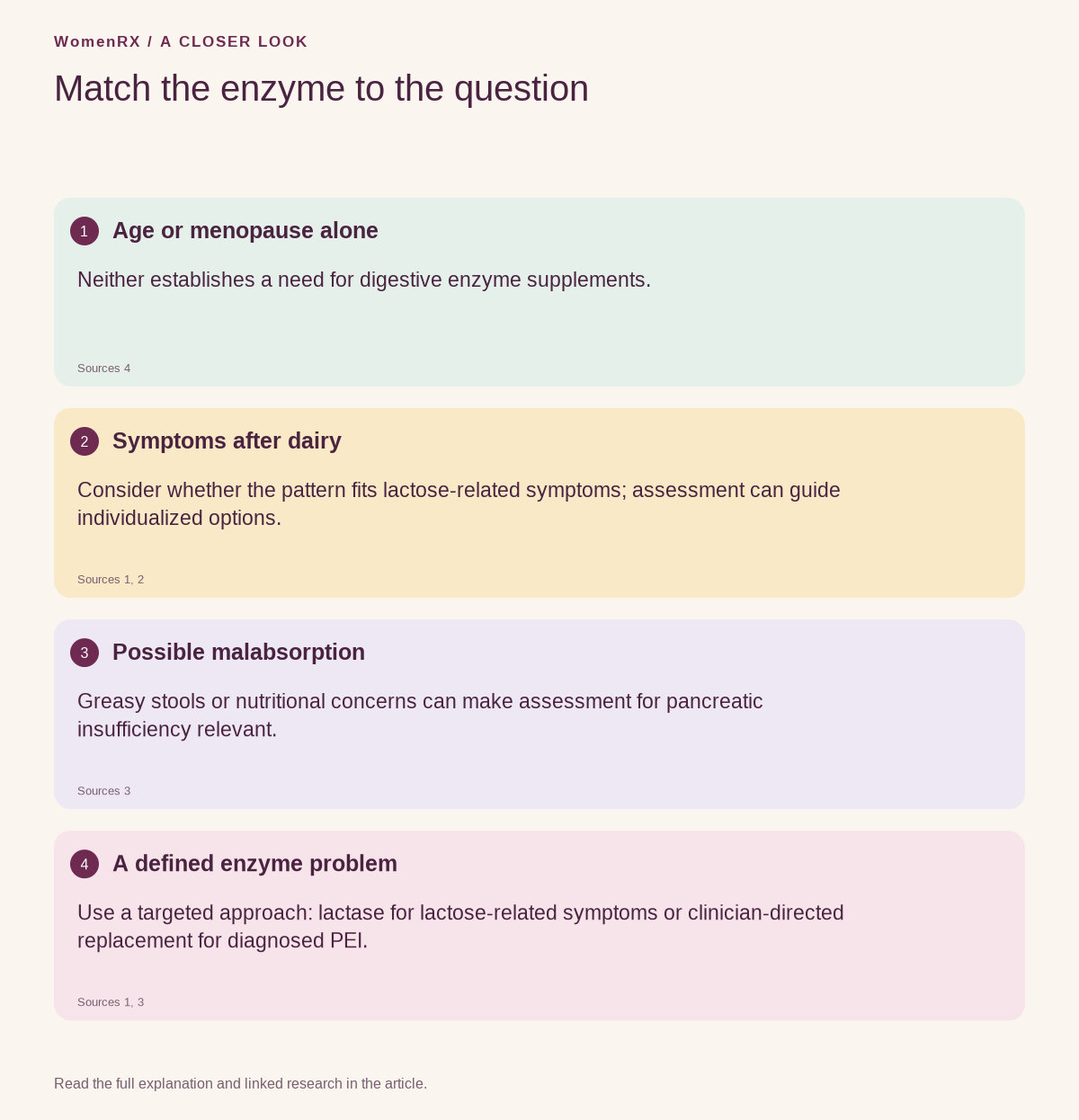
Match the enzyme to the question
Age or menopause alone: Neither establishes a need for digestive enzyme supplements.4
Symptoms after dairy: Consider whether the pattern fits lactose-related symptoms; assessment can guide individualized options.12
Possible malabsorption: Greasy stools or nutritional concerns can make assessment for pancreatic insufficiency relevant.3
A defined enzyme problem: Use a targeted approach: lactase for lactose-related symptoms or clinician-directed replacement for diagnosed PEI.13
Read the figure as text
A practical route from an age-based product claim to a more specific symptom or condition question.- Age or menopause alone: Neither establishes a need for digestive enzyme supplements.4
- Symptoms after dairy: Consider whether the pattern fits lactose-related symptoms; assessment can guide individualized options.12
- Possible malabsorption: Greasy stools or nutritional concerns can make assessment for pancreatic insufficiency relevant.3
- A defined enzyme problem: Use a targeted approach: lactase for lactose-related symptoms or clinician-directed replacement for diagnosed PEI.13
More questions, answered
Should I avoid dairy if I think I’m lactose intolerant?
Not automatically. Guidance supports individualized options, including selective lactose reduction, lactase, or fermented dairy, and cautions against unnecessary restrictions that could compromise calcium and vitamin D intake. 1 A systematic review also found that self-reported intolerance in adults with IBS was not a dependable substitute for assessment. 2
Does a stool elastase test diagnose pancreatic insufficiency by itself?
It is a useful screening test, but it isn’t a perfect stand-alone answer. A meta-analysis found moderate specificity at the commonly evaluated 200 μg/g cutoff, so results need to be interpreted in the context of symptoms, nutritional status, and the likelihood of PEI. 3
Sources you can check
- Clinical guideline of the Asociación Mexicana de Gastroenterología for the diagnosis and treatment of lactose ingestion-related disorders.Remes-Troche JM, Amieva-Balmori M, Uscanga-Domínguez LF, Coss-Adame E, Bernal-Reyes R, Carmona-Sánchez R, Francisco MR, García-Zermeño KR, Gómez-Castaños PC, Gómez-Escudero O, Huer... · Revista de gastroenterologia de Mexico (English) · 2026Return to first citation
- Self-Perceived Lactose Intolerance Versus Confirmed Lactose Intolerance in Irritable Bowel Syndrome: A Systematic Review.Pop A, Popa SL, Pop DD, Ismaiel A, Nechita VI, Dumitrascu DL. · Journal of gastrointestinal and liver diseases : JGLD · 2024Return to first citation
- Diagnostic Accuracy of Fecal Elastase-1 Test for Pancreatic Exocrine Insufficiency: A Systematic Review and Meta-Analysis.de la Iglesia D, Agudo-Castillo B, Galego-Fernández M, Rama-Fernández A, Domínguez-Muñoz JE. · United European gastroenterology journal · 2025Return to first citation
- Unique causes of exocrine pancreatic insufficiency: When to consider pancreatic enzyme supplementation: A narrative review.Williams V, Funk S. · Nutrition in clinical practice : official publication of the American Society for Parenteral and Enteral Nutrition · 2026Return to first citation