When Do Digestive Enzymes Make Sense?
The reason you need an enzyme matters more than the words “digestive support” on a bottle.
Digestive enzymes make the most sense when there’s a specific problem to address. Pancreatic enzyme replacement therapy (PERT) treats exocrine pancreatic insufficiency, a condition that disrupts digestion and absorption. Lactase has a narrower purpose: breaking down lactose. Don’t assume a general enzyme blend does either job based on its label. Side effects and cautions depend on the product.324
Start with the job the enzyme is meant to do
“Digestive enzyme” describes several different products, not one treatment. If you’re comparing bottles because meals leave you bloated or uncomfortable, the useful question is: What specific food or digestive problem is this enzyme supposed to address? That separates clinician-directed PERT for EPI from products marketed for broad digestive support, while leaving room for lactase’s targeted role in lactose digestion.32
PERT treats EPI
Exocrine pancreatic insufficiency, often shortened to EPI, disrupts normal digestion and absorption. Symptoms and nutritional effects can vary. Pancreatic enzyme replacement therapy, or PERT, is the standard treatment for EPI. It is directed at a specific condition as part of clinical care, unlike an over-the-counter blend marketed for general digestive support. A clinical review describes PERT as effective and safe for EPI, while noting that determining whether someone has EPI and how extensively it affects them can be challenging.3
That distinction matters if you’re worried about malabsorption. Buying a general enzyme blend doesn’t establish whether you have EPI, and it isn’t a reason to put off an evaluation. If a clinician has prescribed PERT for EPI, don’t assume an over-the-counter product marketed for general digestive support does the same job.3
Lactase addresses lactose, not every meal
Lactase breaks lactose, the sugar in milk, into smaller sugars. Reduced lactase activity can make lactose harder to digest. That gives lactase a specific rationale when dairy seems to be the problem; it doesn’t explain symptoms that also happen after meals without lactose.21
For example, if bloating and diarrhea repeatedly follow milk but not other meals, lactose intolerance is one possibility to discuss. Recurring symptoms deserve attention rather than an expanding list of foods to avoid. NHS guidance cautions against cutting foods out of your diet without advice from a clinician or dietitian. A clinician may consider a breath test when lactose intolerance is suspected. Food intolerance is also different from food allergy, which can involve itching, wheezing, or swelling of the lips or face.1
A broad blend needs a more specific reason
A label that lists several enzymes doesn’t tell you which ingredient, if any, matches your symptoms. It also doesn’t show that the blend does the same job as PERT for EPI or lactase for lactose digestion. Evidence for one enzyme and one purpose shouldn’t be carried over to every ingredient in a combination product.32
That matters for safety, too: a finding about PERT in people with EPI or about how lactase works doesn’t establish the side effects or safety of a particular blend. If you’re considering one, check its actual ingredients rather than relying on the words “digestive enzyme.”32
Side effects and cautions depend on the product
For pancrelipase, a medication used for pancreatic enzyme replacement, MedlinePlus lists cough as a possible side effect. It also warns that tablets or capsules not swallowed completely can irritate the mouth or affect how the medication works. Those are pancrelipase-specific cautions, not a side-effect list for lactase or every over-the-counter blend.4
If pancrelipase has been prescribed for you, tell the prescriber about a history of intestinal surgery or blockage, gout, high uric acid, or kidney disease. Pancrelipase brands can differ, so a change of brand is also worth discussing rather than treating the products as identical.4 For an over-the-counter blend, the ingredient list is the starting point for a safety question; pancrelipase’s known cautions don’t establish that blend’s risks.
When symptoms call for answers instead of another bottle
Food-related bloating or diarrhea can have more than one explanation. If symptoms keep coming back, getting the pattern assessed is more useful than cycling through products or cutting out multiple foods on your own. Tests sold to diagnose food intolerances aren’t recommended by NHS guidance because their accuracy has limited support and their results can lead people to avoid many foods unnecessarily.1
If a reaction includes wheezing or swelling of the lips, face, or eyes, don’t treat it as routine intolerance or try to manage it with enzymes. Those can be signs of a serious allergic reaction. Seek emergency care immediately.1
Pregnancy and breastfeeding make the exact product worth checking, not a reason to assume you need digestive enzymes. MedlinePlus advises people taking pancrelipase to tell their prescriber if they’re pregnant, planning pregnancy, or breastfeeding.4 Whether a particular over-the-counter blend is appropriate during pregnancy or breastfeeding remains a product-specific safety question; the word “enzyme” alone can’t answer it.
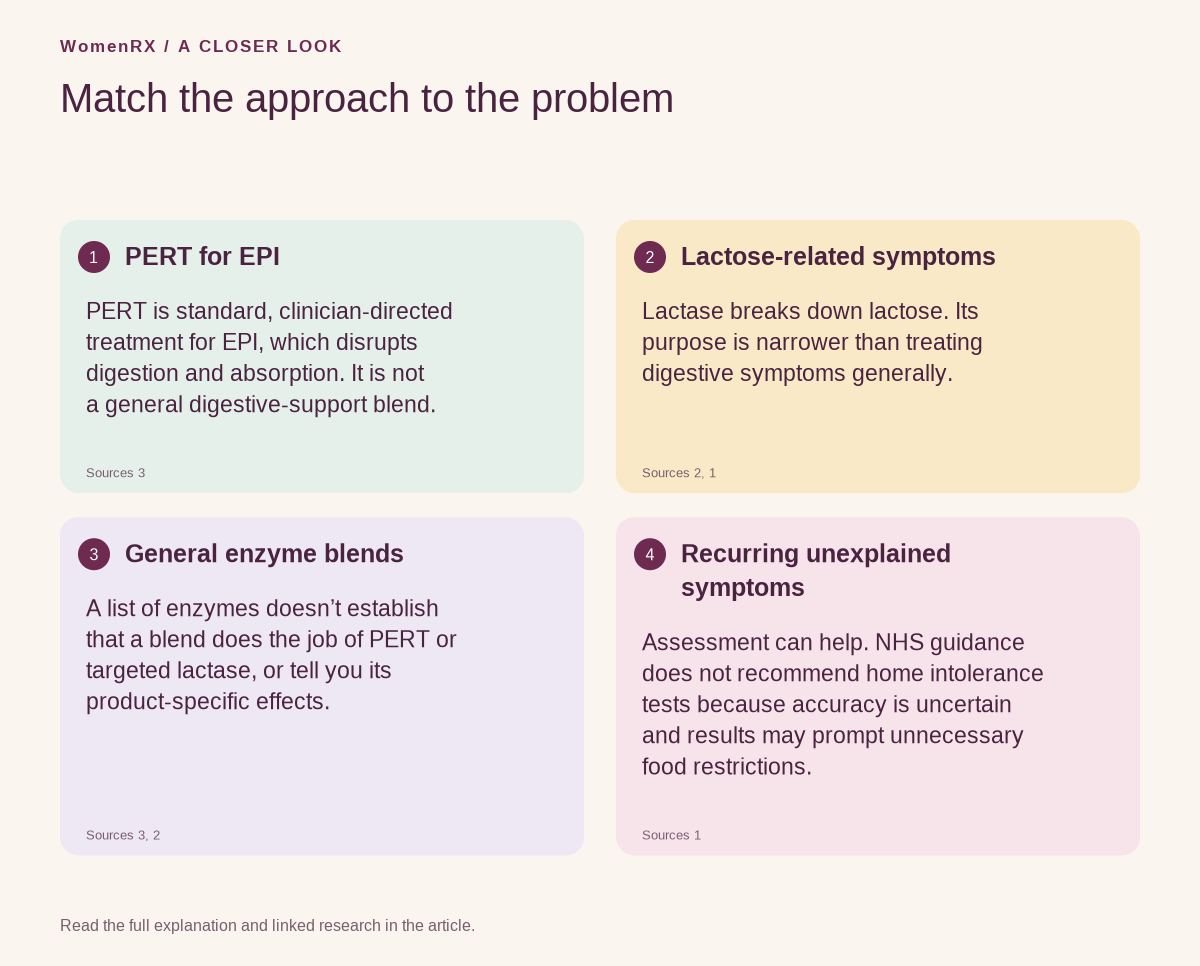
Match the approach to the problem
PERT for EPI: PERT is standard, clinician-directed treatment for EPI, which disrupts digestion and absorption. It is not a general digestive-support blend.3
Lactose-related symptoms: Lactase breaks down lactose. Its purpose is narrower than treating digestive symptoms generally.21
General enzyme blends: A list of enzymes doesn’t establish that a blend does the job of PERT or targeted lactase, or tell you its product-specific effects.32
Recurring unexplained symptoms: Assessment can help. NHS guidance does not recommend home intolerance tests because accuracy is uncertain and results may prompt unnecessary food restrictions.1
Read the figure as text
Clinician-directed pancreatic enzyme replacement therapy (PERT) for EPI, targeted lactase, and general blends have different stated purposes; recurring unexplained symptoms call for assessment.- PERT for EPI: PERT is standard, clinician-directed treatment for EPI, which disrupts digestion and absorption. It is not a general digestive-support blend.3
- Lactose-related symptoms: Lactase breaks down lactose. Its purpose is narrower than treating digestive symptoms generally.21
- General enzyme blends: A list of enzymes doesn’t establish that a blend does the job of PERT or targeted lactase, or tell you its product-specific effects.32
- Recurring unexplained symptoms: Assessment can help. NHS guidance does not recommend home intolerance tests because accuracy is uncertain and results may prompt unnecessary food restrictions.1
Sources you can check
- Food intolerance - NHSAccessed 2026-09-25Return to first citation
- Advances in β-Galactosidase Research: A Systematic Review from Molecular Mechanisms to Enzyme Delivery Systems.Király M, Barna ÁT, Kállai-Szabó N, Kiss BD, Antal I, Ludányi K. · Pharmaceutics · 2025Return to first citation
- Exocrine pancreatic insufficiency and pancreatic exocrine replacement therapy in clinical practice.Berry AJ, Bilbo A. · Nutrition in clinical practice : official publication of the American Society for Parenteral and Enteral Nutrition · 2024Return to first citation
- Pancrelipase: MedlinePlus Drug InformationAccessed 2026-09-25Return to first citation