Digestive Enzyme Doses Depend on What’s Being Treated
There’s no general daily dose for digestive enzymes: pancreatic enzyme replacement is used for diagnosed insufficiency, and its dose is tied to meals and treatment response.
A digestive enzyme dose depends on the enzyme and the reason for taking it. Pancreatic enzyme replacement is used for exocrine pancreatic insufficiency, and dosing guidance is expressed in lipase activity units per meal, not as one universal daily amount. A chronic-pancreatitis guideline range shouldn’t be applied automatically to every digestive symptom or enzyme blend. If you have persistent diarrhea, oily stools, bloating, or weight loss, seek assessment rather than choosing an enzyme dose. Diagnosed EPI calls for clinician-directed PERT; if the cause remains unknown, don’t default to a nonprescription enzyme blend. 3 4
First, ask what problem the enzyme is meant to treat
A digestive enzyme isn’t a general-purpose remedy for every kind of bloating, diarrhea, or discomfort. Pancreatic enzyme replacement therapy (PERT) replaces pancreatic enzymes when someone has exocrine pancreatic insufficiency (EPI), a problem with digesting food because there isn’t enough effective pancreatic enzyme activity. EPI can occur with pancreatic diseases and after pancreatic surgery; symptoms may include diarrhea, oily stools, bloating, weight loss, or abdominal discomfort. These symptoms aren’t specific to EPI, so symptoms alone don’t establish that diagnosis. 4
That distinction matters when you’re looking at a bottle of mixed over-the-counter enzymes. Evidence about PERT in people with EPI doesn’t establish a useful dose for a broad enzyme blend taken for unexplained symptoms. PERT dosing guidance also can’t tell you how much lactase or alpha-galactosidase to take. 3 If you don’t know what the product is intended to address, a number on its label can’t answer whether it’s the right treatment for you.
What the lipase number tells you
For PERT, dosing is commonly described in lipase units, because lipase is central to fat digestion and nutritional status. One review describes European guidance in the context of chronic pancreatitis as recommending a minimum of 40,000-50,000 lipase units with a main meal. That is a treatment-guidance example for a particular clinical context, not a universal dose for all causes of EPI, all enzyme products, or all women with digestive symptoms. Guidance and starting doses can differ, and treatment is individualized. 3
The “per meal” wording is meaningful: PERT is taken with food, and the cited guidance expresses the amount for a main meal rather than as a standalone daily total. The amount may be adjusted based on response. The different pancreatic enzyme formulations also vary in how much lipase and other enzymes they contain, so a lipase-unit figure is more informative for PERT than a vague claim such as “digestive enzyme blend.” It still doesn’t tell you, by itself, whether you need treatment or what amount is right for you. 3
In a systematic review of observational studies involving 3,818 people with EPI, treatment was associated with improvement in diarrhea in most studies. Studies using doses below guideline recommendations often reported symptom improvement, but none showed a nutritional-status benefit; studies using guideline-concordant doses generally helped maintain or improve nutritional status. These findings support assessing more than whether symptoms feel better. They don’t establish a dose for people without diagnosed EPI or for nonprescription blends. 3
When symptoms call for assessment
A clinician can weigh symptoms and medical history against testing. Fecal elastase-1, which measures pancreatic elastase in stool, is described as a commonly available first-line test for EPI. It has limitations: watery stool can produce a falsely low result, and results in the 100-200 micrograms-per-gram range have limited specificity. Nutritional markers may help assess deficiencies, but they aren’t specific to EPI on their own. 4
This is why trying an enzyme and noticing a change can’t reliably diagnose EPI. A response to PERT is not specific, and relying on a treatment trial can lead to unnecessary treatment. If you have persistent diarrhea, oily stools, bloating, or unexplained weight loss, discuss what could be causing it and whether testing makes sense rather than choosing a dose from a general supplement label. 4
Pregnancy and breastfeeding change the self-treatment question
If you’re pregnant, don’t assume an enzyme supplement is safe just because it’s sold over the counter. Medicines and supplements can have risks during pregnancy, and MedlinePlus recommends checking before starting one. That guidance isn’t specific to every enzyme product, so it can’t confirm that a particular blend or dose is suitable. 2
If you’re breastfeeding, some medicines can pass into breast milk. MedlinePlus advises contacting a care provider if you have concerns about whether you should breastfeed. 1 Ask about the specific enzyme product before taking it; this general guidance doesn’t say whether a particular digestive enzyme is suitable during breastfeeding.
A practical way to read the label
Before deciding on a dose, identify the product’s purpose. If EPI has been diagnosed and PERT prescribed, follow the lipase-unit and meal-based instructions you were given; don’t substitute a number from a general article or another product. A nonprescription enzyme blend is not the same treatment. If symptoms remain unexplained, seek assessment rather than defaulting to a blend or borrowing a PERT dose. 3 4 If you’re pregnant, check with a provider before taking a medicine or supplement. 2 If you’re breastfeeding and have concerns about whether to breastfeed, contact a provider. 1
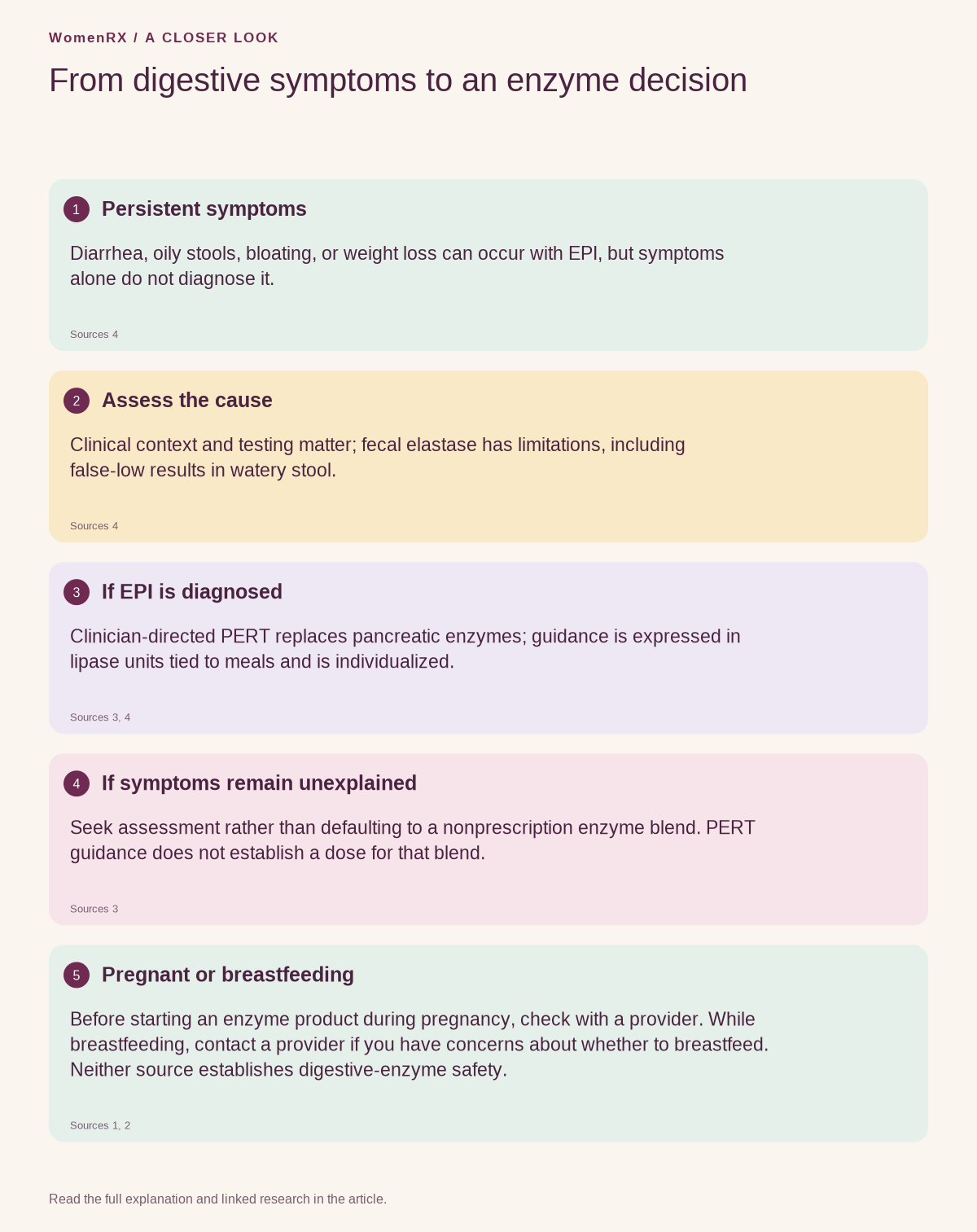
From digestive symptoms to an enzyme decision
Persistent symptoms: Diarrhea, oily stools, bloating, or weight loss can occur with EPI, but symptoms alone do not diagnose it.4
Assess the cause: Clinical context and testing matter; fecal elastase has limitations, including false-low results in watery stool.4
If EPI is diagnosed: Clinician-directed PERT replaces pancreatic enzymes; guidance is expressed in lipase units tied to meals and is individualized.34
If symptoms remain unexplained: Seek assessment rather than defaulting to a nonprescription enzyme blend. PERT guidance does not establish a dose for that blend.3
Pregnant or breastfeeding: Before starting an enzyme product during pregnancy, check with a provider. While breastfeeding, contact a provider if you have concerns about whether to breastfeed. Neither source establishes digestive-enzyme safety.12
Read the figure as text
Start with assessment for persistent symptoms, then follow the relevant branch: diagnosed EPI or symptoms whose cause remains unknown.- Persistent symptoms: Diarrhea, oily stools, bloating, or weight loss can occur with EPI, but symptoms alone do not diagnose it.4
- Assess the cause: Clinical context and testing matter; fecal elastase has limitations, including false-low results in watery stool.4
- If EPI is diagnosed: Clinician-directed PERT replaces pancreatic enzymes; guidance is expressed in lipase units tied to meals and is individualized.34
- If symptoms remain unexplained: Seek assessment rather than defaulting to a nonprescription enzyme blend. PERT guidance does not establish a dose for that blend.3
- Pregnant or breastfeeding: Before starting an enzyme product during pregnancy, check with a provider. While breastfeeding, contact a provider if you have concerns about whether to breastfeed. Neither source establishes digestive-enzyme safety.12
More questions, answered
Can feeling better after enzymes confirm EPI?
No. A symptom response to pancreatic enzyme replacement isn’t specific to EPI, so it can’t confirm the diagnosis by itself. Testing and the clinical context matter. 4
Should I use a PERT dose for a nonprescription enzyme blend?
No. The lipase-unit guidance described here concerns pancreatic enzyme replacement in a clinical treatment context. It doesn’t establish a dose for mixed over-the-counter products or unexplained digestive symptoms. 3
Sources you can check
- Breastfeeding | Benefits of Breastfeeding | MedlinePlusAccessed 2026-09-25Return to first citation
- Pregnancy and Medicines | MedlinePlusAccessed 2026-09-25Return to first citation
- Pancreatic Enzyme Replacement Therapy in Pancreatic Exocrine Insufficiency-Real-World's Dosing and Effectiveness: A Systematic Review.Kadaj-Lipka R, Monica M, Stożek-Tutro A, Ryś P, Rydzewska G. · Digestive diseases and sciences · 2025Return to first citation
- Pancreatic exocrine insufficiency.Iglesia D, Vujasinovic M, Löhr JM, Dominguez-Muñoz JE. · EClinicalMedicine · 2026Return to first citation