Can You Take Digestive Enzymes Long Term?
The answer depends on whether you’re replacing enzymes for a diagnosed condition or taking a supplement for symptoms that haven’t been explained.
If you’ve been taking an over-the-counter enzyme blend every day, its long-term safety and usefulness can’t be inferred from studies of prescription pancreatic enzyme replacement. That treatment improves nutrient absorption in people with diagnosed exocrine pancreatic insufficiency, a specific condition that needs ongoing management.12 For a supplement, the useful next step is to identify its exact ingredients and purpose, then reconsider persistent symptoms rather than assuming you need more enzymes.
First, which kind of enzyme are you taking?
“Digestive enzymes” can describe products used for very different reasons. The clearest evidence for continued treatment concerns prescription pancreatic enzyme replacement therapy, often called PERT. It supplies pancreatic enzymes when the pancreas doesn’t release enough to digest food properly. In a review of 14 randomized trials involving 684 people with diagnosed exocrine pancreatic insufficiency, PERT improved measures of fat and protein absorption compared with placebo.1 That finding doesn’t establish that a store-bought blend helps someone whose main symptom is bloating after dinner.
PERT is also treatment that may need adjustment over time. A review of treatment guidance found substantial variation in dosing recommendations across conditions and emphasized follow-up based on nutritional status and response.2 If you’ve been prescribed it, the question isn’t whether all enzymes are safe to take indefinitely. It’s whether your treatment is still meeting your nutritional needs.
A product naming one enzyme, such as lactase or alpha-galactosidase, is a different question again. Look at the specific ingredient and the food-related purpose stated on its label. Don’t use PERT research as proof that a single-enzyme product works for your symptoms or is safe for daily use over years. This evidence does not establish those product-specific answers.13
Read a blend as a list of ingredients, not one treatment
Turn the bottle around. Does it list pancreatic enzymes, a named enzyme such as bromelain, or several enzymes alongside other ingredients? What symptom or food does it claim to address? A blend makes it harder to tell which ingredient, if any, is helping you. Dietary supplements can contain multiple ingredients, and findings for one product may not apply to another with a different composition.4
Bromelain is one concrete example of why the ingredient matters. It’s an enzyme complex derived from pineapple and appears in discussions of effects beyond food digestion. A critical review found that much of the research on its proposed health effects comes from laboratory and animal studies, with limited clinical evidence to establish long-term safety and effectiveness.6 Its presence on a label doesn’t make a multi-enzyme blend equivalent to prescription replacement therapy.
If you’ve felt better while taking a blend, that experience matters. It just doesn’t reveal whether the product corrected an enzyme deficiency, whether a particular ingredient helped, or whether your symptoms would have changed anyway. Knowing what’s in the bottle gives you a more useful question than “Are digestive enzymes safe forever?”: What is this product intended to do for the symptom I actually have?
When continued symptoms deserve a different question
If you’re still uncomfortable despite taking a supplement regularly, increasing your reliance on it may leave the reason for your symptoms unresolved. That’s a practical reason to seek an assessment, not proof that something serious is wrong. Be especially clear about changes such as persistent oily stools or unintentional weight loss, which can matter when evaluating how well someone is absorbing food.3 Severe upper abdominal pain calls for prompt medical attention rather than another supplement; it is one feature used in diagnosing acute pancreatitis.5
A history of chronic pancreatitis also changes the conversation. Trials in people with exocrine pancreatic insufficiency due to chronic pancreatitis, including some who had pancreatic resection for that condition, support PERT for improving fat absorption.3 Those findings don’t mean everyone with digestive symptoms, or everyone who has had pancreatic surgery for any reason, needs enzymes.
If you’re pregnant or breastfeeding, make the review product-specific: bring the exact label, including any added ingredients, to your care team. Don’t assume that research in people treated for pancreatic insufficiency establishes the safety of a supplement blend in pregnancy or breastfeeding.14 The same distinction applies at any life stage: a diagnosed need for replacement and an unexplained symptom are different starting points.
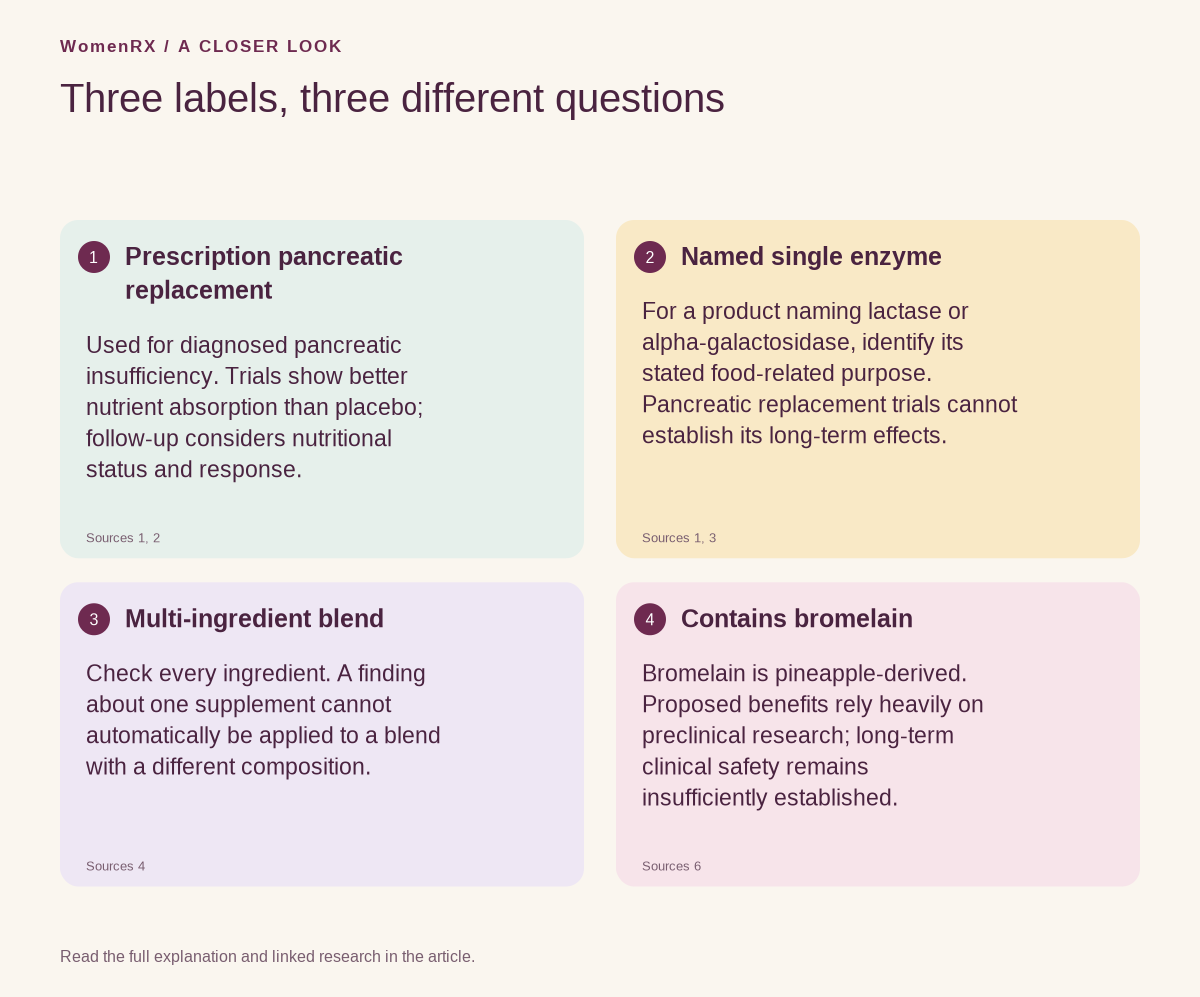
Three labels, three different questions
Prescription pancreatic replacement: Used for diagnosed pancreatic insufficiency. Trials show better nutrient absorption than placebo; follow-up considers nutritional status and response.12
Named single enzyme: For a product naming lactase or alpha-galactosidase, identify its stated food-related purpose. Pancreatic replacement trials cannot establish its long-term effects.13
Multi-ingredient blend: Check every ingredient. A finding about one supplement cannot automatically be applied to a blend with a different composition.4
Contains bromelain: Bromelain is pineapple-derived. Proposed benefits rely heavily on preclinical research; long-term clinical safety remains insufficiently established.6
Read the figure as text
Match the bottle to the evidence before deciding whether to keep taking it.- Prescription pancreatic replacement: Used for diagnosed pancreatic insufficiency. Trials show better nutrient absorption than placebo; follow-up considers nutritional status and response.12
- Named single enzyme: For a product naming lactase or alpha-galactosidase, identify its stated food-related purpose. Pancreatic replacement trials cannot establish its long-term effects.13
- Multi-ingredient blend: Check every ingredient. A finding about one supplement cannot automatically be applied to a blend with a different composition.4
- Contains bromelain: Bromelain is pineapple-derived. Proposed benefits rely heavily on preclinical research; long-term clinical safety remains insufficiently established.6
Sources you can check
- Efficacy of pancreatic enzyme replacement therapy on exocrine pancreatic insufficiency: a systematic review and meta-analysis.Yang X, Yang L, Zhang W, Zhong L, Zheng Y. · European journal of gastroenterology & hepatology · 2026Return to first citation
- Exocrine Pancreatic Insufficiency Dosing Guidelines for Pancreatic Enzyme Replacement Therapy Vary Widely Across Disease Types.Lewis DM, Rieke JG, Almusaylim K, Kanchibhatla A, Blanchette JE, Lewis C. · Digestive diseases and sciences · 2024Return to first citation
- Efficacy of pancreatic enzyme replacement therapy in chronic pancreatitis: systematic review and meta-analysis.de la Iglesia-García D, Huang W, Szatmary P, Baston-Rey I, Gonzalez-Lopez J, Prada-Ramallal G, Mukherjee R, Nunes QM, Domínguez-Muñoz JE, Sutton R, NIHR Pancreas Biomedical Researc... · Gut · 2017Return to first citation
- Aloe2006Return to first citation
- Acute Pancreatitis: Diagnosis and Treatment.Szatmary P, Grammatikopoulos T, Cai W, Huang W, Mukherjee R, Halloran C, Beyer G, Sutton R. · Drugs · 2022Return to first citation
- Potential health benefits of bromelain: a critical review of the current literature.Sanlier N, Irmak E, Ankarali E. · Frontiers in nutrition · 2026Return to first citation