How to Read an Ashwagandha Supplement Label
The most useful comparison is whether a product’s extract and formulation match research on the outcome you care about.
Start with the botanical name, plant part, extract amount, and any stated withanolide standardization. Then check whether the product resembles a formulation studied for your goal. A root extract, a multi-herb blend, and a sustained-release capsule aren’t interchangeable just because their milligram amounts look similar. One stress trial enrolled men and women, but did not report separate results for women. 234
First, identify what’s in the bottle
Look for Withania somnifera, the botanical name for ashwagandha. Does the label say which part of the plant is used, such as the root? Does it give an extract amount per serving and say whether the extract is standardized to a stated percentage of withanolides? Those details make a comparison possible. They don’t, on their own, show that the product works. 23
For example, a 24-week study of stress and weight outcomes used a root-only extract standardized to more than 5% withanolides. A different stress-and-anxiety trial tested a proprietary formulation containing ashwagandha, Triphala, and Trikatu. The result for that blend cannot tell you how much of any effect came from ashwagandha alone. Neither study establishes that a store-bought product with a similar-looking label is the same as the study formulation. 23
Standardized describes a measured feature of an extract, not a ranking of how well products work. A higher withanolide percentage is not, by itself, evidence of a better result: the clinical trials tested whole formulations, not percentages in isolation. 23
Match the research to your actual goal
If your goal is perceived stress, look for studies that measured perceived stress and compare their formulations with the label in front of you. If sleep is your main concern, look for a sleep outcome rather than assuming a stress result answers that question.
In one placebo-controlled trial, researchers studied two amounts of a sustained-release root extract in healthy adults reporting stress for 60 days. Compared with placebo, both groups receiving the extract had improvements in perceived stress and sleep-quality measures at day 60. That finding is about the tested sustained-release product in that study population, not every ashwagandha capsule. The amounts used in a trial are descriptions of its design, not instructions for choosing a dose. 4
Formulation matters at least as much as the large number on the front of a bottle. A single-ingredient root extract, a multi-herb blend, and a sustained-release extract answer different research questions. If a label doesn’t identify the plant part or the type of formulation, it’s hard to make a meaningful comparison. 234
What does the research tell women?
The trial of the proprietary ashwagandha-containing blend explicitly enrolled adult men and women, but the reported findings do not establish whether women responded differently from men. Other stress-trial results described here concern adults without establishing a separate effect for women. 24
There is also a small, women-only trial: 60 women ages 45 to 55 were assigned a root extract or placebo for 56 days to study menopausal symptoms. Its findings concern that group, outcome, and study product. They don’t establish a benefit for fertility, prove that ashwagandha “balances hormones,” or tell you how a different product would work during perimenopause or postmenopause. 6
Separate product testing from benefit claims
If a company says a supplement is “tested,” find out what that means. Does it describe what was checked, who performed the testing, and whether a report identifies the batch you would buy? A testing disclosure and a clinical trial answer different questions: one describes checks on a product, while the other studies outcomes in people. Neither turns a different formulation’s trial result into proof for the product on the shelf.
Be especially wary of broad claims that outrun the measured outcome. A study of perceived stress is not a study of infertility, and a study of menopausal symptoms is not evidence that a supplement treats every hormone-related concern. 46
Consider safety before making a comparison
Short-term trial findings are reassuring within their limits. In an eight-week randomized study of 1,002 adults reporting stress and anxiety, no serious adverse events were reported, and the extract and placebo groups had no significant differences in the listed liver, kidney, and blood measures. The study assessed a particular root extract over eight weeks; it cannot establish the safety of every formulation or longer use. 1
Rare but serious concerns can be missed in a trial. A scoping review collected 25 published cases of liver injury associated with products containing ashwagandha across 13 publications. Those reports cannot show how often injury occurs among users. Jaundice and itching appeared commonly in the reported cases, often after weeks of use; if those symptoms develop while you’re taking ashwagandha, stop using it and seek medical assessment. 5
Pregnancy and breastfeeding deserve a separate decision, not an assumption based on general adult studies. Pregnant and lactating women were excluded from the trial of the multi-herb formulation, so that trial cannot establish safety or benefit for either group. If you’re pregnant or breastfeeding, discuss the specific product with your pregnancy or postpartum care clinician before using it. 2
When two labels look similar, the useful question is not “Which has more ashwagandha?” It’s “Which one tells me enough to identify what I’m buying, and is there research on a comparable formulation for the outcome I want?”
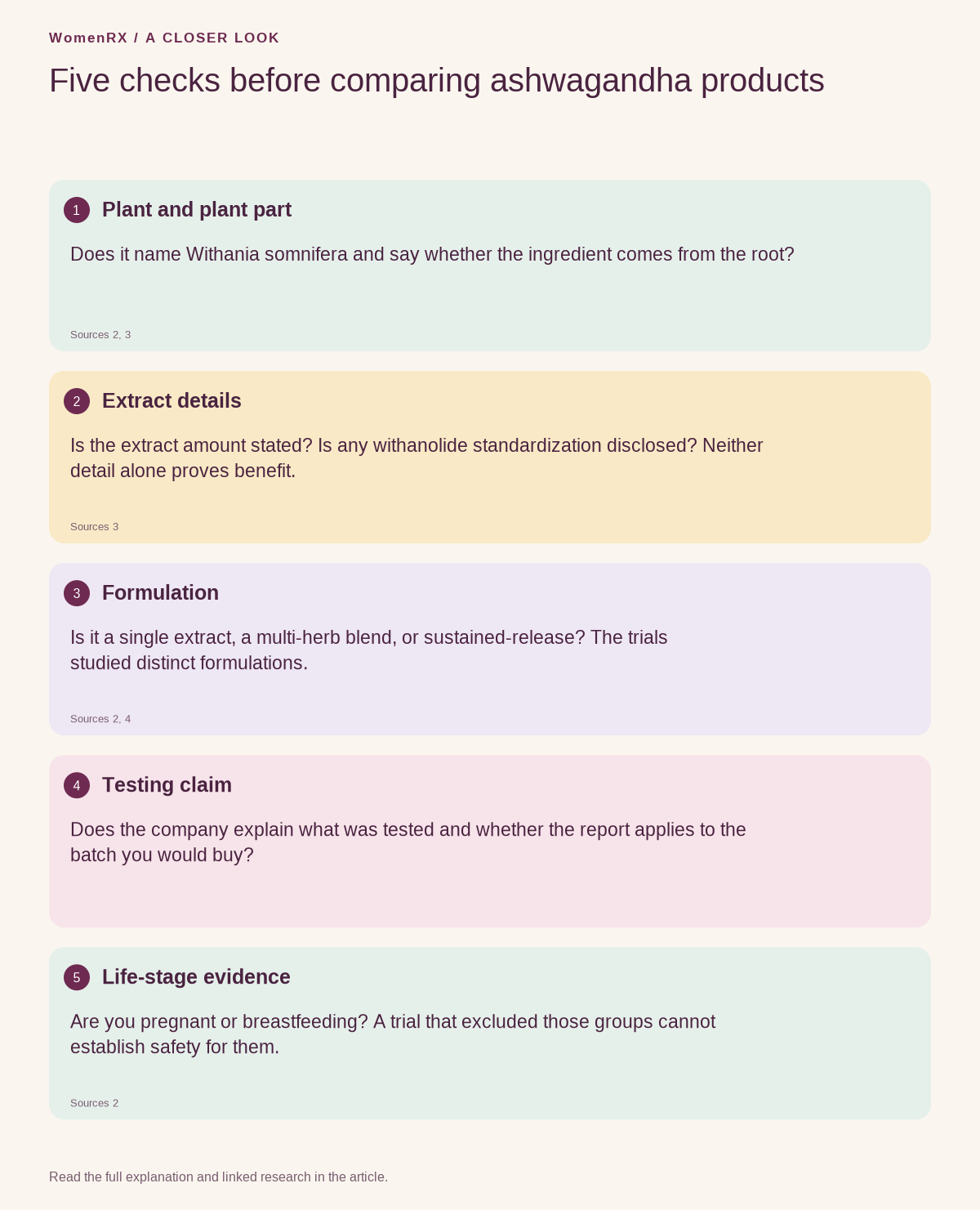
Five checks before comparing ashwagandha products
Plant and plant part: Does it name Withania somnifera and say whether the ingredient comes from the root?23
Extract details: Is the extract amount stated? Is any withanolide standardization disclosed? Neither detail alone proves benefit.3
Formulation: Is it a single extract, a multi-herb blend, or sustained-release? The trials studied distinct formulations.24
Testing claim: Does the company explain what was tested and whether the report applies to the batch you would buy?
Life-stage evidence: Are you pregnant or breastfeeding? A trial that excluded those groups cannot establish safety for them.2
Read the figure as text
Use these questions to see whether a label gives you a meaningful match to research and addresses your safety concerns.- Plant and plant part: Does it name Withania somnifera and say whether the ingredient comes from the root?23
- Extract details: Is the extract amount stated? Is any withanolide standardization disclosed? Neither detail alone proves benefit.3
- Formulation: Is it a single extract, a multi-herb blend, or sustained-release? The trials studied distinct formulations.24
- Testing claim: Does the company explain what was tested and whether the report applies to the batch you would buy?
- Life-stage evidence: Are you pregnant or breastfeeding? A trial that excluded those groups cannot establish safety for them.2
More questions, answered
Does more withanolides mean a better supplement?
Not necessarily. A withanolide percentage describes an extract, but the studies tested specific formulations. They don’t establish that a higher percentage produces better outcomes across products. 23
Sources you can check
- Safety of 8-Week Administration With Ashwagandha (Withania somnifera) Root Extract in Adults With Stress and Anxiety: Findings From a Prospective, Randomized, Multi-Center, Double-Blinded, Placebo-Controlled Study.Pakhale K, Salve J, Ademola J, Parraca J, Langade D. · Phytotherapy research : PTR · 2026Return to first citation
- A proprietary herbal extract of ashwagandha root for stress and anxiety in healthy adults: a randomized, double-blind, three-arm, placebo-controlled efficacy and safety study.West RE, Biswas A, Rao R, Tayade H, Ademola J. · Journal of medicine and life · 2026Return to first citation
- Efficacy and safety of Ashwagandha (Withania somnifera) root extract on stress and weight management in adults: a prospective, randomized, double-blind, placebo-controlled study.Pakhale K, Pakhale R, Srivathsan M, Langade J, Langade D. · Journal of medicine and life · 2025Return to first citation
- Efficacy and safety of Ashwagandha root extract sustained-release (AshwaSR) capsules in healthy adult, stressed subjects: A randomized, double-blind, placebo-controlled, parallel-group, 3-arm clinical trial.Thanawala S, Shah R, Alluri KV, Bhupathiraju K, Desomayanandanam P, Bhuvenendran A. · Medicine · 2026Return to first citation
- Ashwagandha (Withania somnifera)-Associated Liver Injury: A Scoping Review of Clinical Characteristics and Safety Considerations.McIntyre D, Nguyen P, Kim Y, Meyer B, Salloum M. · Cureus · 2026Return to first citation
- A prospective, randomized, double-blind, placebo-controlled study on efficacy and safety of Ashwagandha root extract (Withania somnifera) for managing menopausal symptoms in women.Vani I, Muralidhar G, Rao BS. · Frontiers in reproductive health · 2025Return to first citation