Peptides or Menopause Hormone Therapy? Match Treatment to the Goal
Hormone therapy has established uses for menopause symptoms, while “peptides” can refer to very different treatments with very different evidence.
These aren’t interchangeable treatment categories. Menopausal hormone therapy (MHT) is an evidence-supported option for bothersome hot flashes and night sweats, and for certain genitourinary symptoms. “Peptides” is too broad a label to judge on its own. If the term means an incretin medicine for obesity, that addresses a different clinical question, and menopause-specific evidence remains limited. 1 3

Start with the problem you want treated
There isn’t one meaningful contest between “peptides” and menopause hormone therapy (MHT). MHT has evidence for specific menopause-related symptoms. “Peptide” is a broad label, not a single treatment with one purpose or evidence base. To assess a product, you need its exact name and the condition it’s intended to treat.
For hot flashes and night sweats, MHT remains the most effective treatment. It can also help with genitourinary symptoms of menopause, such as vaginal or urinary symptoms. Its benefits and risks vary with factors including the type of hormones, dose, route, duration, timing of starting treatment, and whether a progestogen is used. It isn’t a universal choice: for people younger than 60 or within 10 years of menopause onset who have no contraindications, the benefit-risk balance is generally favorable for bothersome vasomotor symptoms and prevention of bone loss. 1
If “peptide” means an incretin medicine
One specific group that may come up in midlife weight discussions is incretin-based treatment, including GLP-1 receptor agonists and dual incretin therapies. A menopause-focused position statement discusses these in the context of overweight or obesity and related cardiometabolic and functional health concerns. That is a different treatment question from easing hot flashes or vaginal symptoms.
The menopause-specific evidence is still limited. The position statement describes semaglutide as having the most direct menopause-specific evidence among these medicines, but says that evidence is largely observational. It also describes a reported association between using MHT alongside semaglutide and greater weight loss as hypothesis-generating, not a reason to start MHT for weight loss. 3
That distinction is useful when a treatment pitch bundles several promises together. Ask which specific symptom or diagnosis a treatment is meant to address, and look for evidence for that treatment in people with that same concern. Evidence about obesity treatment does not establish that a medicine treats menopause symptoms, and evidence about MHT for menopause symptoms does not make it a weight-loss treatment.
Match the choice to the symptom
If hot flashes or night sweats are the main concern, ask whether MHT is appropriate for your circumstances. If it isn’t a good fit, or you prefer not to use it, there are nonhormonal options with evidence for vasomotor symptoms. The Menopause Society’s nonhormone statement recommends options including cognitive behavioral therapy, clinical hypnosis, certain prescription medicines, and weight loss; the right alternative depends on the individual and the treatment goal. 2
If vaginal or urinary symptoms are the main concern, the question may not be whether to use systemic MHT. For bothersome genitourinary symptoms not relieved by over-the-counter therapies, guidance includes low-dose vaginal estrogen or other options, depending on the person’s situation. 1
If weight or obesity-related health is the concern, discuss that as its own treatment question. Incretin-based therapies are considered in menopause-focused guidance for people with overweight or obesity, but evidence specific to menopause remains limited. The same guidance says the possible link between MHT use and greater semaglutide-related weight loss shouldn’t be used as a reason to start MHT solely to augment weight loss. 3
A practical way to evaluate a treatment pitch
Before comparing prices, testimonials, or the word “peptide,” pin down three things: the exact treatment, the condition it is meant to treat, and the human evidence for that treatment and condition. Then compare that evidence with established options for your particular symptom. If a pitch claims one product will treat menopause symptoms, change body composition, and improve long-term health all at once, those claims need to be assessed separately. A treatment’s name or mechanism alone doesn’t show that it works for each promised outcome.
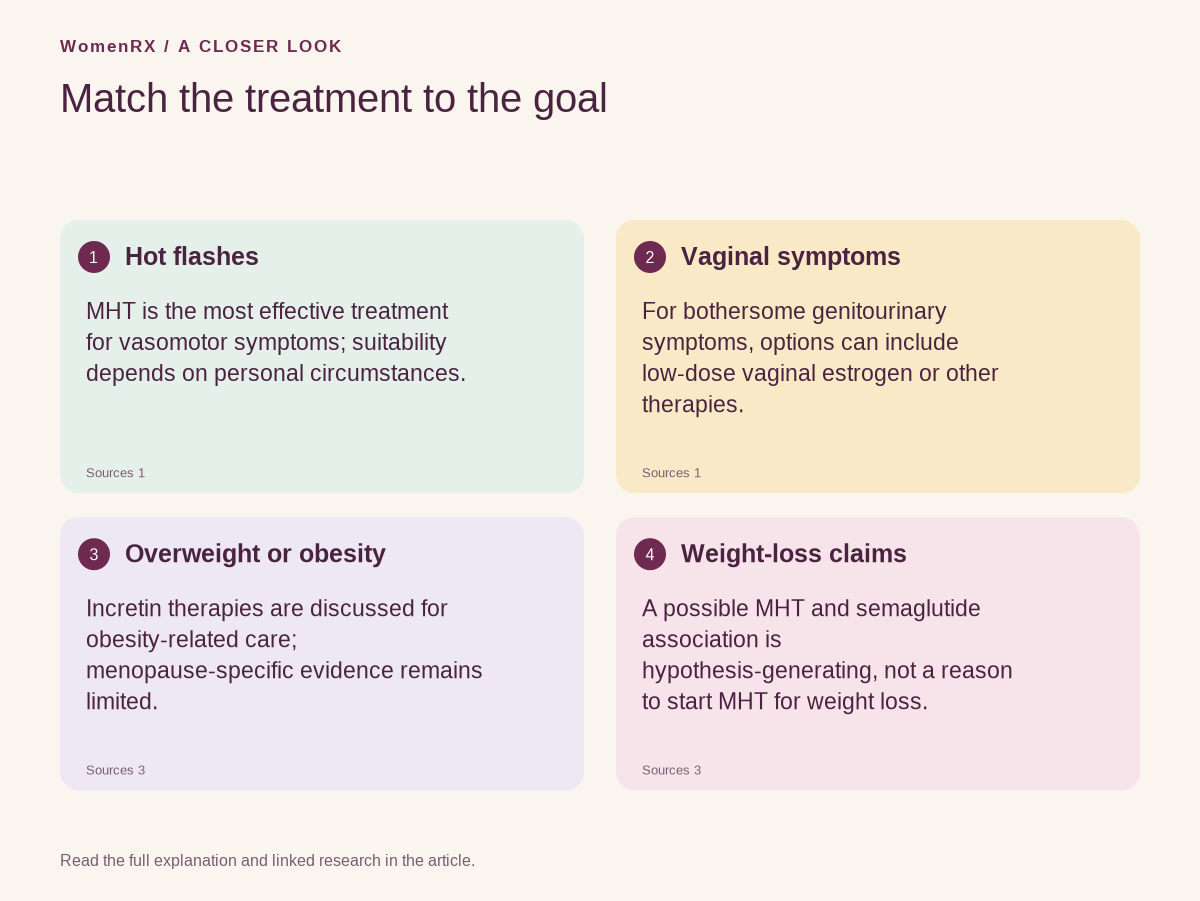
Match the treatment to the goal
Hot flashes: MHT is the most effective treatment for vasomotor symptoms; suitability depends on personal circumstances.1
Vaginal symptoms: For bothersome genitourinary symptoms, options can include low-dose vaginal estrogen or other therapies.1
Overweight or obesity: Incretin therapies are discussed for obesity-related care; menopause-specific evidence remains limited.3
Weight-loss claims: A possible MHT and semaglutide association is hypothesis-generating, not a reason to start MHT for weight loss.3
Read the figure as text
The word “peptide” doesn’t identify one treatment or purpose. Start with the symptom or diagnosis, then check what the evidence supports.- Hot flashes: MHT is the most effective treatment for vasomotor symptoms; suitability depends on personal circumstances.1
- Vaginal symptoms: For bothersome genitourinary symptoms, options can include low-dose vaginal estrogen or other therapies.1
- Overweight or obesity: Incretin therapies are discussed for obesity-related care; menopause-specific evidence remains limited.3
- Weight-loss claims: A possible MHT and semaglutide association is hypothesis-generating, not a reason to start MHT for weight loss.3
More questions, answered
Can an incretin medicine replace MHT for hot flashes?
The menopause-focused evidence summarized here discusses incretin-based therapies in relation to overweight or obesity and related health concerns, not as established treatment for hot flashes. MHT remains the most effective treatment for vasomotor symptoms. 1 3
Is MHT a weight-loss treatment?
The evidence cited here does not support starting MHT solely to increase weight loss. A reported association between MHT use and greater semaglutide-related weight loss is considered hypothesis-generating, not a reason to start MHT for that purpose. 3
Sources you can check
- The 2022 hormone therapy position statement of The North American Menopause Society.“The 2022 Hormone Therapy Position Statement of The North American Menopause Society” Advisory Panel. · Menopause (New York, N.Y.) · 2022Return to first citation
- The 2023 nonhormone therapy position statement of The North American Menopause Society.Menopause (New York, N.Y.) · 2023Return to first citation
- Incretin-based therapies in peri- and postmenopausal women with obesity: an expert position statement from the Spanish Menopause Society.Sánchez-Prieto M, Romero-Domínguez M, Orozco R, Lilue M, Lubián-López DM, González SP, Nieto A, Coronado P, Sánchez-Borrego R, Cano A, Castelo-Branco C, Palacios S, Young Investiga... · Maturitas · 2026Return to first citation