Menopause Symptoms: Match Treatment to the Problem
Hot flashes, disrupted sleep, and vaginal dryness can call for different options, and your health history helps shape the choice.
For hot flashes and night sweats, menopausal hormone therapy is the most effective treatment; several nonhormonal options are also supported. Vaginal moisturizers, lubricants, and local vaginal estrogen target vaginal dryness, not hot flashes or sleep problems. The best fit depends on which symptoms you want to address, your health history, and where you are in the menopause transition. 3 5 6
Begin with the symptom you want to ease
Menopause symptoms don’t all respond to the same treatment. A treatment for hot flashes may not help vaginal dryness, and a local vaginal treatment won’t relieve hot flashes. You might have both kinds of symptoms, so more than one treatment category may be worth discussing. 3 5
Irregular periods can happen just before menopause, but not every change in sleep, mood, or vaginal comfort is necessarily caused by menopause. Vaginal dryness, for example, can also be related to some medicines, pregnancy or breastfeeding, or conditions such as diabetes and Sjögren’s syndrome. 1 2
Hot flashes and night sweats
Menopausal hormone therapy (MHT) is the most effective treatment for hot flashes and night sweats, also called vasomotor symptoms. For women with bothersome symptoms who are younger than 60 or within 10 years of menopause onset, and who have no contraindications, the benefit-risk balance is generally favorable. It appears less favorable when treatment starts after age 60 or more than 10 years after menopause begins. Timing and health history matter, and the balance should be revisited over time. 5
If you prefer not to use hormone therapy, or it isn’t a suitable option for you, evidence-supported nonhormonal treatments include cognitive behavioral therapy, clinical hypnosis, and certain prescription medicines. Weight loss is also listed as an option in the menopause society’s statement. These are not interchangeable choices, and what fits depends on your circumstances. Supplements and herbal remedies, yoga, acupuncture, and cooling techniques are among the approaches the same statement does not recommend for treating vasomotor symptoms. 6
Sleep disruption: look for what’s waking you
If hot flashes or night sweats are waking you, it may make sense to discuss treatment for those symptoms. Vaginal estrogen is local treatment for vaginal dryness and irritation; it does not treat hot flashes or insomnia. 3 5
When sleep trouble isn’t tied to night sweats, don’t assume a menopause treatment aimed at another symptom will solve it. The options listed for vasomotor symptoms aren’t the same as evidence for treating insomnia on its own. Regular exercise may help sleep, and reducing caffeine or alcohol may help some people, but neither point establishes a specific treatment for persistent insomnia. 4 6
Vaginal dryness or irritation
A vaginal moisturizer can help with ongoing dryness, while a water-based lubricant can be used during sex. If those options aren’t enough, low-dose vaginal estrogen is a local treatment for dryness and irritation. It is distinct from systemic hormone therapy: little of the local medicine reaches the rest of the body, and the cited guidance says it does not require added progestogen. It will not treat hot flashes or sleep problems. 2 3
For bothersome vaginal symptoms that haven’t improved with over-the-counter options, low-dose vaginal estrogen or other treatments may be considered when systemic hormone therapy isn’t otherwise indicated. If you have a history such as an estrogen-dependent cancer or cardiovascular disease, that can change which hormone and nonhormone options are appropriate; those choices need to be individualized. 5 6
When a symptom deserves assessment
Don’t automatically attribute unusual vaginal discharge or bleeding after sex or after menopause to menopause. These are reasons to seek assessment. Irregular periods can occur just before menopause, but a new bleeding pattern still needs to be considered in context. 1 2
A practical starting point is to name the symptom affecting you most, whether it seems linked to night sweats or vaginal discomfort, and any treatments you’ve already tried. If several symptoms are affecting you, discuss them separately: for example, a systemic option might be considered for hot flashes, while a local or nonhormonal option could be considered for vaginal symptoms. That’s a way to frame the choices, not a combination that suits everyone. 3 5 6
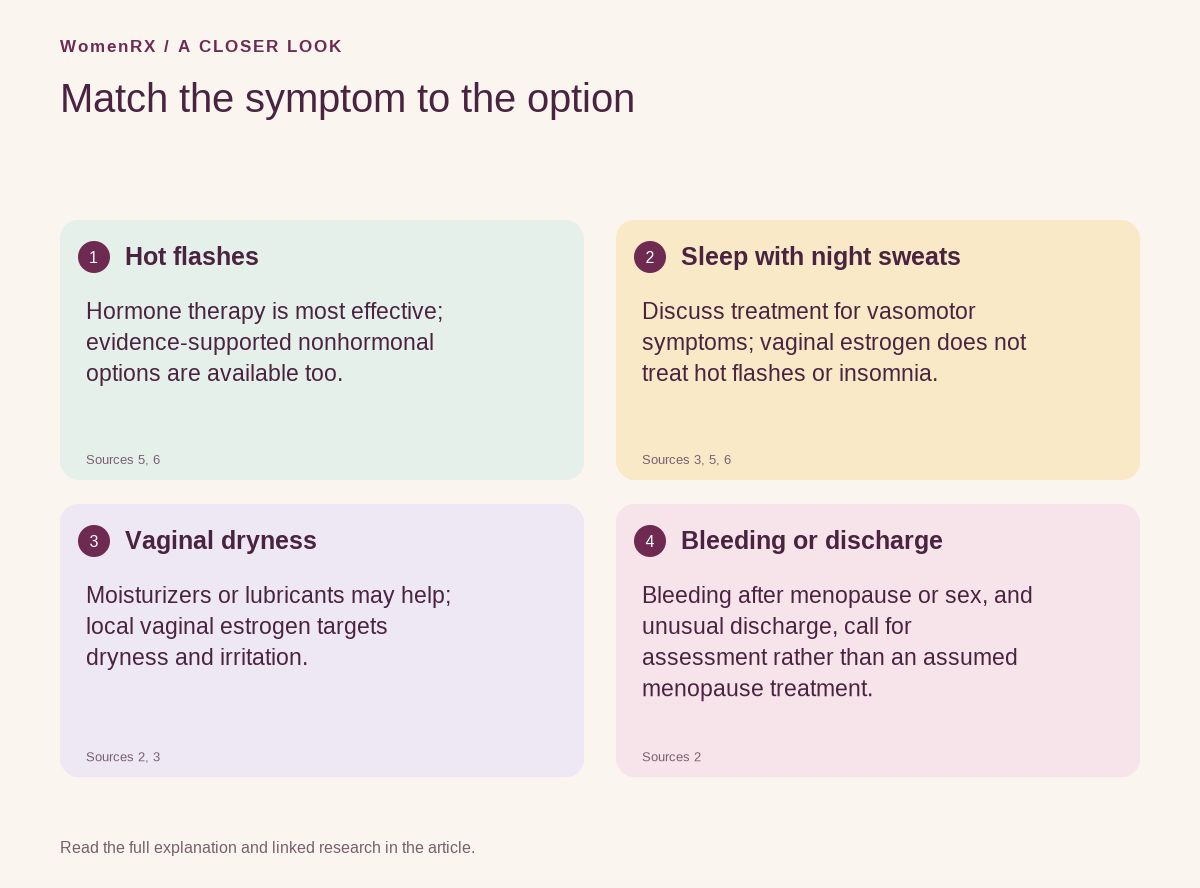
Match the symptom to the option
Hot flashes: Hormone therapy is most effective; evidence-supported nonhormonal options are available too.56
Sleep with night sweats: Discuss treatment for vasomotor symptoms; vaginal estrogen does not treat hot flashes or insomnia.356
Vaginal dryness: Moisturizers or lubricants may help; local vaginal estrogen targets dryness and irritation.23
Bleeding or discharge: Bleeding after menopause or sex, and unusual discharge, call for assessment rather than an assumed menopause treatment.2
Read the figure as text
These treatment categories have different targets. The right conversation depends on the symptom and your health history.- Hot flashes: Hormone therapy is most effective; evidence-supported nonhormonal options are available too.56
- Sleep with night sweats: Discuss treatment for vasomotor symptoms; vaginal estrogen does not treat hot flashes or insomnia.356
- Vaginal dryness: Moisturizers or lubricants may help; local vaginal estrogen targets dryness and irritation.23
- Bleeding or discharge: Bleeding after menopause or sex, and unusual discharge, call for assessment rather than an assumed menopause treatment.2
More questions, answered
Can vaginal estrogen help hot flashes?
No. Vaginal estrogen is a local treatment for vaginal dryness and irritation; it does not treat hot flashes or insomnia. 3
Are supplements a proven alternative for hot flashes?
The North American Menopause Society’s 2023 position statement does not recommend supplements or herbal remedies for menopause-related vasomotor symptoms. 6
Sources you can check
- Period problems - NHSAccessed 2026-09-25Return to first citation
- Vaginal dryness - NHSAccessed 2026-09-25Return to first citation
- About vaginal oestrogen - NHSAccessed 2026-09-25Return to first citation
- Common questions about vaginal oestrogen - NHSAccessed 2026-09-25Return to first citation
- The 2022 hormone therapy position statement of The North American Menopause Society.“The 2022 Hormone Therapy Position Statement of The North American Menopause Society” Advisory Panel. · Menopause (New York, N.Y.) · 2022Return to first citation
- The 2023 nonhormone therapy position statement of The North American Menopause Society.Menopause (New York, N.Y.) · 2023Return to first citation