How to Sort Peptide Product Claims Before You Buy
A peptide’s name doesn’t tell you whether the product being offered is an approved medicine, a compounded preparation, or an unapproved online product.
Some peptide medicines are FDA-approved, but approval belongs to a particular finished product and its labeled uses, not to every preparation with the same ingredient name. Compounded drugs are not FDA-approved. Get the exact product name, formulation, intended use, and dispensing pharmacy to sort out what’s being offered. If an approval claim remains unclear, ask FDA’s CDER Division of Drug Information about the named finished product and claimed use. 12
Start with the product, not the peptide name
“Peptide” describes a type of molecule. It doesn’t tell you a product’s approval status. For example, Saxenda’s prescribing information identifies liraglutide as an analog of the peptide hormone GLP-1. That document specifies the Saxenda injection, how it’s administered, and the people and uses covered by its labeling. A different preparation containing a familiar ingredient name doesn’t inherit those product details or that labeling. 1
That distinction matters beyond GLP-1 medicines. A clinic might name a peptide in an advertisement without telling you whether it plans to provide an approved finished medicine, a preparation made by a compounder, or a product sold directly online. Ask for the exact finished product name, formulation, route of administration, intended use, and dispensing pharmacy. If the answer is only an ingredient name, you still don’t know the product’s status. 125
What each status tells you
An FDA-approved medicine has product-specific prescribing information. Saxenda, for instance, is labeled as a prefilled liraglutide injection for long-term weight management in specified groups, alongside diet and physical activity. Its labeling also describes warnings and what is known about use during pregnancy and breastfeeding. Those details belong to Saxenda; they aren’t a blanket endorsement of other liraglutide preparations, different routes, or uses outside its labeling. 1
A compounded preparation is a different finished drug, even if its ingredient name sounds familiar. FDA says compounded drugs are not FDA-approved and are not reviewed by the agency for safety, effectiveness, or quality before marketing. Compounding also has rules about which bulk substances can be used. For compounding by state-licensed pharmacists or physicians under section 503A, FDA describes qualifying sources for bulk substances and a separate, conditional interim policy for certain nominated substances. Being nominated or covered by an interim policy is not FDA approval of an ingredient or a finished product. 26
For compounded GLP-1 drugs specifically, FDA says a version might be appropriate if a patient’s medical need cannot be met by an FDA-approved drug or the approved drug is not commercially available. FDA has also reported dosing errors involving compounded semaglutide injections, including some cases requiring hospitalization. That is a concern documented for those products, not evidence that every compounded peptide has the same dosing problem. 2
A product marketed online without FDA approval isn’t made trustworthy by a scientific-sounding name or a polished website. FDA has warned about unapproved GLP-1 products sold directly to consumers under labels such as “for research purposes” or “not for human consumption,” sometimes alongside dosing instructions for people. FDA also warns that unsafe online sellers may supply counterfeit medicines or products with the wrong amount of active ingredient. Those warnings provide concrete examples of why a marketing claim cannot establish what is in a package. 23
A peptide on an FDA compounding list isn’t an approved product
If a seller points to an FDA list as proof that a peptide is “approved,” look closely at what the list actually says. FDA’s page on bulk substances that may present significant safety risks names several peptides and specifies different compounding categories and, in some entries, particular routes. For example, its entry for injectable GHK-Cu describes potential risks associated with that route; it does not approve a GHK-Cu injection. The page also identifies concerns about compounded BPC-157, including limited safety-related information for proposed routes. Neither entry verifies the contents, quality, or legal status of a product someone offers you. 5
The distinction between lists matters too. FDA describes a 503A interim category for some nominated bulk substances that may be eligible for further evaluation, subject to conditions. Its safety-risk page also identifies substances under 503B categories. A category designation, a nomination, or an ingredient’s appearance on one of these pages is not a final approval for a peptide medicine. Ask about the actual finished preparation rather than treating a list entry as a product certificate. 56
Separate the medicine check from the seller check
Ask the seller or clinic to put the product details in writing: What is the finished product called? Is it an FDA-approved product or a compounded drug? Which pharmacy will dispense it? If the answer is “it’s the same as” an approved brand, ask whether you’re actually receiving that brand. FDA identifies claims that a compounded GLP-1 drug is the same as an FDA-approved drug as a telehealth warning sign. 2
For a named product such as Saxenda, its prescribing information on DailyMed lets you compare the offered name, formulation, route, and intended use with that product’s labeling. A matching description does not authenticate what a seller will send, and Saxenda’s labeling cannot establish approval for a different product. 13
A seller’s description helps identify the offer, not verify approval. Ask the dispensing pharmacist whether the prescription calls for a named approved finished drug or a compounded preparation. If the approval claim remains unclear, contact FDA’s CDER Division of Drug Information at druginfo@fda.hhs.gov or 855-543-3784. Give the exact product name, formulation, route, and claimed use, and ask whether that finished product is approved for that use. Leave its status unconfirmed until clarified; confirmation of approval still cannot authenticate what an online seller sends. 123
If a pharmacy is involved, check its license through your state board of pharmacy. FDA says a safer online pharmacy requires a prescription, provides a US address and phone number, has a licensed pharmacist available, and is licensed by a state board. That check helps you assess the seller. It does not turn a compounded drug into an approved one or confirm approval of an arbitrary product. 342
Be especially cautious if a site offers a prescription medicine without a prescription, won’t identify a dispensing pharmacy, or describes an injectable product as “research only” while telling you how to use it. Those are reasons to stop and clarify the offer before buying. FDA’s documented “research only” examples concern specific unapproved GLP-1 products; the broader check is whether the seller can identify what it is supplying and who is dispensing it. 23
Pregnancy, breastfeeding, and fertility plans change the question
Don’t apply one peptide product’s reproductive-health information to another. As a concrete example, Saxenda’s label says to discontinue it when pregnancy is recognized; for breastfeeding, it says there are no data on liraglutide in human milk or its effects on a breastfed infant or milk production. These are Saxenda-specific statements, not rules for every peptide medicine. 1
If you’re pregnant, breastfeeding, or planning fertility care, bring the exact product name and proposed use to the prescriber involved in that care before starting it. The useful question is not simply “Are peptides safe?” It’s “What does this particular medicine’s labeling say, and what changes if the product being offered is compounded rather than the approved medicine?” 12
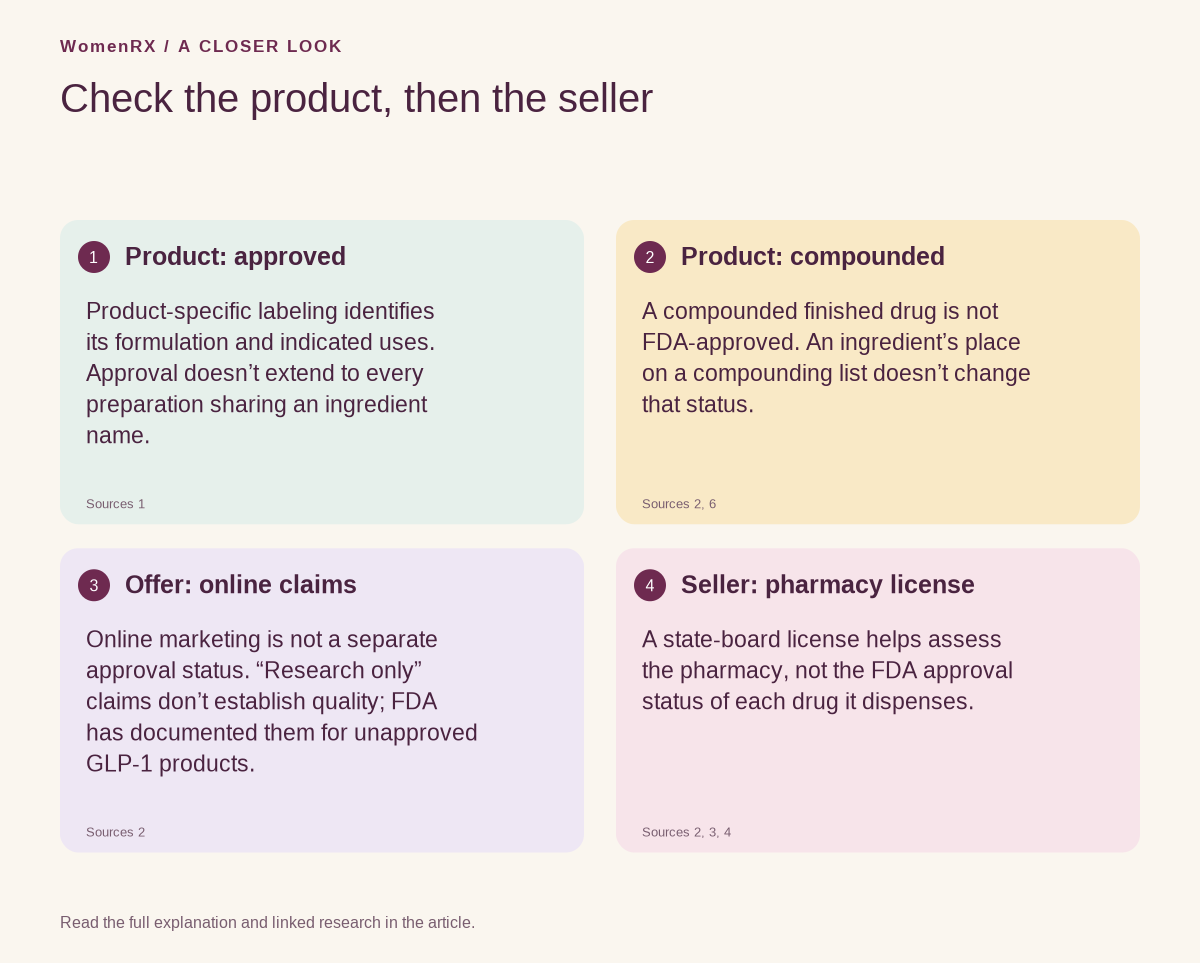
Check the product, then the seller
Product: approved: Product-specific labeling identifies its formulation and indicated uses. Approval doesn’t extend to every preparation sharing an ingredient name.1
Product: compounded: A compounded finished drug is not FDA-approved. An ingredient’s place on a compounding list doesn’t change that status.26
Offer: online claims: Online marketing is not a separate approval status. “Research only” claims don’t establish quality; FDA has documented them for unapproved GLP-1 products.2
Seller: pharmacy license: A state-board license helps assess the pharmacy, not the FDA approval status of each drug it dispenses.234
Read the figure as text
Product status, online marketing, and seller licensing are different checks. They can overlap: a compounded drug is not FDA-approved and may also be offered online.- Product: approved: Product-specific labeling identifies its formulation and indicated uses. Approval doesn’t extend to every preparation sharing an ingredient name.1
- Product: compounded: A compounded finished drug is not FDA-approved. An ingredient’s place on a compounding list doesn’t change that status.26
- Offer: online claims: Online marketing is not a separate approval status. “Research only” claims don’t establish quality; FDA has documented them for unapproved GLP-1 products.2
- Seller: pharmacy license: A state-board license helps assess the pharmacy, not the FDA approval status of each drug it dispenses.234
More questions, answered
Does a prescription mean my peptide product is FDA-approved?
No. A prescription can be written for a compounded drug, and compounded drugs are not FDA-approved. Ask whether it names an approved finished product or a preparation that will be compounded for you. The prescription alone does not verify approval. If the status remains unclear, ask FDA’s CDER Division of Drug Information about the named product. 2
Does an FDA compounding-list entry approve the peptide I’m being sold?
No. FDA’s bulk-substance pages address compounding conditions or potential safety risks, sometimes for specific routes. A listing does not approve a finished drug or verify what a particular seller has supplied. 56
Sources you can check
- SAXENDA (LIRAGLUTIDE) INJECTION, SOLUTION [NOVO NORDISK PHARMACEUTICAL INDUSTRIES, LP] | US prescribing information and patient instructionsAccessed 2026-09-25Return to first citation
- FDA’s Concerns with Unapproved GLP-1 Drugs Used for Weight Loss | FDAAccessed 2026-09-25Return to first citation
- How to Buy Medicines Safely From an Online Pharmacy | FDAAccessed 2026-09-25Return to first citation
- BeSafeRx: Resources for Consumers | FDAAccessed 2026-09-25Return to first citation
- Certain Bulk Drug Substances for Use in Compounding that May Present Significant Safety Risks | FDAAccessed 2026-09-26Return to first citation
- Bulk Drug Substances Used in Compounding Under Section 503A of the FD&C Act | FDAAccessed 2026-09-26Return to first citation