How to Vet an Online Peptide Prescription
Online care can include prescriptions, but a trustworthy offer should make the clinical assessment, exact medicine, pharmacy, and follow-up plan clear.
Yes, a clinician can prescribe medicine through telehealth.1 Before accepting an online “peptide” offer, find out what condition is being treated, which exact product you’d receive, who is prescribing it, which pharmacy will supply it, and who will handle questions or side effects. A prescription does not make a compounded incretin product FDA-approved.5
Start with the condition, not the word “peptide”
“Peptide” describes a broad type of molecule, not a treatment plan. An offer for semaglutide or tirzepatide for weight management raises different questions from an offer for an unnamed “wellness peptide.” Ask for the medicine’s exact name and the condition the clinician proposes to treat before you pay or agree to a prescription.
Online prescribing itself isn’t the warning sign. Telehealth can include prescriptions, though a clinician who isn’t your usual provider may not have your full medical history.1 What matters is whether the person prescribing has enough information to judge whether this particular medicine makes sense for you.
For example, the American College of Physicians’ weight-management guideline addresses nonpregnant adults with specified weight-related conditions. It calls for a discussion of benefits, harms, other health conditions, warnings, goals, preferences, costs, and access when considering medication. That’s a more useful model for assessing a weight-loss offer than a storefront that moves straight from a short quiz to checkout.8
Five questions to ask before accepting the offer
1. What assessment happens before a prescription? Ask what the clinician needs to know about your health conditions, current medicines, and treatment goals, and how you can clarify an answer that doesn’t fit a form. A video visit isn’t automatically more thorough than a message-based exchange. The useful distinction is whether someone reviews your information and can discuss why this treatment is appropriate for you. Telehealth can work for prescribing, but gaps in medical history are a recognized limitation.18
2. Who is making the prescribing decision? Ask for the prescriber’s name and role, whether you can speak with them about the recommendation, and who takes responsibility if the medicine needs to be reconsidered. Ask what information that prescriber will review before making the decision. If a service won’t identify who is making the decision, you can’t have an informed discussion about that decision.
3. What exactly will the pharmacy send? Get the product name and the dispensing pharmacy’s name before accepting an offer. Ask whether you’re being offered an FDA-approved manufactured medicine or a compounded preparation. These aren’t interchangeable descriptions: compounded incretin medicines do not undergo FDA approval, even when a clinician prescribes them. The American College of Clinical Pharmacy’s Endocrine and Metabolism Practice and Research Network recommends helping patients obtain approved medicines when possible and, if a patient chooses a compounded incretin, using a reputable compounding pharmacy and monitoring its safety and effectiveness.5
4. Why this product rather than an approved option? This is especially worth asking if an ad uses a familiar drug name but the checkout page says “compounded.” FDA-approved semaglutide products exist, while compounded semaglutide products have different regulatory status and may present quality and dosing concerns. Compounding can meet a need, but a prescription does not, by itself, resolve questions about the preparation’s quality or dosing.45
5. What happens after the medicine arrives? Ask how to report side effects, who reviews your response, and how to reach the prescribing team if something changes. This isn’t just customer service: the same practice and research network specifically recommends routine safety and effectiveness monitoring for people who choose compounded incretin medicines.5 For tirzepatide products, prescribing information describes potentially severe gastrointestinal reactions and identifies persistent or severe abdominal pain, sometimes spreading to the back, as a possible sign of pancreatitis that needs prompt medical assessment.23
Make the assessment reflect your life
If you’re pregnant, breastfeeding, or planning to conceive, say so before a GLP-1 or related weight-management medicine is selected.67 The ACP guideline’s medication recommendations cited here are for nonpregnant adults, and a women’s-health review identifies contraception and preconception planning as relevant to GLP-1 and related medicines.86 Tell the prescriber about your current medicines, including any hormone treatments, so they have a complete history. That disclosure is not a claim that every hormone treatment interacts with every peptide drug; the exact product and your circumstances determine what needs discussing.1
A useful final test is whether you can explain the offer in one sentence: “This clinician assessed me for this condition and prescribed this named product, supplied by this pharmacy, with this plan for questions and follow-up.” If one of those pieces remains vague, ask for it before deciding. An online visit can be legitimate care; a polished checkout page is not, by itself, evidence of an appropriate assessment or an approved product.15
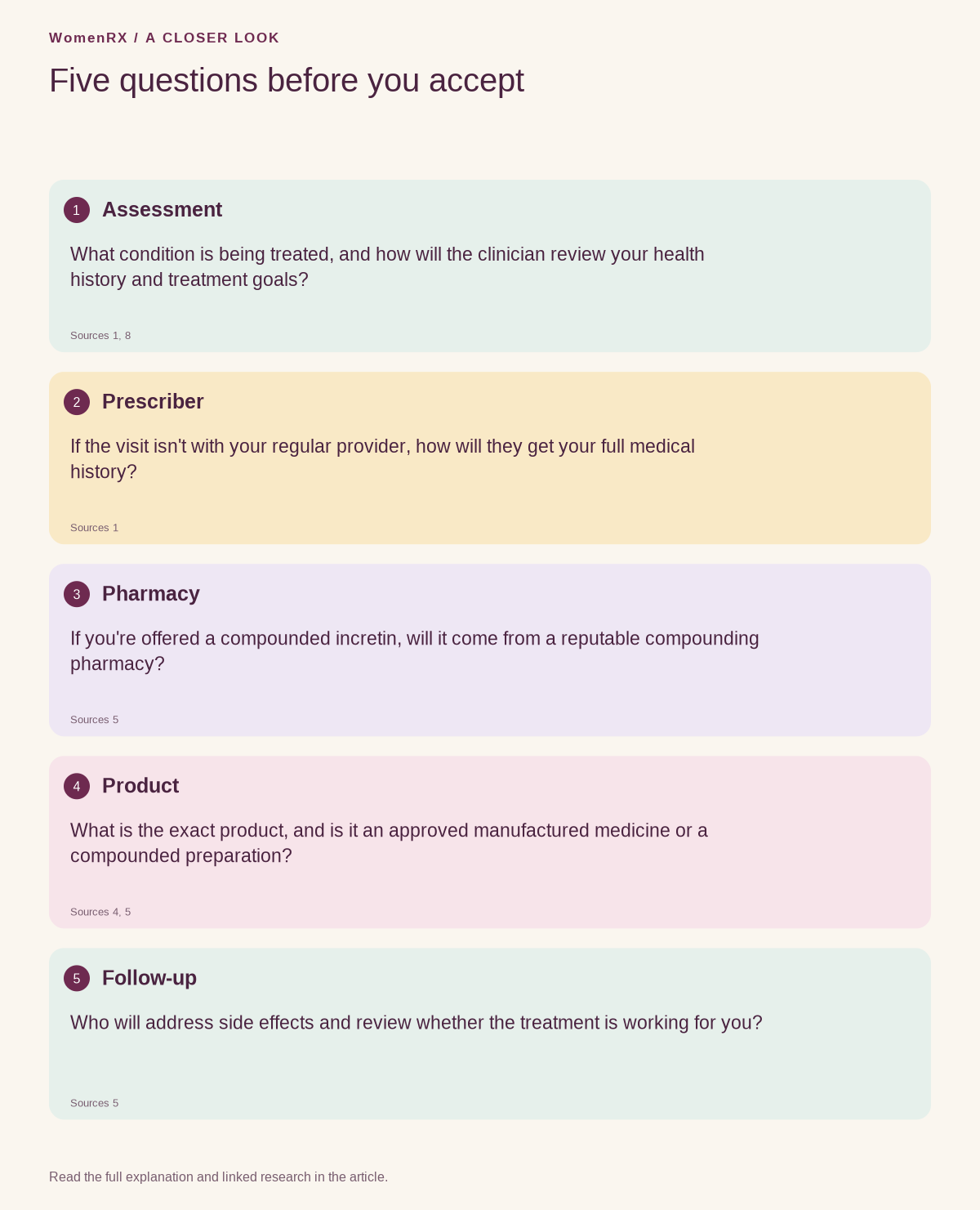
Five questions before you accept
Assessment: What condition is being treated, and how will the clinician review your health history and treatment goals?18
Prescriber: If the visit isn't with your regular provider, how will they get your full medical history?1
Pharmacy: If you're offered a compounded incretin, will it come from a reputable compounding pharmacy?5
Product: What is the exact product, and is it an approved manufactured medicine or a compounded preparation?45
Follow-up: Who will address side effects and review whether the treatment is working for you?5
Read the figure as text
Use these questions to make an online medicine offer specific enough to evaluate; they are not a credential-verification test.- Assessment: What condition is being treated, and how will the clinician review your health history and treatment goals?18
- Prescriber: If the visit isn't with your regular provider, how will they get your full medical history?1
- Pharmacy: If you're offered a compounded incretin, will it come from a reputable compounding pharmacy?5
- Product: What is the exact product, and is it an approved manufactured medicine or a compounded preparation?45
- Follow-up: Who will address side effects and review whether the treatment is working for you?5
More questions, answered
Does a prescription mean a compounded incretin product is FDA-approved?
No. A clinician may prescribe a compounded incretin medicine, but compounded incretin products do not undergo FDA approval. Ask whether the offer is for an approved manufactured product or a compounded preparation.5
Is every online clinic offering compounded medication illegitimate?
No. Telehealth can include prescribing, and compounding can meet a patient need. The questions are whether your treatment is appropriately assessed, the product is clearly identified, and there’s a plan to monitor safety and response.145
Sources you can check
- Telehealth: MedlinePlusAccessed 2026-09-25Return to first citation
- ZEPBOUND (TIRZEPATIDE) INJECTION, SOLUTION ZEPBOUND (TIRZEPATIDE) INJECTION, SOLUTION ZEPBOUND KWIKPEN (TIRZEPATIDE) INJECTION, SOLUTION [ELI LILLY AND COMPANY] | US prescribing information and patient instructionsAccessed 2026-09-25Return to first citation
- MOUNJARO (TIRZEPATIDE) INJECTION, SOLUTION MOUNJARO KWIKPEN (TIRZEPATIDE) INJECTION, SOLUTION [ELI LILLY AND COMPANY] | US prescribing information and patient instructionsAccessed 2026-09-25Return to first citation
- Navigating compounded semaglutide: what health care providers need to know.Liu G, Jarema M, Mo M, Stievater T. · The American journal of managed care · 2025Return to first citation
- Compounded incretins in clinical practice: An opinion of the endocrine and metabolism practice and research network of the American College of Clinical Pharmacy.Courtney LA, Clements JN, Isaacs D, Pitlick JM, Reece SM, Whitley HP. · Diabetes & metabolic syndrome · 2025Return to first citation
- What obgyns need to know about GLP-1 receptor agonists.Chauhan I. · Current opinion in obstetrics & gynecology · 2026Return to first citation
- GLP-1 Receptor Agonists and Fertility: What Is Known So Far?Becker AS, Castilhos JP, Shugair SAS, Colombo T, Hentschke M-. · JBRA assisted reproduction · 2026Return to first citation
- Pharmacologic Treatments With Lifestyle Modifications in Nonpregnant Adults With Overweight or Obesity in Outpatient Settings: A Living Clinical Guideline From the American College of Physicians (April 2026).Qaseem A, Cross JT, Harrod CS, Owens DK, Balk EM, Crandall CJ, Clinical Guidelines Committee of the American College of Physicians, Fitterman N, Gibson M, Lewis J, Mackey K, Miller... · Annals of internal medicine · 2026Return to first citation