How to Choose an Online Therapist Who Fits
The right online therapy option offers the kind of care you need, with qualifications and practical arrangements you can check before booking.
Start with what you want help with, then find out whether the service offers live sessions with a clinician or a different kind of digital support. 2 Ask for the therapist’s credentials, experience with your concern, and approach to treatment. Before booking, check the ongoing cost, privacy arrangements, accessibility options, and what happens if you need urgent help between sessions.

Choosing online therapy isn’t just choosing a video platform. You’re choosing a person, a kind of care, and a way of meeting that needs to work in your life. A short round of questions before you book can prevent a frustrating mismatch.
Find out what you’re signing up for
Online mental health services can include live teletherapy, web-based interventions, or digital tools. These are different forms of support, even when they appear in the same search results. If you want psychotherapy with a clinician, ask whether you’ll have individual appointments, who will provide them, and whether you’ll see the same person each time. 2
Next, describe what you want help with in your own words. You don’t need to arrive knowing the name of a therapy method. You can ask, “How do you usually work with someone dealing with this?” and “What would our sessions involve?” A specific answer is more useful than a long list of specialties on a profile.
Check the clinician behind the profile
Ask for the therapist’s full name, professional credential, licensing jurisdiction, and license number, if applicable. Ask where you can independently check that the credential is current and whether they can provide care while you’re in the location where you’ll attend sessions. A platform profile is a starting point, not a substitute for knowing who will treat you.
If a service can’t tell you who your clinician will be or how to verify their credentials, pause before paying or sharing sensitive information. You can also ask whether the person answering your messages is the therapist you’ll meet, another member of the care team, or automated support.
Look for fit beyond a list of specialties
The first conversation should give you room to explain your goals and ask how you’ll work together. In a review of adult therapy by video or telephone, the quality of the therapeutic relationship had a small, variable association with mental health outcomes. That doesn’t mean an easy first conversation guarantees results. It does make it reasonable to notice whether you feel heard, can ask questions, and can agree on what you’re working toward. 3
Some needs call for more pointed questions. If you’re pregnant or postpartum, ask about experience with the concern bringing you in, rather than assuming that listing “women’s issues” means perinatal expertise. For example, interpersonal psychotherapy has been studied for postpartum depression: a review of nine randomized trials involving 1,269 women found lower symptom scores than routine care over follow-up periods ranging from four weeks to nine months postpartum. That finding is about the treatment approach, not proof that every online version works the same way. 1
If trauma-informed care matters to you, you might ask, “How do you work with trauma without asking me to share more than I’m ready to?” If you want care that respects your identity, relationships, or family structure, ask how the therapist approaches experiences they may not share. You’re looking for an answer that tells you what working together would actually feel like.
Compare the details that affect whether you can keep going
Cost: What does each session cost after any introductory offer? Are there other fees? Ask what insurance arrangements or paperwork are available and what you’d owe for a missed or canceled session. Compare the likely ongoing cost, not just the first appointment.
Privacy: What tools are used for video and messages? Are sessions recorded? Who can access your messages and records, and what limits to confidentiality will the therapist explain? Consider whether you have a place where you can speak freely; if not, ask what other session formats are offered.
Accessibility: Do the appointment times and technology work for you? Ask about phone sessions, captions, interpretation, or other access needs rather than assuming a service provides them.
Help between sessions: How soon should you expect a reply to a message? What should you do if your symptoms worsen or you need urgent help? Ask what support the service actually provides outside appointments. A messaging feature doesn’t, by itself, tell you that someone is watching it in real time.
Let the first session be a two-way check
You can use the first appointment to ask: “What would working on my main concern look like?” “How will we tell whether this is helping?” “What happens if the approach or online format isn’t working for me?”
You don’t have to feel completely comfortable right away. But you should be able to understand the proposed plan, ask about its limits, and raise a concern without being brushed off. If the care, cost, privacy arrangements, or format don’t fit, you can ask about a different approach or keep looking.
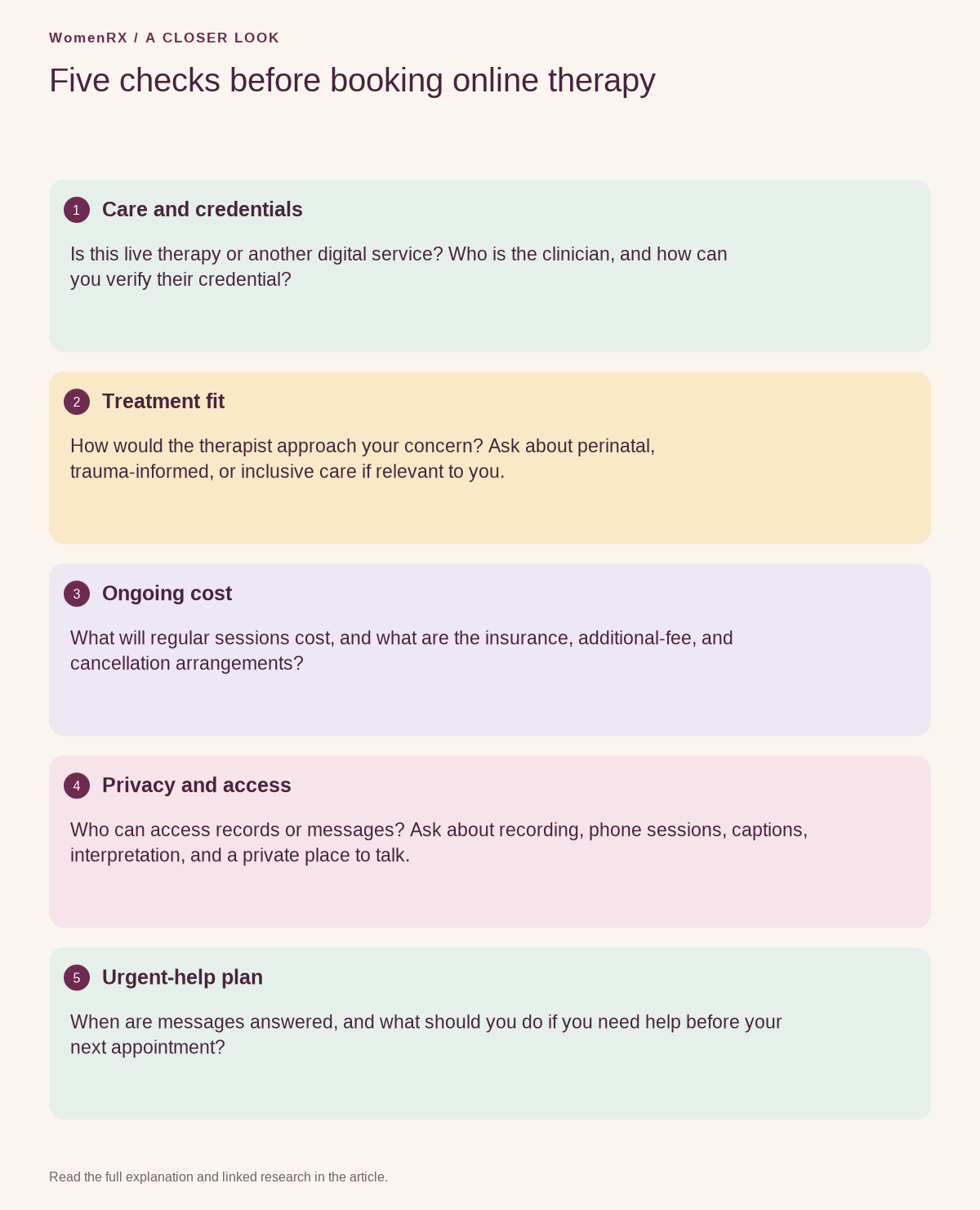
Five checks before booking online therapy
Care and credentials: Is this live therapy or another digital service? Who is the clinician, and how can you verify their credential?
Treatment fit: How would the therapist approach your concern? Ask about perinatal, trauma-informed, or inclusive care if relevant to you.
Ongoing cost: What will regular sessions cost, and what are the insurance, additional-fee, and cancellation arrangements?
Privacy and access: Who can access records or messages? Ask about recording, phone sessions, captions, interpretation, and a private place to talk.
Urgent-help plan: When are messages answered, and what should you do if you need help before your next appointment?
Read the figure as text
Use these questions to compare what each service actually offers.- Care and credentials: Is this live therapy or another digital service? Who is the clinician, and how can you verify their credential?
- Treatment fit: How would the therapist approach your concern? Ask about perinatal, trauma-informed, or inclusive care if relevant to you.
- Ongoing cost: What will regular sessions cost, and what are the insurance, additional-fee, and cancellation arrangements?
- Privacy and access: Who can access records or messages? Ask about recording, phone sessions, captions, interpretation, and a private place to talk.
- Urgent-help plan: When are messages answered, and what should you do if you need help before your next appointment?
More questions, answered
Does a good connection mean online therapy will work for me?
A good working relationship matters, but it isn’t a guarantee. A review of adult video and telephone therapy found a small association between the therapeutic relationship and outcomes, with substantial variation among studies. Ask how you and the therapist will review your progress, not only whether the first conversation feels comfortable. 3
Sources you can check
- Effects of interpersonal psychotherapy on postpartum depression: A systematic review and meta-analysis of randomised controlled trials.Uncu B, Doğan E. · Journal of psychiatric research · 2026Return to first citation
- Next-Generation Cognitive-Behavioral Therapy for Depression: Integrating Digital Tools, Teletherapy, and Personalization for Enhanced Mental Health Outcomes.Gkintoni E, Vassilopoulos SP, Nikolaou G. · Medicina (Kaunas, Lithuania) · 2025Return to first citation
- The association between quality of therapeutic alliance and treatment outcomes in teletherapy: A systematic review and meta-analysis.Aafjes-van Doorn K, Spina DS, Horne SJ, Békés V. · Clinical psychology review · 2024Return to first citation