How to Get a Prescription Online Safely
Before you proceed, check that a clinician will assess your situation, review your medicines, explain follow-up, and clarify where the prescription is going.
An online prescription isn’t automatically safe or unsafe. Look for a clinical assessment that fits your situation, a review of your current medicines, a clear way to get follow-up, and an identifiable pharmacy destination. The format matters less than whether the service can respond to concerns and direct you to another kind of care when remote prescribing isn’t a good fit.

Start with the assessment, not the approval
An online form can collect useful information. The question is what happens after you submit it. Find out whether a clinician reviews your answers, whether you can clarify something the form doesn’t capture, and what the service does if your symptoms or health history call for a different approach.
A video visit isn’t automatically more thorough than a questionnaire, and a questionnaire isn’t automatically inadequate. A systematic review of asynchronous consultations in general practice found that these consultations were used for diagnosis and prescribing, but safety and equity were poorly reported across the included studies. The evidence was varied, so the format alone can’t tell you whether a particular service has assessed your needs well. 3
A useful question is: “If my information raises a concern, who will contact me, and what happens next?” You’re looking for a way to pause the prescription, ask for clarification, or be directed to care that can assess you more fully.
Make sure your medicines are part of the conversation
Share a current list of the medicines you take, including recent changes. If the service can’t see your medical record, ask how it gathers the information it needs and whether a clinician will review it for possible interactions or adjustments. If you’re pregnant, breastfeeding, trying to conceive, or using contraception, include that information when it could affect a medicine decision. Ask directly whether it changes the options being considered.
The importance of this review depends on the medicine. In one U.S. medical-center program for telemedicine prescribing of nirmatrelvir/ritonavir for COVID-19, 78.8% of 457 patients needed at least one medication adjustment, and 44.6% needed two or more. That drug has particular interaction challenges, so these figures don’t describe online prescribing in general. They do illustrate why a clinician may need to review other medicines and explain any changes clearly. 2
In interviews with 16 U.S. mental-health providers, participants described access to relevant health information and working within their expertise as conditions for feeling comfortable prescribing remotely. Those are provider-reported views, not proof that any particular service or process produces better patient outcomes. 4
Ask what follow-up actually looks like
Before accepting a prescription, find out whom to contact if you have a question, your symptoms change, or you’re unsure what the instructions mean. Also ask what would lead the service to recommend another kind of evaluation. A service may not need the same follow-up for every prescription, but it should be able to explain its plan for your situation.
For example, in the nirmatrelvir/ritonavir program, patients received follow-up calls to check how their illness was progressing and ask about reported adverse reactions. That describes one program for one medication, not a requirement for every online prescription. 2
Trace the pharmacy handoff
Ask which pharmacy will receive the prescription and how you’ll know it was sent. Find out whom to contact if the pharmacy hasn’t received it, has a question, or gives you instructions that don’t match what you were told. That last step matters: providers interviewed about U.S. telemedicine prescribing reported e-prescription workflow frustrations and pharmacy miscommunication. In the nirmatrelvir/ritonavir program, the authors also noted that pharmacies may not have all the health information needed to explain medication changes. 2 4
When the prescription is filled, read the label and instructions. A rapid review of remote primary care found electronic-prescribing incidents involving incorrect labels or instructions and errors in dose, strength, or frequency. These were incidents associated with electronic prescriptions, not evidence that telemedicine itself caused them. The review identified no studies reporting medication-safety incidents associated with telemedicine and called for more research. 1
Four questions to ask before you proceed
- Who reviews my information? Can you clarify an answer or ask a question before a decision is made?
- Will my medicines be checked? How will the clinician learn about your current medicines and consider possible interactions or changes?
- What happens if I need more care? Who will contact you, and how can you reach the service after the prescription?
- Where is the prescription going? Which pharmacy will receive it, and whom should you contact if it doesn’t arrive or the instructions are unclear?
These questions aren’t a validated safety score, and they can’t guarantee that every prescription is right for you. They can help you tell whether there’s a clinical process behind the online interaction, rather than approval without a clear assessment or next step.
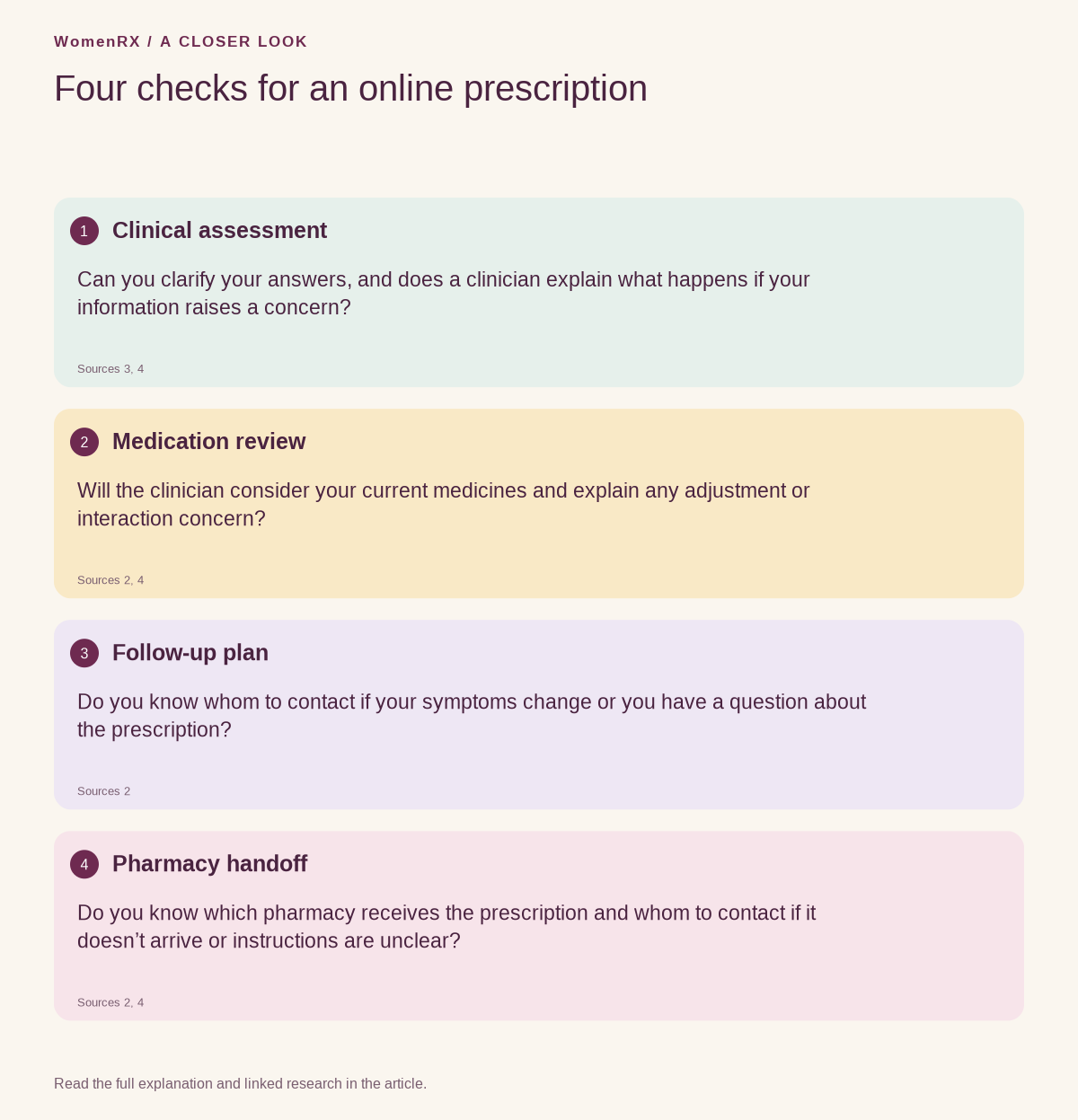
Four checks for an online prescription
Clinical assessment: Can you clarify your answers, and does a clinician explain what happens if your information raises a concern?34
Medication review: Will the clinician consider your current medicines and explain any adjustment or interaction concern?24
Follow-up plan: Do you know whom to contact if your symptoms change or you have a question about the prescription?2
Pharmacy handoff: Do you know which pharmacy receives the prescription and whom to contact if it doesn’t arrive or instructions are unclear?24
Read the figure as text
Use these questions to check whether the service explains the care process behind its online prescribing.- Clinical assessment: Can you clarify your answers, and does a clinician explain what happens if your information raises a concern?34
- Medication review: Will the clinician consider your current medicines and explain any adjustment or interaction concern?24
- Follow-up plan: Do you know whom to contact if your symptoms change or you have a question about the prescription?2
- Pharmacy handoff: Do you know which pharmacy receives the prescription and whom to contact if it doesn’t arrive or instructions are unclear?24
More questions, answered
Is an online questionnaire enough to prescribe safely?
A questionnaire can be part of an assessment, and asynchronous consultations have been used for prescribing in general practice. But research on their safety was poorly reported and varied, so the format alone doesn’t show whether a specific service’s assessment is adequate. Ask how a clinician reviews your answers and what happens if something needs clarification. 3
Sources you can check
- Medication safety incidents associated with the remote delivery of primary care: a rapid review.Gleeson LL, Clyne B, Barlow JW, Ryan B, Murphy P, Wallace E, De Brún A, Mellon L, Hanratty M, Ennis M, Holton A, Pate M, Kirke C, Flood M, Moriarty F. · The International journal of pharmacy practice · 2022Return to first citation
- Telemedicine for Prescribing Nirmatrelvir/Ritonavir: Safety, Logistics, and Challenges.Liebenstein T, Mailig M, Crnich CJ, Balasubramanian P. · Open forum infectious diseases · 2024Return to first citation
- Effectiveness and safety of asynchronous telemedicine consultations in general practice: a systematic review.Leighton C, Cooper A, Porter A, Edwards A, Joseph-Williams N. · BJGP open · 2024Return to first citation
- Mental Health Providers' Challenges and Solutions in Prescribing Over Telemedicine: Content Analysis of Semistructured Interviews.Ivanova J, Cummins MR, Soni H, Ong T, Bunnell BE, López E, Welch BM. · JMIR human factors · 2025Return to first citation