How to Check an Online Prescribing Service
Before you share health information or pay, find out who assesses you, how they make prescribing decisions, and what support follows.
A legitimate-looking website isn’t proof of good care. Before proceeding, identify the clinician who may prescribe and check their credentials with the relevant official licensing body. Ask how your health information will be assessed, whether remote care is suitable for your concern, which pharmacy fills prescriptions, and how you can get follow-up. If pregnancy, breastfeeding, or contraception could matter, ask how that information is considered.
Start with the care process
Online care can make it easier to reach a clinician, but the prescription is only one step. Before sharing sensitive information or paying, look for a clear explanation of who reviews your situation, how they decide whether medication is appropriate, and what happens if you have questions afterward.
Treat testimonials, a polished website, and quick access as neither proof of safe care nor proof of unsafe care. Instead, use them as prompts to ask specific questions. A service should be able to explain its process in plain language.
Find out who makes the decision
Ask who will assess you, what their professional role is, and where they’re licensed. You can check the clinician’s name and license through the relevant official licensing body for the jurisdiction where care is provided. If you can’t find out who is responsible for the prescribing decision, or how to verify their credentials, pause before sharing more information.
Ask what the assessment includes. Will a clinician review your answers and medical history? Can they ask follow-up questions? How do they decide whether an online visit is enough, or whether you need an in-person examination or another type of care?
Remote care can be useful, but it doesn’t replace every part of an in-person assessment. In a survey of 251 Irish general practitioners and pharmacists about pandemic-era changes, respondents raised concerns that virtual consultations could miss physical examination findings and visual cues. That survey reflects clinicians’ perceptions in Irish primary care, not a measured risk rate for online prescribing services. 1 A review of telepsychiatry describes remote assessment, diagnosis, treatment recommendations, medication management, and follow-up as clinical functions, while also noting that telepsychiatry has limitations. It does not establish that every online service provides those functions well. 2
Ask what follow-up looks like
Before proceeding, find out how to contact the prescribing clinician with a medication question, what follow-up is available, and what happens if your symptoms change or the medication causes a problem. Ask whether the service can arrange another kind of assessment if remote care isn’t enough.
These aren’t just customer-service details. Medication care can depend on communication and monitoring after a prescription is sent. In the Irish survey, clinicians described monitoring and communication as challenges during changes to primary care delivery. The study asked about clinicians’ experiences; it didn’t test the safety of direct-to-consumer services. 1
A useful question is: “If I have a concern after the appointment, who will respond, and how?” If the answer is vague, or the service offers no clear route for follow-up, consider waiting before you commit.
Make the pharmacy step clear
Ask which pharmacy will fill the prescription, how it will receive it, and whom to contact if it doesn’t arrive or there’s a question about it. If you prefer to use a different pharmacy, ask whether that’s an option before paying.
Electronic prescription transfer is a practical link between a prescriber and a pharmacy. It doesn’t, by itself, tell you whether the clinical assessment was appropriate. A survey of Irish pharmacists and general practitioners described both communication benefits and workflow challenges with electronic prescription transfer during the pandemic. Those findings concern Irish primary care systems, not every online prescribing arrangement. 1
Include reproductive health when relevant
If pregnancy, trying to conceive, breastfeeding, or contraception could affect a medication decision, ask how the service collects and considers that information. You can ask whether the clinician will review it with you before making a decision, and how to share a change in your circumstances later. These are practical questions to raise when relevant; the right questions depend on the medication and your situation.
Notice when the answers don’t add up
Pause if a service promises a specific prescription before an assessment, won’t explain who is responsible for your care, or can’t describe how to reach the clinician afterward. Also ask for clarification if you can’t tell which pharmacy is involved or how your information is handled.
Concerns about privacy, self-diagnosis, and medication practices have been raised in a review of direct-to-consumer mental-health startups. That review focuses on mental-health services, so it can’t establish how other types of online prescribing services operate. It does underline why it’s worth distinguishing clinician-led care from a product that mainly sells access or convenience. 2
Before you proceed, see if you can answer four questions: Who assesses me? How will they decide what care is appropriate? Which pharmacy is involved? Who can I contact afterward? If a relevant answer is missing, ask before paying or sharing more information.
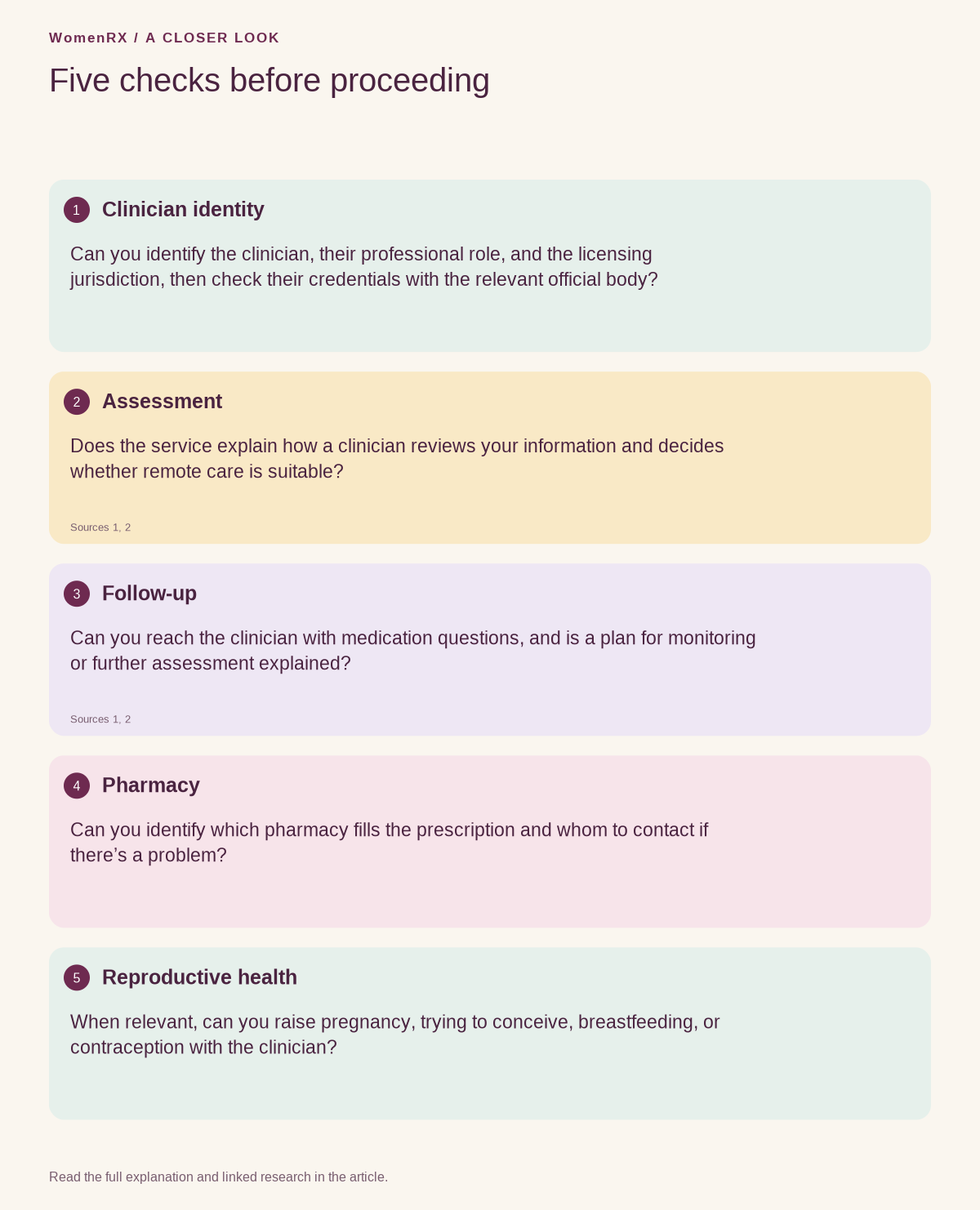
Five checks before proceeding
Clinician identity: Can you identify the clinician, their professional role, and the licensing jurisdiction, then check their credentials with the relevant official body?
Assessment: Does the service explain how a clinician reviews your information and decides whether remote care is suitable?12
Follow-up: Can you reach the clinician with medication questions, and is a plan for monitoring or further assessment explained?12
Pharmacy: Can you identify which pharmacy fills the prescription and whom to contact if there’s a problem?
Reproductive health: When relevant, can you raise pregnancy, trying to conceive, breastfeeding, or contraception with the clinician?
Read the figure as text
Use these questions to clarify who is responsible for care and what happens before and after a prescription decision.- Clinician identity: Can you identify the clinician, their professional role, and the licensing jurisdiction, then check their credentials with the relevant official body?
- Assessment: Does the service explain how a clinician reviews your information and decides whether remote care is suitable?12
- Follow-up: Can you reach the clinician with medication questions, and is a plan for monitoring or further assessment explained?12
- Pharmacy: Can you identify which pharmacy fills the prescription and whom to contact if there’s a problem?
- Reproductive health: When relevant, can you raise pregnancy, trying to conceive, breastfeeding, or contraception with the clinician?
Sources you can check
- Changes to primary care delivery during the COVID-19 pandemic and perceived impact on medication safety: A survey study.Gleeson LL, Ludlow A, Wallace E, Argent R, Collins C, Clyne B, Mellon L, Barlow JW, Ryan B, De Brún A, Holton A, Pate M, Kirke C, Flood M, Moriarty F. · Exploratory research in clinical and social pharmacy · 2022Return to first citation
- Telepsychiatry in an Era of Digital Mental Health Startups.Achtyes ED, Glenn T, Monteith S, Geddes JR, Whybrow PC, Martini J, Bauer M. · Current psychiatry reports · 2023Return to first citation