Brown or White Rice? A Practical Guide to Choosing
Brown rice offers more fiber, while white rice cooks faster in rice-milling research; the better choice for tonight depends on the meal and what you enjoy.
Brown rice retains bran and germ that further milling removes. In USDA reference data, 100 grams of cooked medium-grain brown rice has 1.8 grams of fiber, 2.32 grams of protein, and 23.5 grams of carbohydrate. The same weight of cooked, unenriched medium-grain white rice has 2.38 grams of protein and 28.6 grams of carbohydrate; its fiber amount isn’t reported in that entry. Choose with fiber, cooking time, and your preferences in mind. 3 4 6
What changes when rice is milled
Brown rice keeps its bran and germ; white rice has been milled further. 3 In a study of rice milling fractions, further milling reduced dietary fiber, cooking time, and measured texture characteristics including hardness. 4
Fiber adds bulk to your diet and supports digestion. If you’re adding more of it, do so gradually: increasing fiber too quickly can bring on gas, bloating, or cramps. Those effects can matter more to your choice than a nutrition label’s general advantage. 2
Compare the same cooked amount
For a like-for-like comparison, USDA reference data put 100 grams of cooked medium-grain brown rice at about 112 calories, 23.5 grams of carbohydrate, 2.32 grams of protein, and 1.8 grams of fiber. 100 grams of cooked, unenriched medium-grain white rice has about 130 calories, 28.6 grams of carbohydrate, and 2.38 grams of protein. These are equal weights of cooked rice, not suggested serving sizes. The white-rice entry doesn’t report fiber, so it can’t provide an exact gram-for-gram fiber difference; a missing value doesn’t mean zero. 6
For a familiar household measure, USDA estimates that one cup of cooked medium-grain brown rice weighs 195 grams and contains 3.5 grams of fiber, 45.8 grams of carbohydrate, 4.5 grams of protein, and about 218 calories. That’s a food-composition estimate, not a suggested portion or a measurement of every brown rice. 5
Protein is nearly the same in the two 100-gram reference amounts. If fiber is your reason for choosing brown rice, the more useful distinction is what milling does to the grain, not a claim that brown rice is a high-protein food or will cause weight loss. 4 6
Then look at the whole meal. Rice is only one part of it, and a grain choice doesn’t determine whether a meal is nourishing on its own. If brown rice’s extra fiber is welcome and you like its texture, it may be an easy whole-grain choice. If you prefer white rice, it can still fit into an everyday meal. You don’t have to treat one as the universally correct option.
If blood sugar or pregnancy affects your choice
For gestational diabetes, NHS guidance lists brown rice as one lower-glycemic starchy food example, alongside foods such as pulses and wholewheat pasta. It also recommends individualized meal-planning advice and blood-sugar monitoring. Brown rice is an option in that guidance, not a promise of a particular reading for you or a special rice rule for pregnancy as a whole. Outside gestational diabetes, this comparison is a general food choice, not a benefit specific to women. 1
A simple way to choose tonight
Choose brown rice when you want the less-milled grain and its extra fiber suits you. Choose white rice if you prefer it; check the package directions for the cooking time of either rice. If you’re increasing fiber, try the change gradually and pay attention to how your digestion feels. Either choice can be part of a typical meal; there’s no need to make the decision a test of willpower. 2 4
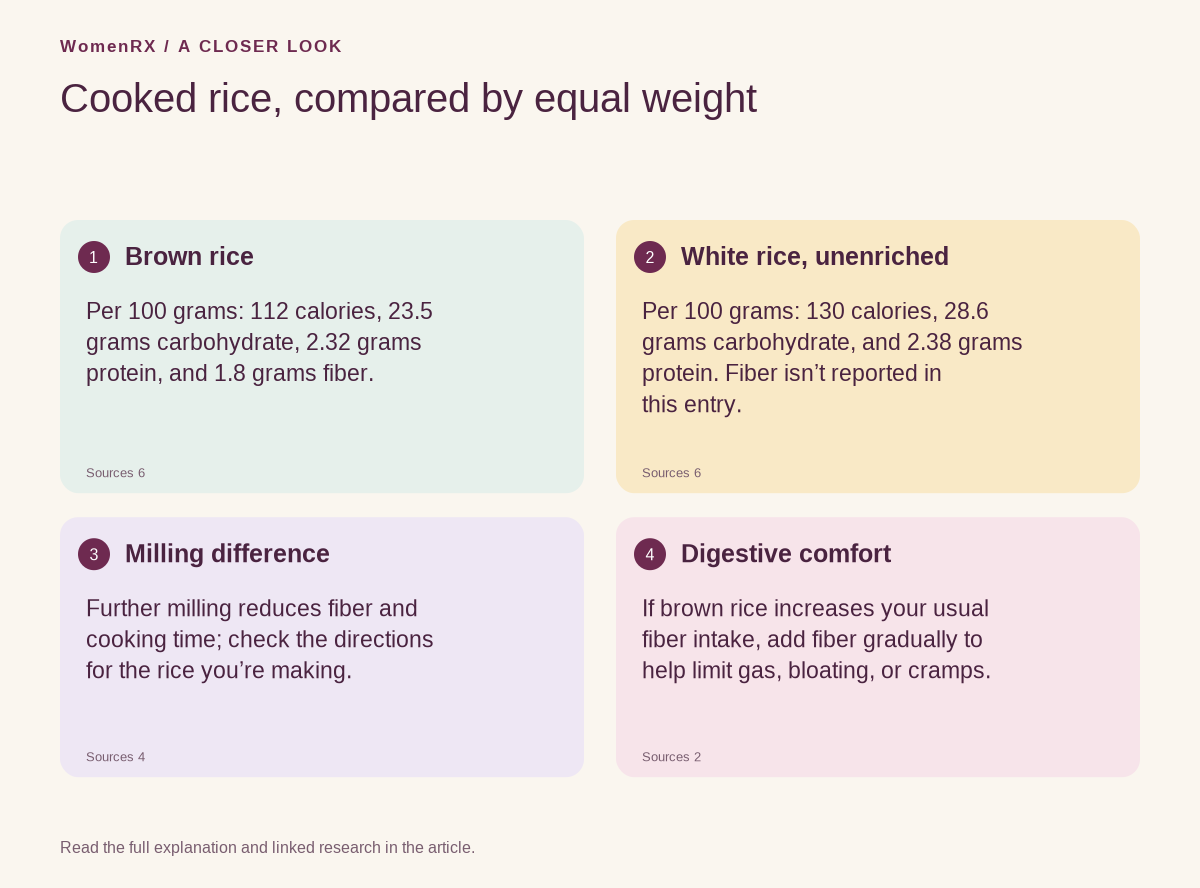
Cooked rice, compared by equal weight
Brown rice: Per 100 grams: 112 calories, 23.5 grams carbohydrate, 2.32 grams protein, and 1.8 grams fiber.6
White rice, unenriched: Per 100 grams: 130 calories, 28.6 grams carbohydrate, and 2.38 grams protein. Fiber isn’t reported in this entry.6
Milling difference: Further milling reduces fiber and cooking time; check the directions for the rice you’re making.4
Digestive comfort: If brown rice increases your usual fiber intake, add fiber gradually to help limit gas, bloating, or cramps.2
Read the figure as text
USDA reference amounts compare 100 grams of each cooked, medium-grain rice. Equal weights make the figures comparable; they aren’t recommended serving sizes.- Brown rice: Per 100 grams: 112 calories, 23.5 grams carbohydrate, 2.32 grams protein, and 1.8 grams fiber.6
- White rice, unenriched: Per 100 grams: 130 calories, 28.6 grams carbohydrate, and 2.38 grams protein. Fiber isn’t reported in this entry.6
- Milling difference: Further milling reduces fiber and cooking time; check the directions for the rice you’re making.4
- Digestive comfort: If brown rice increases your usual fiber intake, add fiber gradually to help limit gas, bloating, or cramps.2
More questions, answered
Does brown rice guarantee a smaller blood-sugar rise?
No. Gestational-diabetes guidance lists brown rice as a lower-glycemic food example, but that does not guarantee a specific response for every person or meal. If you have gestational diabetes, use the blood-sugar monitoring and meal plan recommended for you. 1
Is white rice a poor choice because it has less fiber?
Not necessarily. Milling reduces fiber, but that difference alone does not make white rice unsuitable for an everyday meal. Your preferred texture, the cooking directions for the rice you have, and the rest of the meal can all matter to your choice. 4
Sources you can check
- Gestational diabetes - Treatment - NHSAccessed 2026-09-25Return to first citation
- Dietary Fiber: MedlinePlusAccessed 2026-09-25Return to first citation
- Optimizing brown rice liquefaction and saccharification using response surface methodology for grain ethanol production.Jang SW, Yu HH, Kim JC, Jang M. · Scientific reports · 2026Return to first citation
- The impact of milling degree on physicochemical, nutritional, rheological, textural properties, and in vitro digestibility of rice: From brown rice to white rice.Yılmaz Tuncel N, Andac AE, Polat Kaya H, Tuncel NB. · Food chemistry · 2025Return to first citation
- USDA SR Legacy: Rice, brown, medium-grain, cooked (Includes foods for USDA's Food Distribution Program) (FDC 168875)Accessed 2026-09-25Return to first citation
- USDA SR Legacy: brown-rice reference food comparisonAccessed 2026-09-25Return to first citation