Can Cauliflower Replace Rice, and What Does It Provide?
Cauliflower can make a good vegetable base, but it brings much less carbohydrate to a meal than cooked rice.
Cauliflower can stand in for rice when you want a vegetable base, but that doesn’t make the two nutritionally interchangeable. A weighed 100 g portion of raw cauliflower contains 25 calories, 5 g carbohydrate, 2 g fiber, and 1.9 g protein.3 Cooked cauliflower and cooked white rice also differ substantially in energy and carbohydrate, so choose between them based on the meal you want, not the idea that one is a nutritional copy of the other.4
What cauliflower gives you
Cauliflower is a vegetable that can fill the space rice usually occupies on a plate. It contributes some fiber and a little protein, but it isn’t a concentrated protein food. For a simple reference point, 100 g of raw cauliflower has 25 calories, about 5 g carbohydrate, 2 g fiber, and 1.9 g protein. Those are weighed-food estimates, not values for a package of cauliflower rice or for cauliflower cooked with oil or sauce.3
Its fiber is a useful part of the picture. Fiber from vegetables and other plant foods helps digestion and can add fullness to a meal. That doesn’t establish cauliflower itself as a proven weight-loss food. And if a larger serving of vegetables is a big change for you, adding fiber gradually may be more comfortable than making the switch all at once.1
A side-by-side look at cooked cauliflower and rice
Preparation and portion matter here. The USDA reference for boiled, drained cauliflower without salt lists ½ cup of 1-inch pieces as 62 g. At that weight, it provides approximately 14 calories, 2.5 g carbohydrate, 1.4 g fiber, and 1.1 g protein. The reference for cooked, unenriched medium-grain white rice lists 1 cup as 186 g. At that weight, it provides approximately 242 calories, 53 g carbohydrate, and 4.4 g protein. The rice entry used here does not report a fiber value, so it cannot support a cup-to-cup fiber comparison.4
Those are two practical household measures, not equal-weight servings. Even at the same 100 g weight, the difference in meal role is clear: the cooked cauliflower reference has about 23 calories and 4.1 g carbohydrate, while the cooked white rice reference has 130 calories and 28.6 g carbohydrate. Their protein values are modest in both cases, at about 1.8 g and 2.4 g per 100 g, respectively.4
Boiled cauliflower pieces aren’t a measurement of riced cauliflower. Chopping the vegetable into rice-sized pieces can make it work in a similar place on the plate, but this comparison should not be read as a nutrition label for a particular recipe or product.4
Choose by what the meal needs
If you want a vegetable under a saucy main dish, cauliflower may suit that job. If rice is supplying a substantial share of the meal’s carbohydrate and energy, replacing it entirely with cauliflower changes the meal rather than simply changing its shape. You can also combine the two. For example, rice with cauliflower alongside it keeps the grain while adding a vegetable.4
Neither choice supplies much protein on its own. If you’re building a meal around cauliflower, think about the other foods on the plate rather than expecting the vegetable base to do every job. Beans or a dairy food, for example, can contribute protein; protein is needed to build and maintain muscles, bones, and skin.2
This comparison doesn’t turn into a special cauliflower rule during pregnancy, breastfeeding, or menopause. The food-composition figures describe foods, not benefits tested in women at any of those stages.34 During pregnancy, one practical distinction is food handling: wash fresh produce before preparing it, since unwashed vegetables are a food-safety risk.5 Otherwise, the useful question stays the same: does this meal need a vegetable base, a more substantial source of carbohydrate, or both?
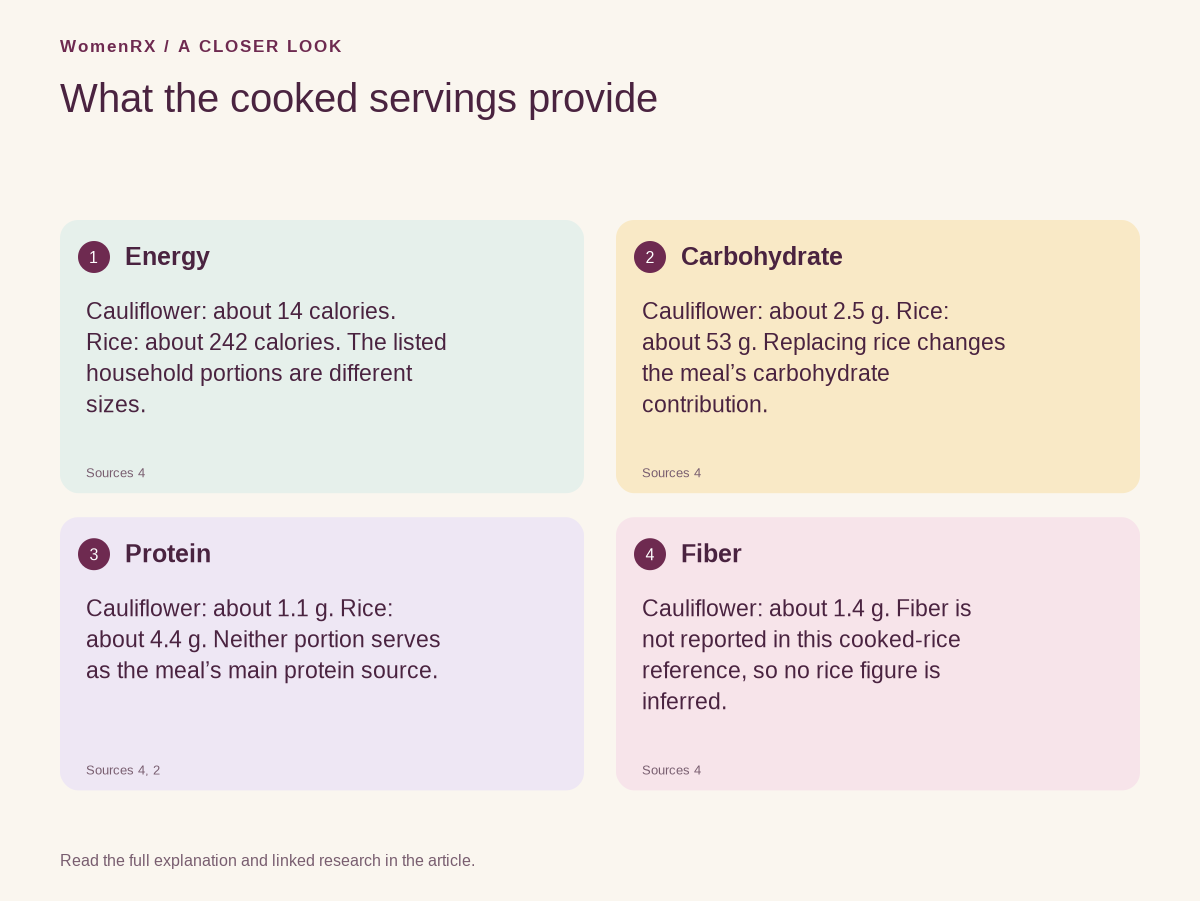
What the cooked servings provide
Energy: Cauliflower: about 14 calories. Rice: about 242 calories. The listed household portions are different sizes.4
Carbohydrate: Cauliflower: about 2.5 g. Rice: about 53 g. Replacing rice changes the meal’s carbohydrate contribution.4
Protein: Cauliflower: about 1.1 g. Rice: about 4.4 g. Neither portion serves as the meal’s main protein source.42
Fiber: Cauliflower: about 1.4 g. Fiber is not reported in this cooked-rice reference, so no rice figure is inferred.4
Read the figure as text
These USDA household measures describe different foods and different weights: ½ cup boiled cauliflower pieces (62 g) and 1 cup cooked white rice (186 g). They are not measurements of a cauliflower-rice product.- Energy: Cauliflower: about 14 calories. Rice: about 242 calories. The listed household portions are different sizes.4
- Carbohydrate: Cauliflower: about 2.5 g. Rice: about 53 g. Replacing rice changes the meal’s carbohydrate contribution.4
- Protein: Cauliflower: about 1.1 g. Rice: about 4.4 g. Neither portion serves as the meal’s main protein source.42
- Fiber: Cauliflower: about 1.4 g. Fiber is not reported in this cooked-rice reference, so no rice figure is inferred.4
More questions, answered
Is cauliflower rice a good source of protein?
Not on its own. The USDA reference lists about 1.8 g protein per 100 g of boiled, drained cauliflower. That figure describes cooked pieces, not a specific cauliflower-rice product. If protein is a priority for the meal, include another protein-containing food.42
Sources you can check
- Dietary Fiber: MedlinePlusAccessed 2026-09-25Return to first citation
- Dietary Proteins: MedlinePlusAccessed 2026-09-25Return to first citation
- USDA SR Legacy: Cauliflower, raw (FDC 169986)Accessed 2026-09-25Return to first citation
- USDA SR Legacy: cauliflower reference food comparisonAccessed 2026-09-25Return to first citation
- Safer Food Choices for Pregnant Women | Food Safety | CDCAccessed 2026-09-25Return to first citation