How Peas Fit Into a Weight-Management Meal
Green peas can be an easy addition to a satisfying meal, but weight-loss findings for dried pulses don’t tell us what green peas do on their own.
Yes. Green peas can be part of a weight-management meal. At the same cooked weight, they provide less fiber and protein than cooked split peas or lentils, so the best fit depends on whether you want a side or a meal base.4 Weight trials studied whole dried pulses as a group, not green peas specifically, and reported no women-specific estimate in the published abstract.3
The kind of pea matters
Picture two dinners: green peas alongside eggs and toast, or a bowl of split-pea soup. Both can fit your plans, but they’re different meal choices. Green peas might be one part of dinner; cooked split peas might form its base. That distinction matters when you read claims about peas and weight loss.
A review of randomized trials defined dietary pulses as dried, non-oil legume seeds, including dry peas, beans, lentils and chickpeas. It compared diets containing whole pulses with diets without a pulse intervention. The pooled estimate in its published abstract does not isolate green peas or split peas.3 So a finding about that pooled group isn’t a prediction of what will happen if you add green peas to dinner.
What the weight research actually found
Across 21 trials involving 940 participants, diets containing pulses were associated with an average 0.34 kg more weight loss than comparison diets without a pulse intervention. Median pulse intake was 132 g per day, and median trial length was six weeks. That’s a modest short-term difference across several foods and meal plans, not evidence that any pea dish burns fat.3
The published abstract gives no women-specific weight estimate. You don’t need a special claim about women’s metabolism to make use of peas as food, but the pooled average shouldn’t be presented as an effect demonstrated specifically in women.3
Build the meal, rather than betting on one ingredient
If you like green peas, try them in a meal that also has foods you find satisfying. For example, add them to a grain bowl with eggs, or serve them beside a sandwich instead of treating them as a weight-loss trick. If you prefer cooked split peas, a soup can make them the center of the meal. These are meal ideas, not combinations tested in the pulse trials.
Here’s a like-for-like food comparison. At an illustrative 150 g cooked weight, boiled green peas provide about 8.3 g fiber, 8.0 g protein and 126 calories. Boiled split peas, listed as mature seeds, provide about 12.5 g fiber, 12.5 g protein and 177 calories; boiled lentils provide about 11.9 g fiber, 13.5 g protein and 174 calories. These are generic USDA reference foods prepared without salt, not current branded-product labels or recommended portions. An equal-weight comparison helps show the tradeoff: the split peas and lentils bring more fiber and protein, as well as more calories, than the green peas in these records.4
Fiber adds bulk and can help you feel full sooner. Increase it gradually if you’re eating more than usual, since a quick increase can cause gas, bloating or cramps.1 Green peas can work as a side, while cooked split peas or lentils can form the base of a meal. How much of either nutrient you get still depends on the amount you eat and the rest of the dish.4
There’s also a difference between adding a food and using it in place of something else. A serving of peas added to an otherwise unchanged meal isn’t the same meal choice as replacing part of that meal with peas. Broader nutrition guidance supports flexible eating patterns that include vegetables and pulses, rather than relying on a single food for weight change.2 For green peas, that’s the practical takeaway: use them where they make a meal work better for you, without borrowing a weight-loss promise from research on dried pulses.
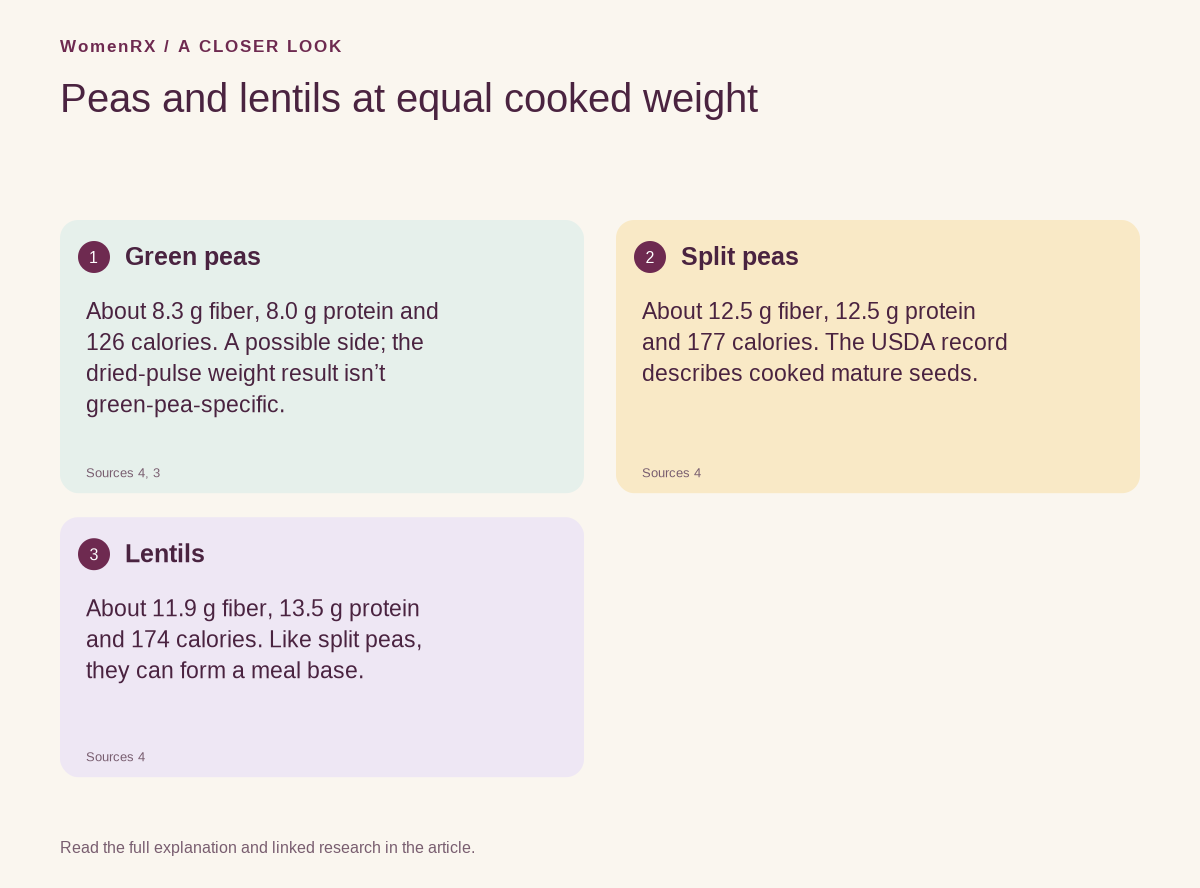
Peas and lentils at equal cooked weight
Green peas: About 8.3 g fiber, 8.0 g protein and 126 calories. A possible side; the dried-pulse weight result isn’t green-pea-specific.43
Split peas: About 12.5 g fiber, 12.5 g protein and 177 calories. The USDA record describes cooked mature seeds.4
Lentils: About 11.9 g fiber, 13.5 g protein and 174 calories. Like split peas, they can form a meal base.4
Read the figure as text
An illustrative 150 g comparison of generic boiled foods prepared without salt, not a suggested portion or a comparison of branded products.- Green peas: About 8.3 g fiber, 8.0 g protein and 126 calories. A possible side; the dried-pulse weight result isn’t green-pea-specific.43
- Split peas: About 12.5 g fiber, 12.5 g protein and 177 calories. The USDA record describes cooked mature seeds.4
- Lentils: About 11.9 g fiber, 13.5 g protein and 174 calories. Like split peas, they can form a meal base.4
More questions, answered
Do findings about whole pulses apply to pea-protein products?
Not directly. The weight-loss review compared diets containing whole dietary pulses with diets without a pulse intervention; it didn’t establish the same effect for isolated pea protein or products made with it.3
Sources you can check
- Dietary Fiber: MedlinePlusAccessed 2026-09-25Return to first citation
- European Association for the Study of Obesity Position Statement on Medical Nutrition Therapy for the Management of Overweight and Obesity in Adults Developed in Collaboration with the European Federation of the Associations of Dietitians.Hassapidou M, Vlassopoulos A, Kalliostra M, Govers E, Mulrooney H, Ells L, Salas XR, Muscogiuri G, Darleska TH, Busetto L, Yumuk VD, Dicker D, Halford J, Woodward E, Douglas P, Bro... · Obesity facts · 2023Return to first citation
- Effects of dietary pulse consumption on body weight: a systematic review and meta-analysis of randomized controlled trials.Kim SJ, de Souza RJ, Choo VL, Ha V, Cozma AI, Chiavaroli L, Mirrahimi A, Blanco Mejia S, Di Buono M, Bernstein AM, Leiter LA, Kris-Etherton PM, Vuksan V, Beyene J, Kendall CW, Jenk... · The American journal of clinical nutrition · 2016Return to first citation
- USDA SRLegacy: peas and matched reference-food preparationsAccessed 2026-09-25Return to first citation