When Is Testosterone Prescribed for Women, and How Is Treatment Monitored?
For postmenopausal women, testosterone may be considered for distressing low sexual desire after a broader assessment, not because a blood test is low.
The clearest evidence-supported use of testosterone in women is hypoactive sexual desire disorder (HSDD) in postmenopausal women. A testosterone blood level cannot diagnose HSDD or, by itself, show that treatment is needed. Assessment should consider the pattern of low desire and possible health, emotional, relationship, or medication-related contributors. If treatment is considered, the discussion should cover off-label use, expected benefit, uncertainties, and follow-up. 2 3 4
The reason for treatment matters more than a lab result
Testosterone is not a general treatment for low energy, trouble concentrating, bone health, or every change in sexual desire. The best-supported use is for appropriately selected postmenopausal women with distressing low desire, called hypoactive sexual desire disorder (HSDD). Research suggests a modest benefit for this group; it does not support testosterone for improving energy, cognition, or bone or brain health. 2 3
A total testosterone result cannot tell you whether you have HSDD. Guidelines say it should not be used to diagnose the condition. A clinician may check a level before treatment as a baseline for monitoring, but the decision depends on the concern and its context, not on a threshold alone. 2
What a diagnosis-first assessment explores
HSDD care starts by understanding the low-desire concern: when it began, whether it is acquired and occurs broadly or only in particular situations, and whether it causes distress. The assessment also considers potentially changeable contributors and the wider biopsychosocial picture, including health, mental health, and relationship factors. 2 4
For example, you might be asked what changed around the time your desire shifted, whether a health condition or medication could be affecting sexual health, and whether mood or relationship concerns are part of the picture. These are areas to explore, not a checklist that diagnoses HSDD. Health conditions and some medicines can affect sexual desire, so reviewing them can help clarify what might be contributing. 1 4
If a modifiable factor or another concern appears to be the main driver, testosterone may not be the first answer. HSDD care guidance describes options such as education, addressing potentially modifiable factors, and individualized therapy or other treatment, with choices informed by menopausal status. 2 4
Who the evidence applies to
The strongest support is for postmenopausal women with HSDD. Guidelines describe only limited supporting data for women in late reproductive age, so the evidence should not be assumed to apply equally across life stages. 2 3
In the United States, there is no FDA-approved testosterone formulation for women. Use for HSDD is therefore off-label. If it is being considered, the discussion should include that status, the potential for moderate benefit, alternatives, and the fact that long-term safety has not been established. 2 3 4
Guidelines recommend systemic transdermal testosterone for appropriately selected women and describe cautious use of a testosterone product approved for men, with prescribing adapted for women. They do not recommend compounded products because efficacy and safety data are lacking. 2
What follow-up should cover
Before treatment, a total testosterone level can provide a baseline. During treatment, monitoring should include total testosterone levels, with the aim of keeping them within the physiologic range seen in premenopausal women, and assessment for signs of androgen excess. The level is a safety and monitoring measure, not proof that HSDD is present. 2
Follow-up should also return to the reason treatment began: whether desire and related distress have changed, and whether unwanted effects have appeared. One 2025 position statement recommends treatment monitoring within 3-6 weeks; your prescriber can explain the timing and plan for subsequent review. 5
Before starting, you could ask: What supports HSDD as the best explanation for my concern? What other contributors should we address? What benefit is realistic, and what remains uncertain? What formulation is being considered? When will we review symptoms, testosterone levels, and signs of excess? Those questions keep the decision focused on your experience and on whether the treatment is helping, not just on a lab value.
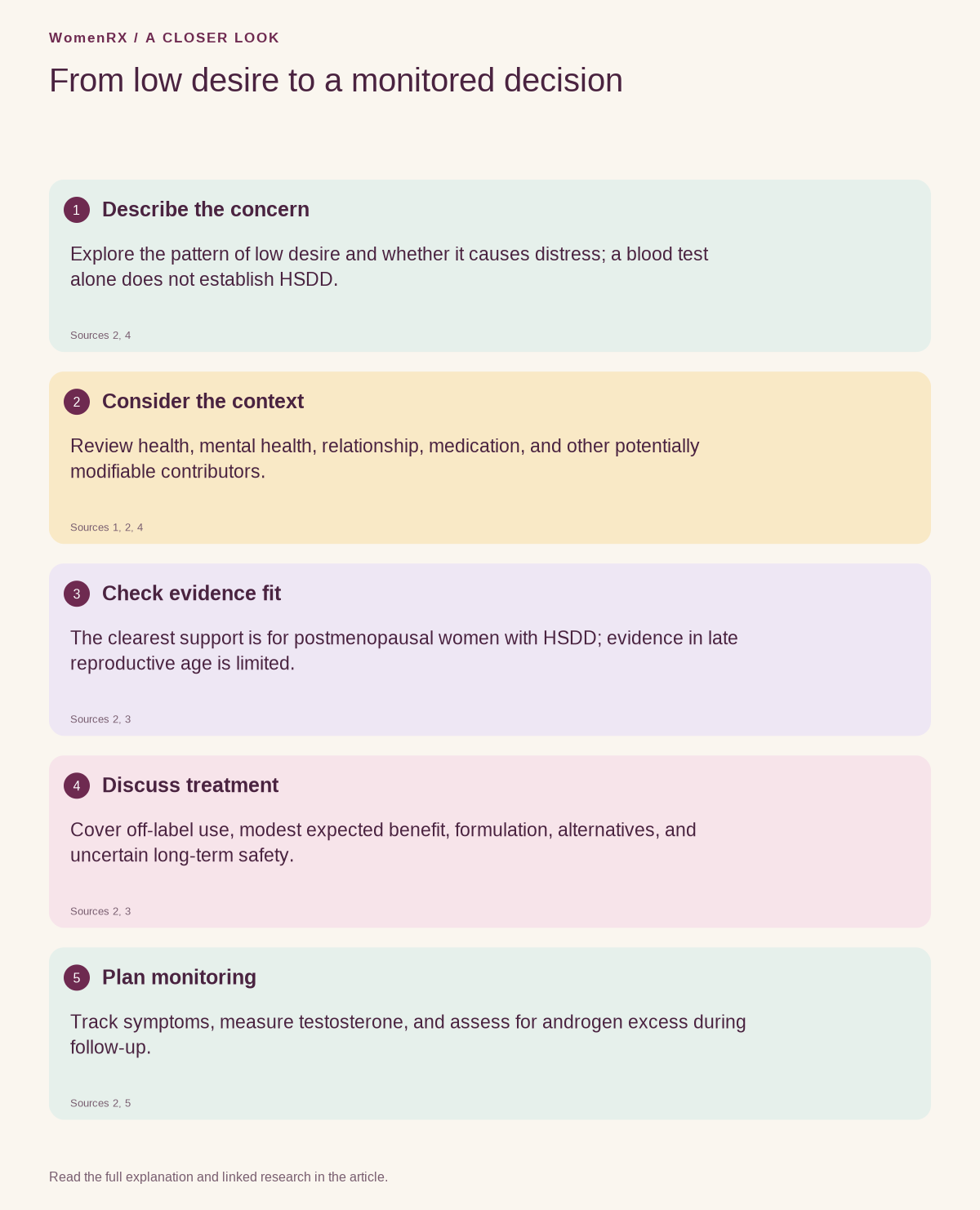
From low desire to a monitored decision
Describe the concern: Explore the pattern of low desire and whether it causes distress; a blood test alone does not establish HSDD.24
Consider the context: Review health, mental health, relationship, medication, and other potentially modifiable contributors.124
Check evidence fit: The clearest support is for postmenopausal women with HSDD; evidence in late reproductive age is limited.23
Discuss treatment: Cover off-label use, modest expected benefit, formulation, alternatives, and uncertain long-term safety.23
Plan monitoring: Track symptoms, measure testosterone, and assess for androgen excess during follow-up.25
Read the figure as text
This pathway shows why assessment begins with the concern and its context, not a testosterone result.- Describe the concern: Explore the pattern of low desire and whether it causes distress; a blood test alone does not establish HSDD.24
- Consider the context: Review health, mental health, relationship, medication, and other potentially modifiable contributors.124
- Check evidence fit: The clearest support is for postmenopausal women with HSDD; evidence in late reproductive age is limited.23
- Discuss treatment: Cover off-label use, modest expected benefit, formulation, alternatives, and uncertain long-term safety.23
- Plan monitoring: Track symptoms, measure testosterone, and assess for androgen excess during follow-up.25
More questions, answered
Does a low testosterone result mean I need treatment?
No. A total testosterone level is not a test for diagnosing HSDD. It may be checked as a baseline if treatment is being considered, but a low result alone does not establish an indication for testosterone. 2
Is testosterone established for low desire before menopause?
The clearest evidence and guideline support are for postmenopausal women with HSDD. Guidelines describe limited data in late reproductive age, so the evidence is less established outside the postmenopausal group. 2 3
Sources you can check
- Sexual Health | MedlinePlusAccessed 2026-09-25Return to first citation
- International Society for the Study of Women's Sexual Health Clinical Practice Guideline for the Use of Systemic Testosterone for Hypoactive Sexual Desire Disorder in Women.Parish SJ, Simon JA, Davis SR, Giraldi A, Goldstein I, Goldstein SW, Kim NN, Kingsberg SA, Morgentaler A, Nappi RE, Park K, Stuenkel CA, Traish AM, Vignozzi L. · Journal of women's health (2002) · 2021Return to first citation
- Testosterone for the Treatment of Hypoactive Sexual Desire Disorder in Perimenopausal and Postmenopausal Women.Kling JM. · Obstetrics and gynecology · 2025Return to first citation
- The International Society for the Study of Women's Sexual Health Process of Care for Management of Hypoactive Sexual Desire Disorder in Women.Clayton AH, Goldstein I, Kim NN, Althof SE, Faubion SS, Faught BM, Parish SJ, Simon JA, Vignozzi L, Christiansen K, Davis SR, Freedman MA, Kingsberg SA, Kirana PS, Larkin L, McCabe... · Mayo Clinic proceedings · 2018Return to first citation
- Androgen therapy in midlife and older women: a position statement of the Latin American Association of Gynecological Endocrinology (ALEG).Pilnik S, Belardo A, Marchesan LB, Camero-Lascano A, Acuña-San Martín M, Elizalde-Cremonte A, Ojeda E, Manzur A, Chedraui P. · Climacteric : the journal of the International Menopause Society · 2025Return to first citation