How Tirzepatide Doses Are Adjusted and Monitored
Dose increases are meant to balance treatment response with tolerability, not to push everyone toward the highest dose.
Tirzepatide is generally started at a low dose and increased gradually to reduce gastrointestinal side effects. The next step depends on the product’s instructions, why you’re taking it, your response, and how well you tolerate it. If you miss a dose, check the instructions for your exact product. The Zepbound and Mounjaro labels give the same missed-dose rule. 1 2
Why increases are gradual
Tirzepatide can cause nausea, diarrhea, vomiting, or other stomach symptoms. The Zepbound prescribing information recommends gradual dose increases to reduce the risk of gastrointestinal reactions. In analyses of clinical trials in adults with overweight or obesity, most gastrointestinal side effects happened during dose escalation and were mild to moderate. 1 3
That doesn’t mean you have to feel sick for treatment to work. In a post hoc analysis of the SURMOUNT-1 and SURMOUNT-2 trials, weight reduction was similar among participants who reported no nausea, nausea alone, or nausea, vomiting, or diarrhea. Nausea wasn’t necessary for similar weight reduction in those trial groups. 3
The product instructions matter
Tirzepatide is sold under different brand names, and their instructions aren’t interchangeable. For example, the Zepbound label gives a specific escalation schedule for its approved uses: it starts with 2.5 mg once weekly for four weeks, then increases to 5 mg once weekly. Further increases, if appropriate, are in 2.5 mg steps after at least four weeks at the current dose. The label says maintenance-dose selection should consider both treatment response and tolerability. 1
Mounjaro’s instructions also start with 2.5 mg once weekly, but describe dose increases when additional blood sugar control is needed. Don’t use one product’s instructions to decide how to take the other, and don’t convert doses between products on your own. Follow the directions for the prescription you actually have. 2
What monitoring is for
Dose check-ins are a chance to review both benefit and side effects. The Zepbound label says to consider treatment response and tolerability when selecting a maintenance dose. It also says a lower maintenance dose may be considered when a patient doesn’t tolerate the current one. 1
In clinical-trial analyses, gastrointestinal events were concentrated during dose escalation. That helps explain why dose increases are spaced out, but it doesn’t mean everyone will have the same symptoms or response. 3
If you miss a dose
Product instructions can differ overall, so check the current medication guide for your prescription if you’re unsure. The Zepbound and Mounjaro labels give the same missed-dose rule: take the missed dose within four days (96 hours); if more than four days have passed, skip it and take the next dose on the regular day. Both labels also say the weekly administration day may be changed if at least three days (72 hours) separate doses. 1 2
If you use oral contraception or are planning pregnancy
If you take oral hormonal contraception, ask your prescriber or pharmacist how the current instructions for your product address starting tirzepatide and increasing its dose. If you’re planning pregnancy, bring that up with your prescriber. These questions are worth addressing directly rather than relying on general dose-escalation advice.
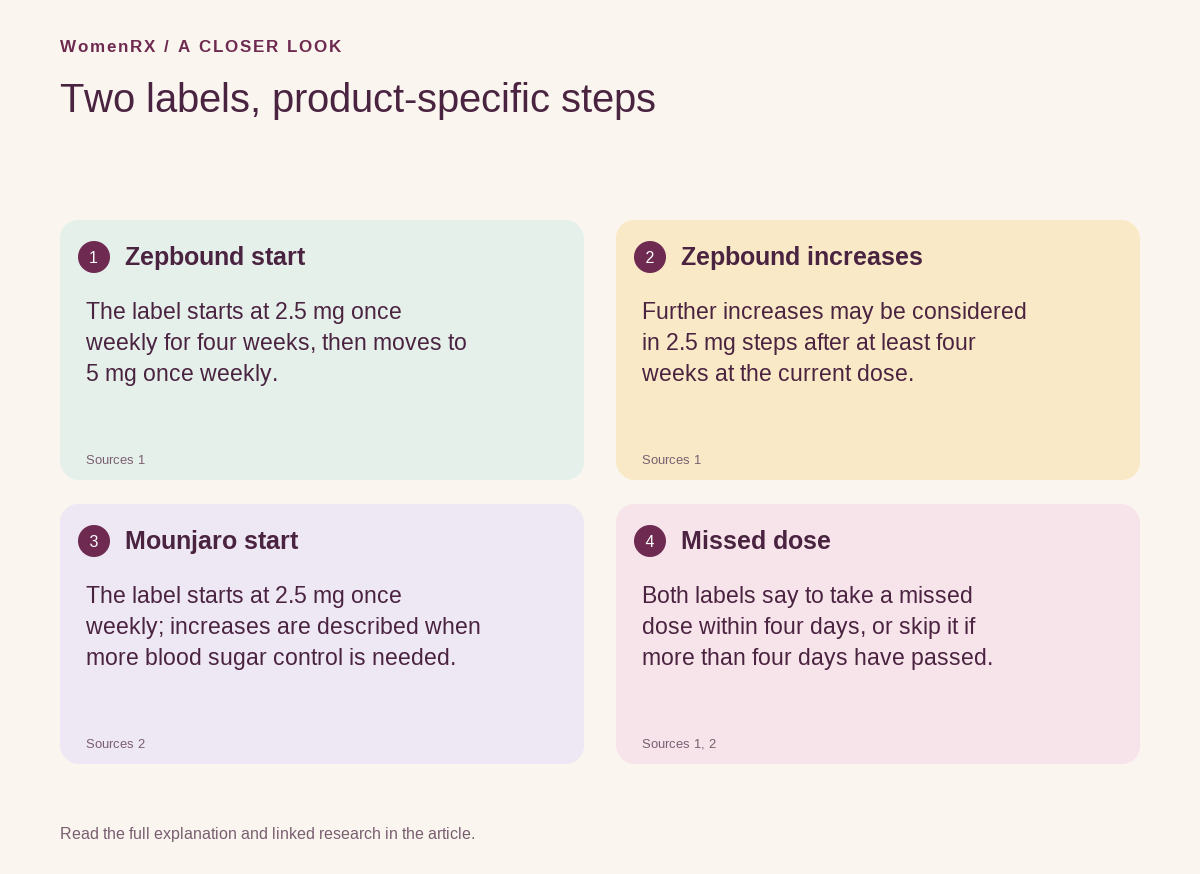
Two labels, product-specific steps
Zepbound start: The label starts at 2.5 mg once weekly for four weeks, then moves to 5 mg once weekly.1
Zepbound increases: Further increases may be considered in 2.5 mg steps after at least four weeks at the current dose.1
Mounjaro start: The label starts at 2.5 mg once weekly; increases are described when more blood sugar control is needed.2
Missed dose: Both labels say to take a missed dose within four days, or skip it if more than four days have passed.12
Read the figure as text
The examples below show why the instructions on your own prescription matter. They are label summaries, not a personal dosing plan.- Zepbound start: The label starts at 2.5 mg once weekly for four weeks, then moves to 5 mg once weekly.1
- Zepbound increases: Further increases may be considered in 2.5 mg steps after at least four weeks at the current dose.1
- Mounjaro start: The label starts at 2.5 mg once weekly; increases are described when more blood sugar control is needed.2
- Missed dose: Both labels say to take a missed dose within four days, or skip it if more than four days have passed.12
More questions, answered
Does nausea mean the dose is working?
Not necessarily. In a post hoc analysis of two trials in adults with overweight or obesity, weight reduction was similar among participants with no nausea, nausea alone, or nausea, vomiting, or diarrhea. 3
Can I change my weekly injection day?
The Zepbound and Mounjaro instructions allow a change when at least 72 hours separate doses. Check the current instructions for your specific product before changing your schedule. 1 2
Sources you can check
- ZEPBOUND (TIRZEPATIDE) INJECTION, SOLUTION ZEPBOUND (TIRZEPATIDE) INJECTION, SOLUTION ZEPBOUND KWIKPEN (TIRZEPATIDE) INJECTION, SOLUTION [ELI LILLY AND COMPANY] | US prescribing information and patient instructionsAccessed 2026-09-25Return to first citation
- MOUNJARO (TIRZEPATIDE) INJECTION, SOLUTION MOUNJARO KWIKPEN (TIRZEPATIDE) INJECTION, SOLUTION [ELI LILLY AND COMPANY] | US prescribing information and patient instructionsAccessed 2026-09-25Return to first citation
- Gastrointestinal tolerability and weight reduction associated with tirzepatide in adults with obesity or overweight with and without type 2 diabetes in the SURMOUNT-1 to -4 trials.Rubino DM, Pedersen SD, Connery L, Cao D, Chigutsa F, Stefanski A, Fraseur Brumm J, Griffin R, Gerber C. · Diabetes, obesity & metabolism · 2025Return to first citation