Why Tirzepatide Doses Use Milligrams, Not Syringe Units
Milligrams tell you how much tirzepatide is in a dose; a syringe marking can’t tell you that without the vial and syringe details.
A tirzepatide dose is stated in milligrams (mg), the amount of drug. Milliliters (mL) describe liquid volume, while concentration (mg/mL) connects the two. A syringe marking labeled “units” doesn’t, by itself, tell you the milligrams of tirzepatide. If your instructions say “units,” have the dispensing pharmacist confirm the exact vial, syringe and intended marking before you inject.12
Four labels that answer different questions
When you see mg on a tirzepatide prescription, it means an amount of medication. mL means an amount of liquid. mg/mL, the concentration, tells you how much medication is in a given volume of that liquid. Product information lists these quantities separately because they aren’t interchangeable.2
The difference is visible in the listed Mounjaro multidose vial formulations. One is labeled 2.5 mg per 0.6 mL; another is 5 mg per 0.6 mL. They have the same listed volume per injection but different amounts of tirzepatide. So knowing a liquid volume, without knowing which formulation it came from, doesn’t establish the drug amount. Those labels illustrate the distinction, not a volume to use for your own injection.2
Why a syringe marking isn’t a tirzepatide dose
A syringe helps measure liquid. The Zepbound and Mounjaro instructions for vial users specify a syringe capable of measuring the intended volume. That doesn’t make a number on a syringe a universal tirzepatide dose.12
If your syringe is marked in “units,” that word alone doesn’t identify milligrams of tirzepatide or explain how your particular syringe is calibrated. Don’t borrow a conversion from someone else’s vial. To interpret the instruction, the pharmacist needs to check your prescribed dose, the concentration on your actual vial, and the type and markings of your actual syringe. The product information here does not establish a universal meaning for a “unit” marking on syringes supplied with tirzepatide.12
This distinction matters especially when you receive a vial with instructions that use syringe markings rather than a ready-to-use device. A clinical brief discussing compounded GLP-1 medications identifies compounded vials and dosing errors as safety concerns, but it does not provide a conversion that applies to every vial or syringe.3
What to do with unclear instructions
Before an injection, compare the name and concentration on the vial with the written instructions. If the instructions give only a number of “units,” the concentration is hard to find, or the syringe differs from the one you were shown, pause and ask the dispensing pharmacist to identify the intended marking for that exact vial and syringe. Ask them to explain how it relates to the dose prescribed in mg. Don’t try to resolve a mismatch by estimating from an online chart.12
If you’ve already injected and aren’t sure how much you received, tell the pharmacist or prescriber what the vial says, which syringe you used, and which marking you filled to. That gives them the product-specific details needed to assess what happened rather than relying on the word “units” alone.12
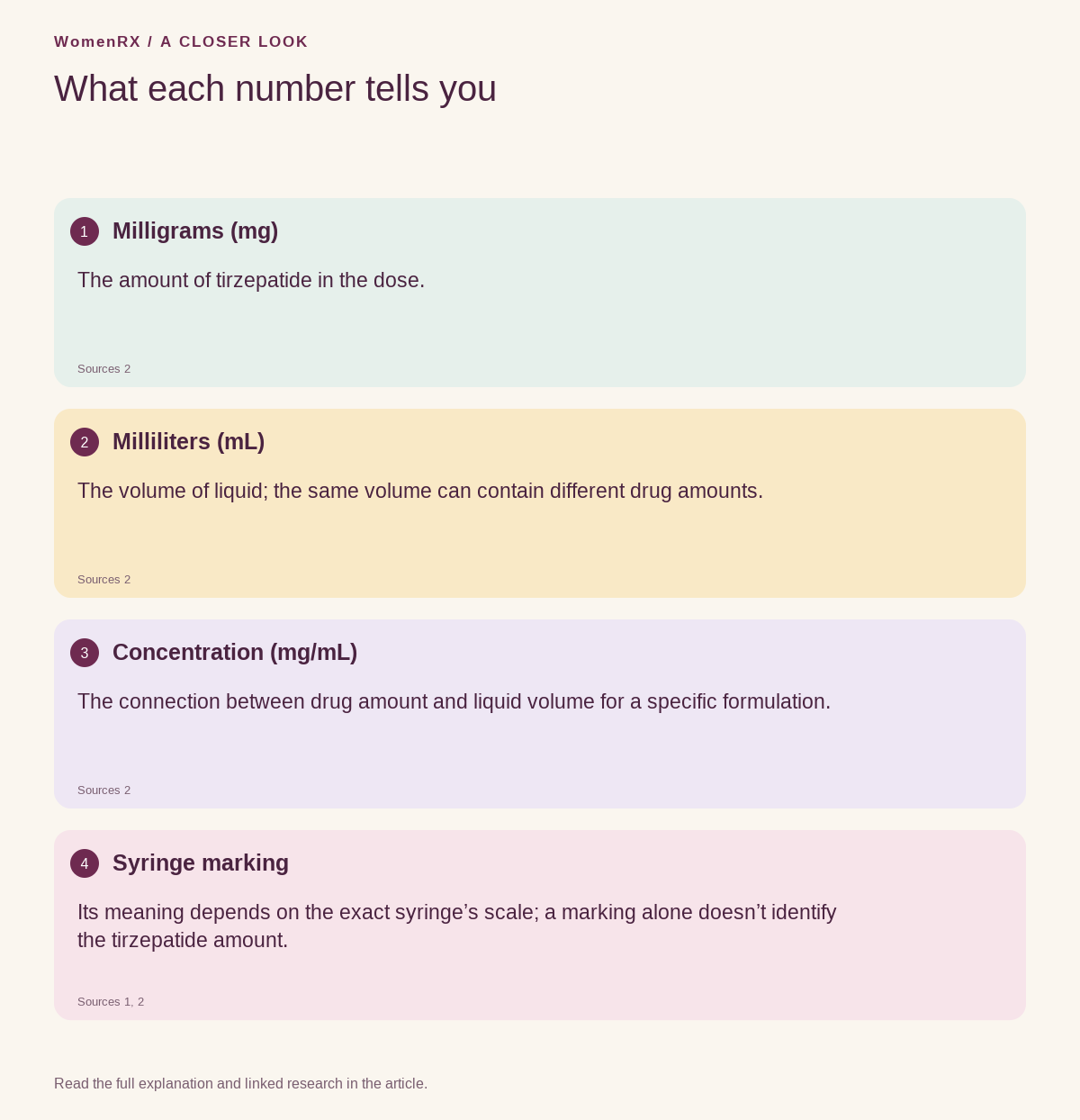
What each number tells you
Milligrams (mg): The amount of tirzepatide in the dose.2
Milliliters (mL): The volume of liquid; the same volume can contain different drug amounts.2
Concentration (mg/mL): The connection between drug amount and liquid volume for a specific formulation.2
Syringe marking: Its meaning depends on the exact syringe’s scale; a marking alone doesn’t identify the tirzepatide amount.12
Read the figure as text
These four pieces of information play different roles when interpreting an injectable tirzepatide label.- Milligrams (mg): The amount of tirzepatide in the dose.2
- Milliliters (mL): The volume of liquid; the same volume can contain different drug amounts.2
- Concentration (mg/mL): The connection between drug amount and liquid volume for a specific formulation.2
- Syringe marking: Its meaning depends on the exact syringe’s scale; a marking alone doesn’t identify the tirzepatide amount.12
Sources you can check
- ZEPBOUND (TIRZEPATIDE) INJECTION, SOLUTION ZEPBOUND (TIRZEPATIDE) INJECTION, SOLUTION ZEPBOUND KWIKPEN (TIRZEPATIDE) INJECTION, SOLUTION [ELI LILLY AND COMPANY] | US prescribing information and patient instructionsAccessed 2026-09-25Return to first citation
- MOUNJARO (TIRZEPATIDE) INJECTION, SOLUTION MOUNJARO KWIKPEN (TIRZEPATIDE) INJECTION, SOLUTION [ELI LILLY AND COMPANY] | US prescribing information and patient instructionsAccessed 2026-09-25Return to first citation
- The "microdosing" dilemma: Balancing patient anecdotes with clinical safety amid GLP-1 compounding restrictions.Trainer N. · Journal of the American Association of Nurse Practitioners · 2026Return to first citation