GLP-1 Syringe Units Aren’t Your Medicine Dose
The mark on a syringe tells you how much liquid to draw, but it doesn’t tell you how much medicine that liquid contains.
If your GLP-1 medicine comes in a vial, don’t read the syringe’s “units” as milligrams of medicine. The prescribed dose, the vial’s concentration, and the amount of liquid to draw are different quantities. Before injecting, ask the dispensing pharmacist to match your exact prescription and vial to a mark on the syringe you’ll use. There’s no universal units-to-milligrams conversion.

What the numbers mean
A vial-and-syringe prescription may put several numbers in front of you at once. They answer different questions:
- Prescribed dose: How much medicine are you meant to receive? This may be written in milligrams (mg).
- Vial concentration: How much medicine is in a given amount of liquid? This may be written as mg per milliliter (mg/mL).
- Liquid volume: How much liquid must be drawn up to deliver that prescribed dose?
- Syringe marking: Where should the liquid reach on the particular syringe you have?
The concentration connects the medicine dose to the liquid volume. If the concentration changes, the same volume can contain a different dose. A syringe marked in “units” adds another potential mix-up: its markings are a way to measure liquid, not a label for milligrams of GLP-1 medicine. A number copied from another person’s directions or an online chart cannot establish the right mark for your vial.
A pen’s dose dial is not a vial conversion chart
Check which device your instructions actually describe. The US instructions for Saxenda, a liraglutide product, describe a prefilled pen with doses selected in milligrams. Victoza’s liraglutide instructions also describe a prefilled pen with milligram dose selections. Neither set of pen instructions tells you which mark to use on a separate syringe for a vial. 1 2
If you have a vial, work from the label and directions for the product dispensed to you, not directions for a pen or another vial. Even a familiar medicine name isn’t enough to determine a syringe mark without the concentration and syringe scale.
Get one answer that links the vial to your syringe
Take the vial, prescription label, written directions, and syringe to the dispensing pharmacy, or have them in front of you when you call. Ask the pharmacist to walk through the whole connection:
- “What medicine and concentration are on this vial?”
- “What dose is prescribed for me?”
- “What liquid volume delivers that dose from this vial?”
- “Which mark on this syringe measures that volume?”
Then ask the pharmacist to show you the mark and check as you point it out or demonstrate drawing up the amount. In a randomized study of caregivers measuring children’s oral liquid medicines, instructions tailored to the prescription plus a dosing demonstration and a chance to show the measurement back reduced observed errors compared with standard counseling. That study didn’t test injectable GLP-1 medicines, but it illustrates why a product-specific demonstration is more useful than a number alone. 3
If the vial label, written directions, and pharmacist’s explanation don’t agree, pause before injecting and ask the pharmacy to reconcile them. Don’t choose the closest mark or use a conversion for a different vial. If you think you’ve already injected a different amount than prescribed, tell the pharmacist or prescriber what you drew up, which vial and syringe you used, and when you injected so they can advise you on the next step.
This measurement check applies to anyone using a vial and syringe. If you’re pregnant, might be pregnant, or are planning a pregnancy, whether the medicine itself is suitable for you is a separate question for your prescriber. Knowing the correct syringe mark doesn’t answer it.
Four numbers, four different jobs
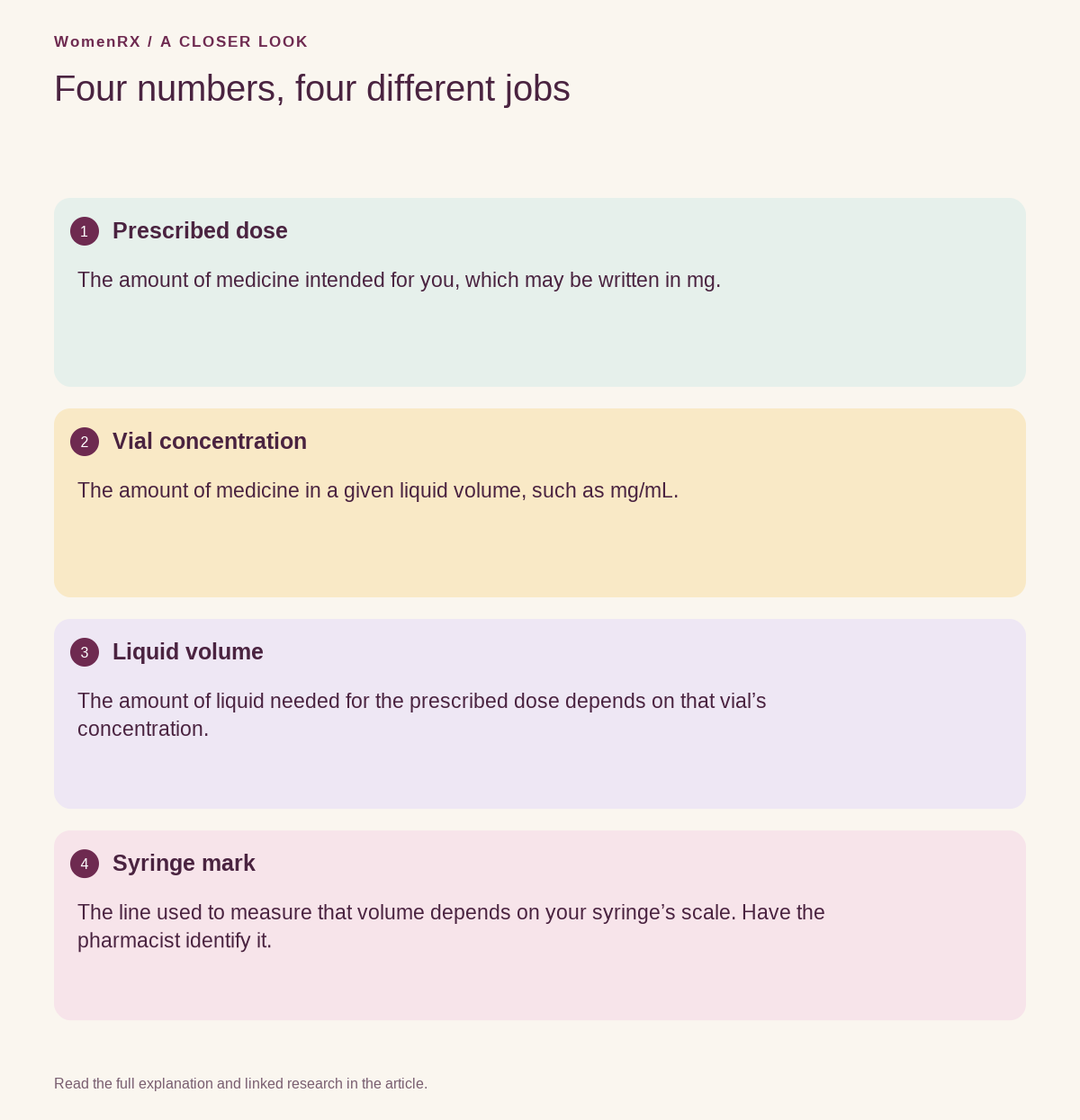
Prescribed dose: The amount of medicine intended for you, which may be written in mg.
Vial concentration: The amount of medicine in a given liquid volume, such as mg/mL.
Liquid volume: The amount of liquid needed for the prescribed dose depends on that vial’s concentration.
Syringe mark: The line used to measure that volume depends on your syringe’s scale. Have the pharmacist identify it.
Read the figure as text
Use this distinction to ask the dispensing pharmacist to connect your prescription, vial, and syringe.- Prescribed dose: The amount of medicine intended for you, which may be written in mg.
- Vial concentration: The amount of medicine in a given liquid volume, such as mg/mL.
- Liquid volume: The amount of liquid needed for the prescribed dose depends on that vial’s concentration.
- Syringe mark: The line used to measure that volume depends on your syringe’s scale. Have the pharmacist identify it.
More questions, answered
What if my directions say “units” but my prescription says “mg”?
Those labels describe different things: a syringe measurement and an amount of medicine. Ask the dispensing pharmacist to confirm the vial’s concentration, the liquid volume for your prescribed dose, and the corresponding mark on your actual syringe before injecting.
Sources you can check
- SAXENDA (LIRAGLUTIDE) INJECTION, SOLUTION [NOVO NORDISK PHARMACEUTICAL INDUSTRIES, LP] | US prescribing information and patient instructionsAccessed 2026-09-25Return to first citation
- VICTOZA (LIRAGLUTIDE) INJECTION [NOVO NORDISK] | US prescribing information and patient instructionsAccessed 2026-09-25Return to first citation
- Health Literacy-Informed Communication to Reduce Discharge Medication Errors in Hospitalized Children: A Randomized Clinical Trial.Carroll AR, Johnson JA, Stassun JC, Greevy RA, Mixon AS, Williams DJ. · JAMA network open · 2024Return to first citation