What We Know About Long-Term Mounjaro Use
Tirzepatide can maintain benefits with continued treatment, but current follow-up does not answer every question about years of use.
Longer studies and reviews show that tirzepatide can sustain weight loss while treatment continues, with gastrointestinal symptoms the most common side effects. But much of the reported trial follow-up is measured in weeks rather than many years, and rare or longer-term outcomes still need study. Continuing treatment is a review of ongoing benefit, side effects, and personal goals, not a fixed-duration rule. 2 3
What longer follow-up can tell you
“Long term” can mean different things: staying on treatment beyond the first few months, maintaining results for a year or more, or taking it for many years. The evidence described in reviews includes clinical studies with outcomes reported around 72 weeks, as well as a longer-term extension and observational studies. That gives a useful view of sustained treatment, but it is not the same as knowing every effect of use over decades. 3
For adults with overweight or obesity, a systematic review found that continued tirzepatide treatment maintained weight loss, while stopping treatment was followed by progressive weight regain. This helps explain why treatment may be considered ongoing rather than a short course for some people. It does not mean everyone should continue: the review also identifies persistence, cardiovascular outcomes, and long-term safety across diverse groups as areas where more evidence is needed. 3
These findings should be read in the context of the people and outcomes studied. Evidence in an obesity population does not automatically answer every question about Mounjaro use for type 2 diabetes, or about a particular person’s health and treatment goals.
What side effects and risks are reported
Gastrointestinal symptoms are the most commonly described side effects in the long-term review and a review of tirzepatide in adults without diabetes. The latter describes these symptoms as generally mild to moderate and often occurring during dose escalation. Individual experience can differ, and a side effect that disrupts eating, hydration, or daily life is worth raising at a treatment review. 2 3
There is also a specific thyroid warning in U.S. product information. Tirzepatide caused thyroid C-cell tumors in rats; whether it causes these tumors, including medullary thyroid cancer, in people is unknown. Mounjaro should not be used by someone with a personal or family history of medullary thyroid carcinoma or with MEN 2. The product information says routine calcitonin blood testing or thyroid ultrasound has uncertain value for early detection, so more screening is not automatically better. 1
The same product information lists a new neck lump or swelling, persistent hoarseness, trouble swallowing, or shortness of breath as symptoms to report. Those symptoms do not by themselves establish a cause, but they should not be ignored. 1
Make continuation a personal review
A useful review weighs what treatment is doing for you against what it costs you in side effects and effort. You might consider whether your original treatment goal is being met, whether any side effects have become harder to manage, and whether your health or circumstances have changed. The evidence does not set one treatment duration that fits everyone.
For example, a person who is maintaining a meaningful benefit and tolerating treatment may have a different discussion from someone whose symptoms are interfering with daily life or whose goals have changed. The long-term review’s finding that weight regain can follow discontinuation is a reason to plan a change rather than assume results will persist unchanged after stopping. It is not a reason to continue regardless of side effects or circumstances. 3
For women, include pregnancy plans, pregnancy, or breastfeeding in that conversation, and revisit goals if they shift during perimenopause or after menopause. The long-term weight and safety findings summarized here do not answer whether tirzepatide is appropriate during pregnancy or breastfeeding. Don’t infer reproductive safety from weight-loss results in adults generally; ask for advice specific to your situation before making treatment changes.
Questions that make the discussion concrete
Bring the conversation back to your own results and priorities:
- What benefit are we aiming to maintain, and how will we assess whether it is still worthwhile?
- Are my side effects manageable, or do they call for a change in the plan?
- Has my health, pregnancy planning, breastfeeding status, or treatment goal changed?
- What should I know about the thyroid warning given my personal and family history?
- If I stop or change treatment, what should I expect and how will we plan for that?
The reviewed findings do not establish one treatment duration for every woman. The best review is specific to why you take tirzepatide, what it is doing for you, and what has changed.
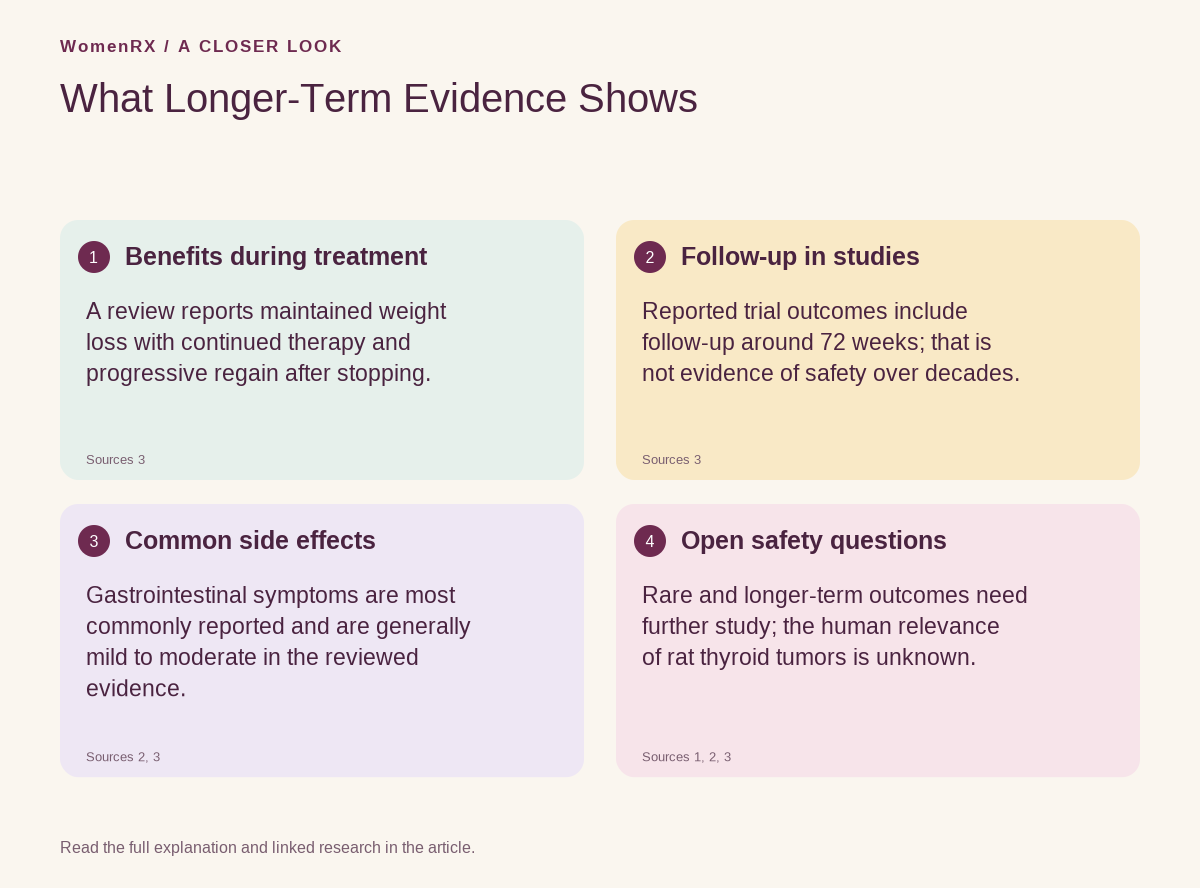
What Longer-Term Evidence Shows
Benefits during treatment: A review reports maintained weight loss with continued therapy and progressive regain after stopping.3
Follow-up in studies: Reported trial outcomes include follow-up around 72 weeks; that is not evidence of safety over decades.3
Common side effects: Gastrointestinal symptoms are most commonly reported and are generally mild to moderate in the reviewed evidence.23
Open safety questions: Rare and longer-term outcomes need further study; the human relevance of rat thyroid tumors is unknown.123
Read the figure as text
Separate benefits observed during ongoing treatment from common side effects and questions that remain open.- Benefits during treatment: A review reports maintained weight loss with continued therapy and progressive regain after stopping.3
- Follow-up in studies: Reported trial outcomes include follow-up around 72 weeks; that is not evidence of safety over decades.3
- Common side effects: Gastrointestinal symptoms are most commonly reported and are generally mild to moderate in the reviewed evidence.23
- Open safety questions: Rare and longer-term outcomes need further study; the human relevance of rat thyroid tumors is unknown.123
More questions, answered
Does taking Mounjaro long term mean taking it for life?
Not necessarily. The available review describes maintained weight loss during continued treatment and progressive regain after discontinuation, but it does not establish a lifetime treatment rule. Duration is a decision to revisit as benefits, side effects, and goals change. 3
Do you need routine thyroid blood tests or ultrasounds while taking Mounjaro?
U.S. product information says the value of routine calcitonin testing or thyroid ultrasound for early detection is uncertain. It identifies a personal or family history of medullary thyroid cancer and MEN 2 as reasons not to use Mounjaro. 1
Sources you can check
- MOUNJARO (TIRZEPATIDE) INJECTION, SOLUTION MOUNJARO KWIKPEN (TIRZEPATIDE) INJECTION, SOLUTION [ELI LILLY AND COMPANY] | US prescribing information and patient instructionsAccessed 2026-09-25Return to first citation
- Tirzepatide for obesity without diabetes: mechanistic insights, clinical evidence, and future directions.He WT, Song YD, Wang XY, He SY, Tao X, Yuan SX, Zhou L, Long EW. · Frontiers in pharmacology · 2026Return to first citation
- Long-Term Clinical Outcomes and Real-World Effectiveness of Tirzepatide in Adults With Overweight or Obesity: A Systematic Review.Olaniyi AO, Gogineni KK, Olaniyi H, Sabir H, Agbonrofo Eboigbe G, Yerima SR, Gabriels N. · Cureus · 2026Return to first citation