What Is Known About Long-Term Melatonin Use?
Short-term melatonin use is better studied than nightly use for months or years, so persistent sleep trouble calls for a fresh look rather than a higher dose by default.
Melatonin hasn’t been shown to be either harmless or dangerous for every adult who takes it long term. In a review of sleep-disorder trials, most lasted four weeks or less, and the longest followed participants for 29 weeks. If you’re still taking it regularly, review whether it helps, any side effects, what you take with it, and why sleep remains difficult before increasing the dose. 5
What the safety research can tell you
Melatonin is a hormone your body produces as it gets dark. Taking it adds to that natural supply and can help with short-term sleep problems. That doesn’t answer a different question: what happens when you take it night after night for months or years? 2
A systematic review examined adverse events in 37 randomized trials of melatonin for sleep disorders. Participants were monitored for up to 29 weeks, but most trials lasted four weeks or less. Reported side effects were generally mild to moderate; the more frequent ones included daytime sleepiness, headache, and dizziness. Few serious or clinically significant events were reported. Because longer trials were scarce, though, the review could not establish the safety of continuous use over extended periods. 5
The trials used a wide range of doses. That range tells us what researchers studied, not which dose is right for you or whether a particular dose is safe indefinitely. Those trials don’t establish a general dose threshold for long-term use. If you’re considering an increase, treat that as a reason to review whether melatonin is helping and why sleep remains difficult, rather than increasing by default. 5
When a short-term fix becomes a nightly habit
UK clinical guidance describes short courses of melatonin for insomnia, sometimes extending to 13 weeks, and says specialists may use it longer for some types of insomnia. Those durations aren’t a universal safety limit or a US treatment schedule. They do show why duration should be part of the conversation if a product you meant to use briefly has become routine. 23
Start with the question that matters most: Is it helping the problem you actually have? For example, if you began taking melatonin because you had trouble falling asleep, but now you’re waking repeatedly, taking more may not address what changed. Note whether you’re falling asleep more easily, how you feel the next day, and whether the sleep problem is continuing despite regular use. Guidance recommends revisiting persistent sleep trouble rather than simply extending a completed short-term course. 3
Also pay attention to how you feel during the day. Next-day tiredness or irritability, headache, and dizziness are reported effects. If you feel too sleepy or dizzy to drive or use equipment safely, don’t do those activities. A side effect that persists or bothers you is a reason to discuss whether melatonin still fits your plan. 12
What you take alongside it matters
Alcohol can add to melatonin’s sedating effects. Sleep-affecting herbal remedies may also make you very drowsy. NHS guidance specifically warns that cannabis, heroin, and methadone can increase melatonin’s sleep-inducing effects and make waking difficult. 23
If you take medicines or other sleep products, bring the names and amounts to a pharmacist or clinician before adding melatonin or increasing it. A complete list makes it possible to check your combination; the specific cautions above aren’t a complete interaction list.
Pregnancy, breastfeeding, and menopause change the question
Pregnancy research has explored melatonin for specific medical conditions, but it hasn’t established that routine use for insomnia is safe throughout pregnancy. Longer-term safety evidence remains limited. Breastfeeding needs a separate decision: a three-year study in women with breast cancer excluded people who were lactating, so it cannot answer whether melatonin is safe while breastfeeding. If you’re pregnant, planning pregnancy, or breastfeeding, discuss the sleep problem and melatonin use before treating it as an ongoing routine. 46
If sleep changed around perimenopause or after menopause, consider what is waking you. For example, waking during hot flashes is useful context to raise when discussing persistent sleep disruption, rather than assuming the answer is more melatonin.
One study did follow women taking melatonin for three years, but they were receiving treatment for non-metastatic breast cancer, and the study assessed quality of life in that setting. It cannot establish a long-term dose or safety expectation for women taking melatonin for everyday insomnia. 4
The practical distinction is between continuing because it still has a clear purpose and continuing because sleep remains difficult and you’re unsure what else to do. If it’s the latter, review the sleep problem, the benefit you notice, side effects, and other substances you take before making a dose increase your next move. 35
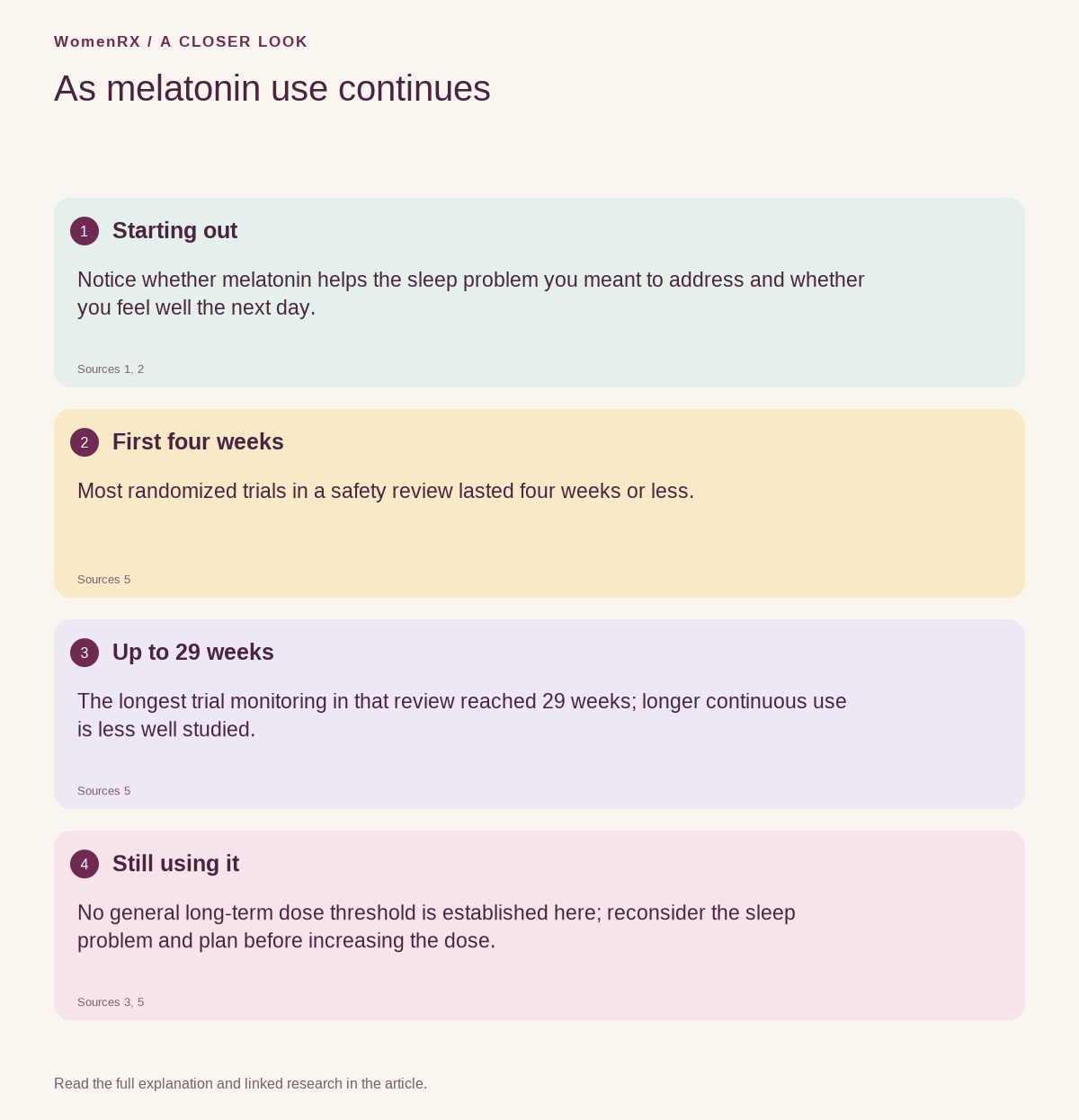
As melatonin use continues
Starting out: Notice whether melatonin helps the sleep problem you meant to address and whether you feel well the next day.12
First four weeks: Most randomized trials in a safety review lasted four weeks or less.5
Up to 29 weeks: The longest trial monitoring in that review reached 29 weeks; longer continuous use is less well studied.5
Still using it: No general long-term dose threshold is established here; reconsider the sleep problem and plan before increasing the dose.35
Read the figure as text
Research covers shorter periods more fully than ongoing nightly use, so the questions worth asking change over time.- Starting out: Notice whether melatonin helps the sleep problem you meant to address and whether you feel well the next day.12
- First four weeks: Most randomized trials in a safety review lasted four weeks or less.5
- Up to 29 weeks: The longest trial monitoring in that review reached 29 weeks; longer continuous use is less well studied.5
- Still using it: No general long-term dose threshold is established here; reconsider the sleep problem and plan before increasing the dose.35
More questions, answered
Will I become dependent on melatonin?
Guidance says you’re unlikely to become addicted to melatonin when taking it as prescribed. It separately advises asking a doctor or pharmacist about stopping if you’ve taken it for a long time or are worried about becoming dependent on it. 3
Sources you can check
- Side effects of melatonin - NHSAccessed 2026-09-25Return to first citation
- About melatonin - NHSAccessed 2026-09-25Return to first citation
- Common questions about melatonin - NHSAccessed 2026-09-25Return to first citation
- The Effect of Melatonin on Increasing the Health Related Quality of Life in Non-Metastatic Breast Cancer Patients: Three-Year Follow up a Clinical Trial.Keshtpour Amlashi Z, Sheida F, Anbiaee R, Tapak L, Hosseini SR, Mosaedian H, Barati N. · Integrative cancer therapies · 2024Return to first citation
- Adverse Events Associated with Melatonin for the Treatment of Primary or Secondary Sleep Disorders: A Systematic Review.Besag FMC, Vasey MJ, Lao KSJ, Wong ICK. · CNS drugs · 2019Return to first citation
- Clinical Use of Melatonin as a Cross-Sectional Modulator of Oxidative Stress Across the Perinatal Continuum: From Placental Dysfunction to Neonatal Disease.Cipriani F, Furlan E, Lonoce L, Laschi E, Minerva M, Perilli L, Lotti F, Grosso S. · Nutrients · 2026Return to first citation