What Is Known About Long-Term Maca Use?
Research hasn’t established whether taking maca supplements over the long term is safe, and findings about one preparation don’t automatically apply to another.
Research to date hasn’t established a safe duration for continued maca supplement use. Reviews describe inconclusive human evidence and gaps in clinical safety knowledge. A chemical analysis found differences in measured alkaloid content among the raw powder and finished products it tested, but that study did not show that the differences cause harm or change effects. 1 2 3
What research can say about continued use
Maca has a history as a food and traditional remedy, but that history doesn’t settle whether a particular supplement is safe to take continuously. A review of maca’s reproductive-health claims found that animal research and clinical trials had produced inconclusive results, with limitations including study methods and sample size. A separate toxicology review said clinical safety information was inadequate and called for more research. Neither establishes a safe duration for long-term supplement use. 2 3
That distinction matters if you’re considering maca for fertility, sexual health, or menopausal symptoms. The reproductive-health review assessed claims involving women and men, but its findings don’t establish a reliable benefit or a long-term safety conclusion for a particular group of women. They also don’t support assuming that maca balances hormones or works the same way across menstrual, perimenopausal, and postmenopausal life stages. 2
The preparation matters, but not in a simple way
Maca has been consumed as food in forms such as cooked or baked preparations, porridge, and fermented drinks. Supplements can be made from root powder or extracts, and finished products may include other ingredients. Food use is useful context, but it doesn’t prove that a supplement with a different preparation has the same effects or safety profile. 1 2
A 2024 chemical-analysis study measured alkaloids in raw maca powder and seven finished products sold in Belgium. The finished products included different formats, such as capsules and tablets. Measured total alkaloid content varied among the samples, and the researchers reported that commercial preparation affected the measured amount. This was a composition study, not a clinical comparison: it didn’t show that the measured differences caused symptoms, changed benefits, or predicted long-term safety. 1
So “maca” on the front of a label doesn’t tell you whether your product matches one used in a study. If you’re discussing continued use, bring the container or a clear photo of the label, including the preparation and other ingredients. That makes the conversation about your actual product rather than maca in general.
What has been reported about side effects?
A research paper summarizing a United States Pharmacopeia safety review lists nonserious effects reported with maca consumption, including nausea, abdominal pain, diarrhea, headache, anxiety, insomnia, and a fast heartbeat. The reported list doesn’t provide a rate for each symptom or show how risk changes with duration. It’s useful as a set of possible symptoms to recognize, not a prediction that you’ll experience them. 1
Animal findings offer limited context, not a long-term answer for people. A 2005 review described low acute oral toxicity in animals, while also emphasizing the need for better information on maca’s composition and clinical safety. Acute animal findings can’t establish the safety of taking a supplement for months or years, or the safety of a specific product in women. 3
Questions that make continued use easier to assess
If you’re weighing whether to keep taking maca, start with the reason you chose it and what would count as a meaningful benefit for you. Then discuss the exact product and preparation, how long you’ve been using it, and any new symptoms. Useful questions include:
- Is there human evidence for my specific goal, and does it involve people at my life stage?
- Does the research use a preparation comparable to this product?
- Which symptoms should make me stop and check in?
- How will we decide whether continuing is worthwhile?
The evidence doesn’t give a confident long-term safety answer, so there’s no research-based duration to apply to every maca product or person. A clear goal, the exact label, and attention to how you feel are more useful starting points than assuming that traditional food use or a study of a different preparation answers the question.
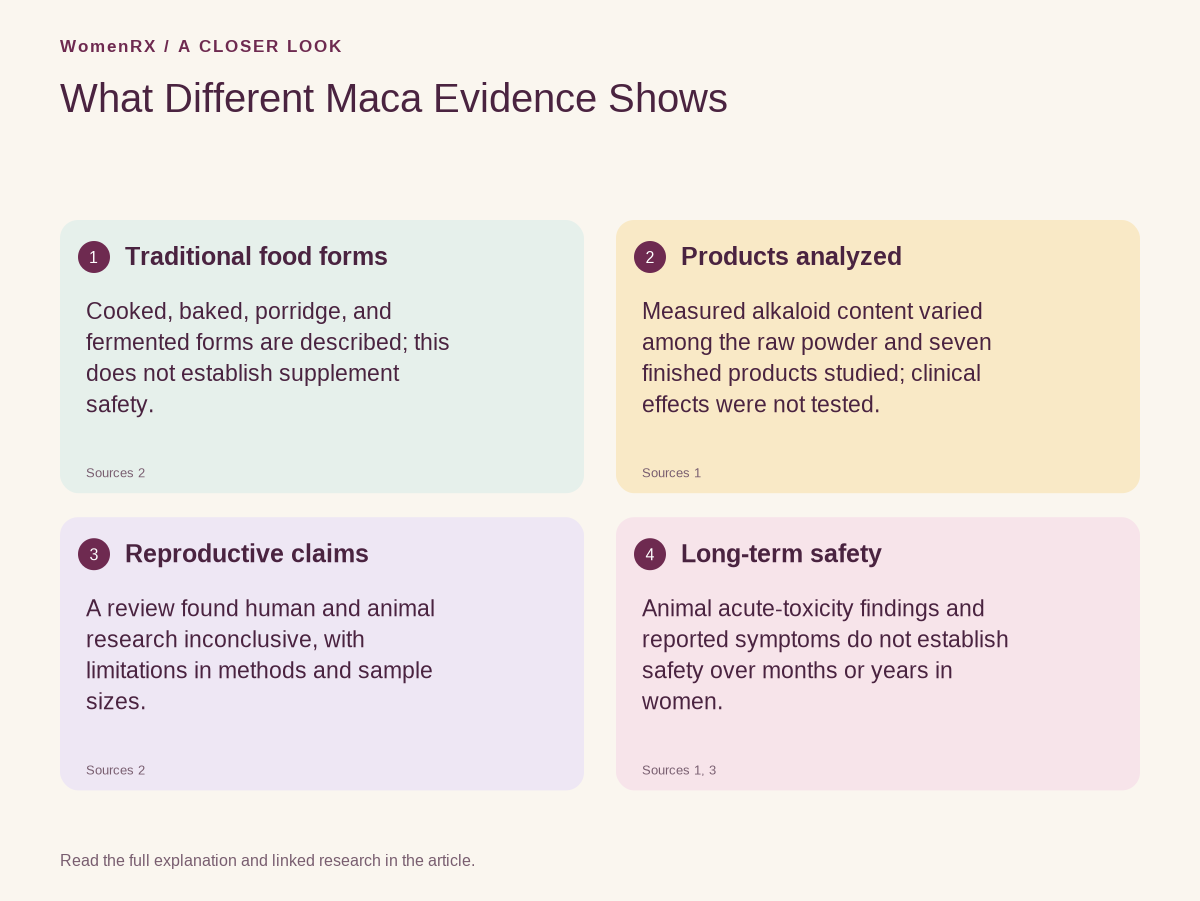
What Different Maca Evidence Shows
Traditional food forms: Cooked, baked, porridge, and fermented forms are described; this does not establish supplement safety.2
Products analyzed: Measured alkaloid content varied among the raw powder and seven finished products studied; clinical effects were not tested.1
Reproductive claims: A review found human and animal research inconclusive, with limitations in methods and sample sizes.2
Long-term safety: Animal acute-toxicity findings and reported symptoms do not establish safety over months or years in women.13
Read the figure as text
Preparation, study type, and participant group shape what a finding can tell you about continued use.- Traditional food forms: Cooked, baked, porridge, and fermented forms are described; this does not establish supplement safety.2
- Products analyzed: Measured alkaloid content varied among the raw powder and seven finished products studied; clinical effects were not tested.1
- Reproductive claims: A review found human and animal research inconclusive, with limitations in methods and sample sizes.2
- Long-term safety: Animal acute-toxicity findings and reported symptoms do not establish safety over months or years in women.13
More questions, answered
Does maca’s traditional use as food prove supplements are safe long term?
No. Traditional food preparations and supplements may differ, and food use doesn’t establish the long-term safety of a specific supplement product. 1 2
Sources you can check
- UPLC-TQD-MS/MS Method Validation for Quality Control of Alkaloid Content in Lepidium meyenii (Maca)-Containing Food and Dietary Supplements.Le NT, Foubert K, Theunis M, Naessens T, Bozdag M, Van Der Veken P, Pieters L, Tuenter E. · ACS omega · 2024Return to first citation
- Is the hype around the reproductive health claims of maca (Lepidium meyenii Walp.) justified?Beharry S, Heinrich M. · Journal of ethnopharmacology · 2018Return to first citation
- Toxicological aspects of the South American herbs cat's claw (Uncaria tomentosa) and Maca (Lepidium meyenii) : a critical synopsis.Valerio LG, Gonzales GF. · Toxicological reviews · 2005Return to first citation