Can Menopausal Estrogen Be Prescribed Online?
A remote visit may lead to an estrogen prescription when the clinician can assess your symptoms and health history well enough to recommend it.
Sometimes. Telemedicine may be part of diagnosing, starting treatment for, and following up on genitourinary symptoms of menopause, but an online visit doesn’t guarantee a prescription. The clinician still has to decide whether estrogen fits your symptoms and individual risks, and whether a remote assessment is enough. If it is prescribed, confirm how the prescription will be filled and how follow-up will work. 1 3
The visit can start the decision, not promise its outcome
Menopausal estrogen may be discussed in a remote appointment, but whether it’s prescribed depends on two separate questions: what symptoms you’re treating, and whether the clinician can assess your situation well enough through remote care. A review of genitourinary syndrome of menopause (GSM) says telemedicine may play a role in diagnosis, treatment initiation, and follow-up. That makes remote care one possible route, not a guarantee that every symptom or case can be handled online. 3
The first useful step is to describe what’s bothering you most. Hot flashes and night sweats point to a different treatment discussion than vaginal dryness, irritation, pain with sex, or some urinary symptoms. Systemic hormone therapy is the most effective treatment for bothersome hot flashes and night sweats. Low-dose vaginal estrogen is an option for certain bothersome GSM symptoms when over-the-counter therapies haven’t helped and systemic hormone therapy isn’t otherwise indicated. These approaches aren’t interchangeable. 1
What to have ready for the assessment
You don’t need to arrive with a diagnosis or a perfect checklist. It can help to be ready to explain your main symptoms, when they began, how they affect you, and what you’ve already tried. Say whether you’re still having periods or are postmenopausal, and, if you know it, when your last period was. Treatment timing is one part of the benefit-risk discussion. 1
Share health history that could affect the decision. For example, estrogen-dependent cancers and cardiovascular disease are named as circumstances that can make someone a less suitable candidate for hormone therapy; they don’t by themselves answer what’s right in every individual case. The clinician may need more detail to assess your situation. 2
The benefits and risks of hormone therapy also vary with the treatment type, dose, route, duration, timing of initiation, and whether a progestogen is used. NAMS describes a more favorable benefit-risk balance for people younger than 60 or within 10 years of menopause onset who have no contraindications, for certain treatment goals. It describes a less favorable balance for people starting more than 10 years after menopause or after age 60. Those group-level findings are part of a discussion, not an online eligibility test. 1
How the online-to-prescription path may work
A practical way to think about the process is conditional:
- Describe the symptom and goal. Be clear whether you’re seeking help mainly with hot flashes and night sweats or with vaginal or urinary symptoms.
- Review timing and health history. The clinician considers the treatment goal alongside relevant history and factors that change the balance of benefits and risks. 1 2
- Decide whether the remote assessment is sufficient. Telemedicine may support GSM care, but if the clinician needs more information or an examination to make a sound assessment, further or in-person evaluation may be the next step. 3
- If estrogen is recommended, confirm the next logistics. Ask whether a prescription was issued, where it was sent, and how to fill it. The appointment itself doesn’t mean a prescription will be written.
- Agree on follow-up. Ask how you’ll review whether the treatment is helping and when the benefits and risks will be reconsidered. Periodic reevaluation is part of individualized hormone therapy care. 1
The specific service, clinician, and pharmacy arrangements can differ. The practical question is whether the clinician has enough information to make a treatment decision and whether you know what happens next if the decision is to prescribe, gather more information, or consider another option.
If estrogen isn’t the choice
A clinician may recommend a different approach based on your symptoms, history, or preference. For hot flashes and night sweats, NAMS identifies several evidence-supported nonhormone options, including certain prescription medicines and cognitive behavioral therapy. This doesn’t mean every alternative suits every person, but it gives you a way to ask about options rather than treating estrogen as the only path. 2
For vaginal or urinary symptoms, clarify whether the concern fits GSM and what options match that symptom. A remote visit may be part of care, including follow-up, while the clinician decides whether more assessment is needed. 3
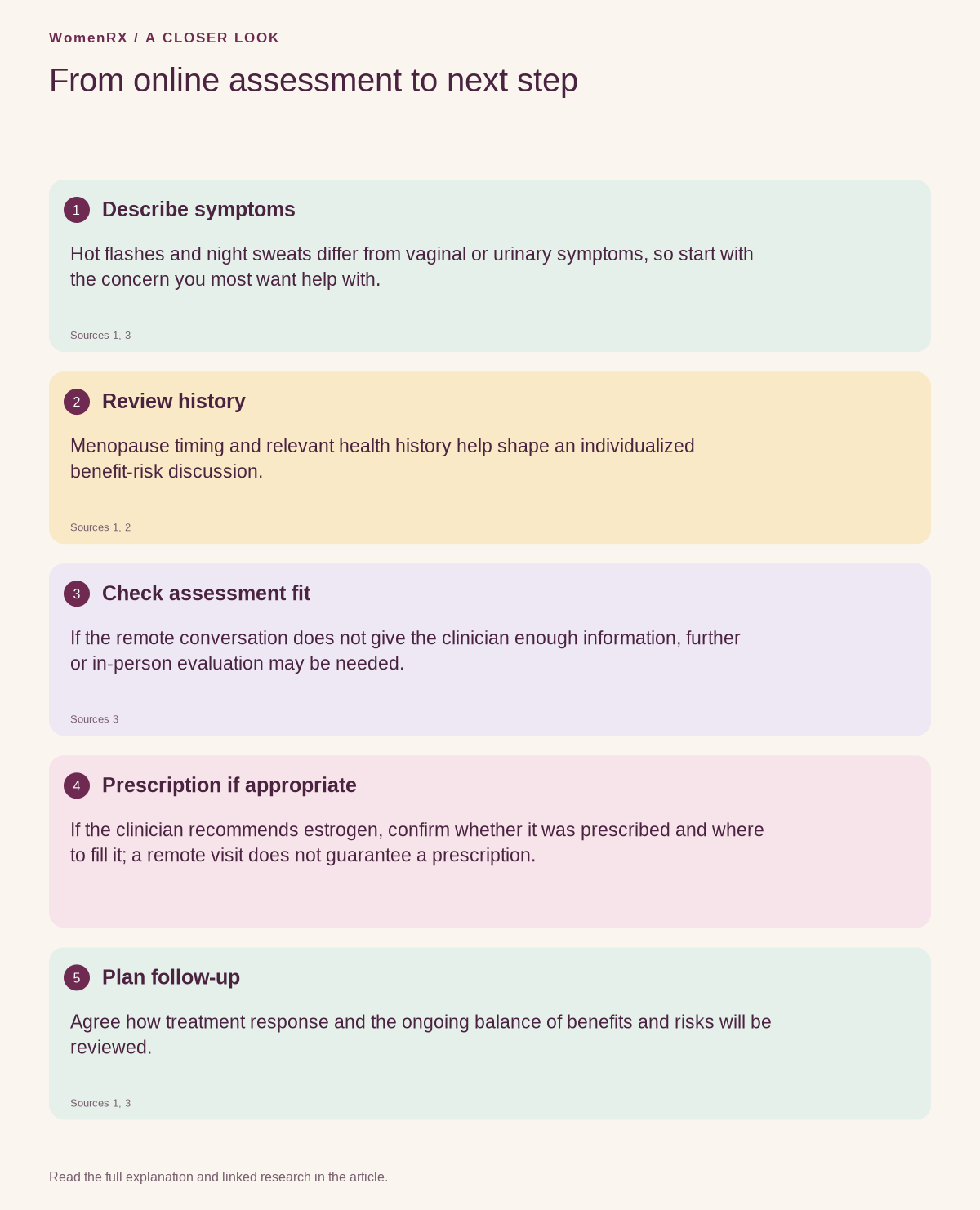
From online assessment to next step
Describe symptoms: Hot flashes and night sweats differ from vaginal or urinary symptoms, so start with the concern you most want help with.13
Review history: Menopause timing and relevant health history help shape an individualized benefit-risk discussion.12
Check assessment fit: If the remote conversation does not give the clinician enough information, further or in-person evaluation may be needed.3
Prescription if appropriate: If the clinician recommends estrogen, confirm whether it was prescribed and where to fill it; a remote visit does not guarantee a prescription.
Plan follow-up: Agree how treatment response and the ongoing balance of benefits and risks will be reviewed.13
Read the figure as text
A remote visit can lead to different next steps depending on the symptoms, health history, and whether the clinician can assess the situation remotely.- Describe symptoms: Hot flashes and night sweats differ from vaginal or urinary symptoms, so start with the concern you most want help with.13
- Review history: Menopause timing and relevant health history help shape an individualized benefit-risk discussion.12
- Check assessment fit: If the remote conversation does not give the clinician enough information, further or in-person evaluation may be needed.3
- Prescription if appropriate: If the clinician recommends estrogen, confirm whether it was prescribed and where to fill it; a remote visit does not guarantee a prescription.
- Plan follow-up: Agree how treatment response and the ongoing balance of benefits and risks will be reviewed.13
More questions, answered
Does an online appointment mean I’ll get estrogen?
No. The clinician still needs to decide whether estrogen fits your symptoms and individual benefit-risk discussion, and whether remote assessment is enough. 1 3
Is vaginal estrogen the same as estrogen for hot flashes?
They’re used in different treatment contexts. Systemic hormone therapy is the most effective treatment for bothersome hot flashes and night sweats; low-dose vaginal estrogen is an option for certain GSM symptoms. 1
Sources you can check
- The 2022 hormone therapy position statement of The North American Menopause Society.“The 2022 Hormone Therapy Position Statement of The North American Menopause Society” Advisory Panel. · Menopause (New York, N.Y.) · 2022Return to first citation
- The 2023 nonhormone therapy position statement of The North American Menopause Society.Menopause (New York, N.Y.) · 2023Return to first citation
- The genitourinary syndrome of menopause.Phillips NA, Bachmann GA. · Menopause (New York, N.Y.) · 2021Return to first citation