How Is Micronized Progesterone Prescribed and Taken?
A few words on your prescription can tell you the route, timing, and pattern, but the right directions depend on your specific product and hormone-therapy plan.
Read the route and schedule together. For example, “by mouth” identifies an oral route, while “on [specified days]” describes a schedule that isn’t daily. These examples explain wording, not what your prescription should say. Menopause hormone therapy is individualized, so don’t copy another person’s directions or change yours based on a general schedule. If missed-dose instructions are unclear, ask your pharmacist or prescriber. 1
Read the route before the rest
Start with the route written on your prescription. Wording such as “by mouth” or “oral” identifies an oral route. “Vaginal” identifies a different route. These are examples of what route wording can communicate, not directions for a particular product. Use the route stated for your prescription rather than inferring it from the medicine’s name, appearance, or a regimen you’ve seen elsewhere.
Route and formulation matter in a hormone-therapy plan. For example, a study of healthy postmenopausal women with an intact uterus examined oral estradiol paired with vaginal progesterone gel. That particular regimen did not fully oppose estradiol’s effects on the uterine lining, so it shouldn’t be treated as a general schedule or a substitute for your own prescription. 2
Daily directions and scheduled days mean different things
Next, look for how often and on which days the prescription says to use the medicine. “Daily” indicates a daily schedule. Wording such as “on [specified days] of each month” points to a schedule limited to the named days. The brackets are placeholders, not a recommended number of days or a sample regimen.
If your directions mention a repeating pattern, make sure you know when it starts and what counts as the next cycle. Don’t fill in missing days yourself. Menopause hormone therapy is individualized, and its risks can vary with factors including dose, route, and timing. A schedule that suits one plan may not suit another. 1
If progesterone is part of a plan that also includes estrogen, confirm how the instructions fit together rather than adjusting either medicine on your own. The study above tested one specific oral-estrogen and vaginal-progesterone regimen; it doesn’t establish what schedule is right for someone else. 2
Timing is separate from the days you take it
A direction about when to take a medicine is separate from which days to take it. For example, a label may specify a time of day. Follow the timing on your own prescription rather than changing it based on a general suggestion or someone else’s experience.
A review reports that oral micronized progesterone can be associated with drowsiness and dizziness, and describes nighttime administration as potentially better tolerated. That may help explain why timing comes up, but it doesn’t set the right time for every person or prescription. If you’re unsure what your timing instruction means, ask a pharmacist to interpret the directions for your product. 3
If you miss a dose or the directions don’t add up
Missed-dose directions depend on the product and prescription. Check the instructions that came with your medicine. If they don’t answer your question, ask your pharmacist or prescriber whether to take it late, skip it, or do something else. Don’t double a dose or make a new schedule unless your product instructions or prescriber direct you to.
If the label and the directions you remember don’t match, check which instructions apply before changing the route or schedule. You can ask: “Can you confirm whether this is by mouth or vaginal, which days I take it, what time I take it, and what I should do if I miss a dose?”
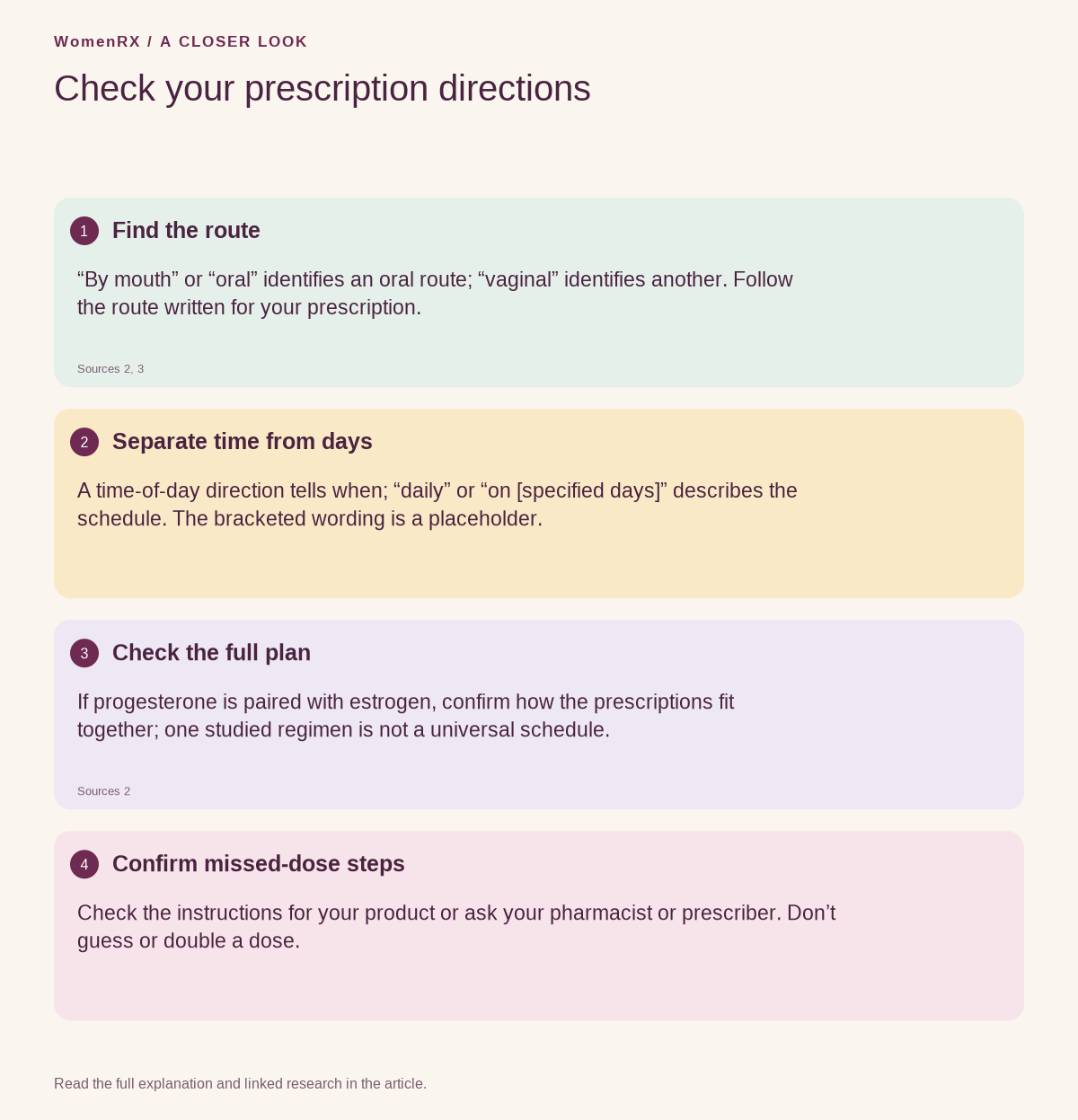
Check your prescription directions
Find the route: “By mouth” or “oral” identifies an oral route; “vaginal” identifies another. Follow the route written for your prescription.23
Separate time from days: A time-of-day direction tells when; “daily” or “on [specified days]” describes the schedule. The bracketed wording is a placeholder.
Check the full plan: If progesterone is paired with estrogen, confirm how the prescriptions fit together; one studied regimen is not a universal schedule.2
Confirm missed-dose steps: Check the instructions for your product or ask your pharmacist or prescriber. Don’t guess or double a dose.
Read the figure as text
Use the words on your own prescription to distinguish how to take it from when and on which days. The examples explain label wording; they aren’t a sample regimen.- Find the route: “By mouth” or “oral” identifies an oral route; “vaginal” identifies another. Follow the route written for your prescription.23
- Separate time from days: A time-of-day direction tells when; “daily” or “on [specified days]” describes the schedule. The bracketed wording is a placeholder.
- Check the full plan: If progesterone is paired with estrogen, confirm how the prescriptions fit together; one studied regimen is not a universal schedule.2
- Confirm missed-dose steps: Check the instructions for your product or ask your pharmacist or prescriber. Don’t guess or double a dose.
More questions, answered
Can I use someone else’s schedule if the prescription strength is the same?
No. The same strength doesn’t establish that the route, product, or schedule is the same. Menopause hormone therapy is individualized, and factors including dose and route can differ across plans. 1
Sources you can check
- The 2022 hormone therapy position statement of The North American Menopause Society.“The 2022 Hormone Therapy Position Statement of The North American Menopause Society” Advisory Panel. · Menopause (New York, N.Y.) · 2022Return to first citation
- Use of oral estradiol plus vaginal progesterone in healthy postmenopausal women.Sriprasert I, Mert M, Mack WJ, Hodis HN, Shoupe D. · Maturitas · 2021Return to first citation
- Diagnostic and therapeutic use of oral micronized progesterone in endocrinology.Memi E, Pavli P, Papagianni M, Vrachnis N, Mastorakos G. · Reviews in endocrine & metabolic disorders · 2024Return to first citation