Are Testosterone Pellets an Appropriate Option for Women?
Pellets last for months, but their long release can make testosterone harder to adjust than a transdermal treatment.
Testosterone pellets aren’t a routine first choice for women. Guidance generally limits testosterone treatment to postmenopausal women with hypoactive sexual desire disorder (HSDD) and favors transdermal formulations. Pellets can release testosterone for four to six months, but may cause high early levels and are less reversible once inserted. Evidence for their benefits and long-term safety remains limited. 12
First ask what the treatment is for
The question isn’t only which delivery method is most convenient. It’s whether testosterone is an appropriate treatment for your specific concern. Guidance summarized in a recent review limits testosterone treatment to postmenopausal women with hypoactive sexual desire disorder (HSDD). A 2025 position statement recommends confirming HSDD through a formal biopsychosocial evaluation, which considers factors beyond hormone levels. It also says testosterone levels aren’t a way to diagnose the condition. 12
Recommendations aren’t identical everywhere, but the guidance in these sources favors transdermal testosterone. The position statement does not recommend pellets, citing concern about high dosing and insufficient evidence. In the US, testosterone treatment for women is off-label; the cited clinical review reports that there isn’t a testosterone formulation specifically approved for women. 23
That makes it reasonable to ask why a pellet is being offered, what evidence supports using it for your situation, and what alternatives have been considered.
The pellet tradeoff: fewer applications, less flexibility
A pellet is placed under the skin and releases testosterone over several months. A review of studies in peri- and postmenopausal women describes release lasting about four to six months. That extended delivery may mean less day-to-day treatment work. The tradeoff is that an implanted dose is less readily adjusted or reversed than a treatment that can be changed. 1
Pellets can also produce an early rise in testosterone above the usual female range, followed by sustained levels, with substantial variation between individuals. That matters because guidance recommends keeping levels within the premenopausal physiological range. Ask what can realistically be changed if your levels are higher than intended or you develop a side effect while the pellet is still releasing hormone. 12
The evidence for pellets is much thinner than the evidence for transdermal treatment. The review found only one small randomized trial of pellets. It reported improvements in sexual activity, orgasm, and satisfaction at 24 weeks, but participants received testosterone plus estradiol implants. That means the trial can’t show what testosterone pellets alone contributed. Other reported improvements come largely from observational studies, which can suggest a possible benefit but can’t establish as reliably that the pellet caused it. 1
Safety questions remain, too. The review describes acne and increased hair growth among reported androgen-related effects, along with rare, temporary voice changes. It found cardiovascular, metabolic, and endometrial safety evidence to be sparse or inconsistent. A lack of a clear safety signal in limited studies isn’t the same as proving long-term safety. 1
How the routes compare
Transdermal gel or cream is the route favored in the cited guidance. It requires regular application, but can be adjusted more readily than a long-acting implant. Testosterone can transfer through skin contact, so ask what precautions are needed to prevent exposing someone else. 123
Pellets reduce the need for regular application, but release hormone for months and are less reversible once inserted. Their evidence base includes only one small randomized trial, alongside observational studies. 1
Injections aren’t necessarily a steadier alternative: the review describes sharp fluctuations in testosterone levels with this route. Oral testosterone undecanoate is associated in the same review with erratic absorption, high peaks, and adverse effects on blood lipids. The routes therefore differ in more than convenience, and the review doesn’t establish injections or oral treatment as equivalent evidence-based substitutes for transdermal therapy in women. 1
Questions worth settling before an implant
- What diagnosis are we treating, and how was it established? Ask how your symptoms fit HSDD and what other influences on sexual desire were considered. 2
- Why choose a pellet instead of a transdermal formulation? Ask what benefit the longer-lasting delivery offers in your case, and what flexibility you give up. 12
- What will the monitoring plan be? The position statement recommends checking a baseline testosterone level and monitoring within three to six weeks, with the aim of keeping levels in the premenopausal physiological range. It doesn’t provide a pellet-specific monitoring protocol, so ask how those recommendations apply to an implant. 2
- What happens if levels are too high or side effects appear? Ask what can be changed after insertion and whether removal is possible and appropriate in your situation. The review describes pellets as having limited reversibility, so it’s worth discussing this before the procedure. 1
- What is still uncertain? Ask how the limited pellet trial evidence and unanswered long-term safety questions affect the recommendation for you. 1
A pellet may appeal if you value treatment that lasts for months. But convenience alone doesn’t establish that it’s the right option: the central tradeoff is fewer applications in exchange for less ability to adjust treatment, with less robust evidence than for transdermal testosterone. A clear explanation of the goal, monitoring plan, and alternatives can help you decide whether that tradeoff makes sense.
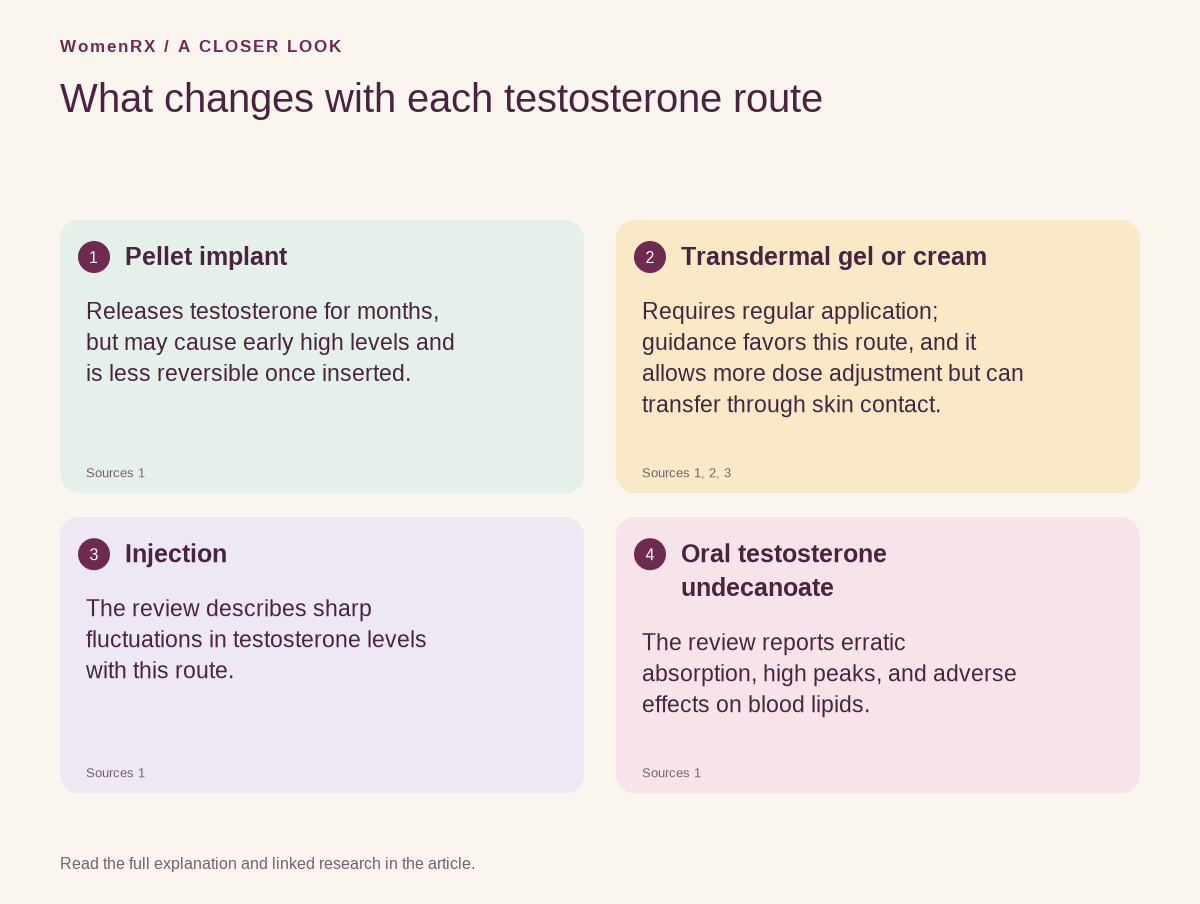
What changes with each testosterone route
Pellet implant: Releases testosterone for months, but may cause early high levels and is less reversible once inserted.1
Transdermal gel or cream: Requires regular application; guidance favors this route, and it allows more dose adjustment but can transfer through skin contact.123
Injection: The review describes sharp fluctuations in testosterone levels with this route.1
Oral testosterone undecanoate: The review reports erratic absorption, high peaks, and adverse effects on blood lipids.1
Read the figure as text
The routes differ in how often treatment is applied, how easily it can be adjusted, and the evidence or tradeoffs described in the review.- Pellet implant: Releases testosterone for months, but may cause early high levels and is less reversible once inserted.1
- Transdermal gel or cream: Requires regular application; guidance favors this route, and it allows more dose adjustment but can transfer through skin contact.123
- Injection: The review describes sharp fluctuations in testosterone levels with this route.1
- Oral testosterone undecanoate: The review reports erratic absorption, high peaks, and adverse effects on blood lipids.1
Sources you can check
- Testosterone Pellets in Women: Revisiting Safety and Clinical Outcomes.Pinto da Costa Viana D, Jacobsen L, Gabriel LH, Lobo de Souza Correia E, da Maia Fernandes D, Nagel ML, Comin A. · Cureus · 2025Return to first citation
- Androgen therapy in midlife and older women: a position statement of the Latin American Association of Gynecological Endocrinology (ALEG).Pilnik S, Belardo A, Marchesan LB, Camero-Lascano A, Acuña-San Martín M, Elizalde-Cremonte A, Ojeda E, Manzur A, Chedraui P. · Climacteric : the journal of the International Menopause Society · 2025Return to first citation
- Long-term testosterone pellet insertion in women with low libido shows no evidence of erythrocytosis and a minimal side effect profile.Hernandez BS, Saffati G, Lowrey KA, Reddy A, Park BS, Song JJ, Lyon G, Khera M. · Translational andrology and urology · 2025Return to first citation