Does testosterone help women lose weight? What menopause evidence supports
Testosterone is considered for a specific menopause-related concern, not established as a weight-loss treatment.
Testosterone should not be assumed to cause weight loss in women. Menopause guidance discusses considering it for low sexual desire when hormone therapy alone hasn’t helped, not for weight management. Studies of weight-loss programs in women have found changes in testosterone levels, but that is different from testing testosterone treatment as a way to lose weight. 1 2 3
The key distinction: treating desire isn’t treating weight
Testosterone is sometimes discussed in menopause care, but the indication matters. NICE says to consider testosterone for menopause-associated low sexual desire when hormone therapy alone hasn’t been effective. That recommendation is about sexual desire, not weight loss. 1
So if someone claims testosterone will help you lose weight, ask what evidence supports that specific result in women like you. Evidence that a hormone level changes during weight loss doesn’t show that taking the hormone causes weight loss.
What the weight-loss studies actually tell us
In a small 16-week dietary weight-loss study, 15 women with obesity were among the participants retested. Their bioavailable testosterone decreased during the program. The study examined hormone levels and insulin sensitivity; it did not test testosterone treatment as a weight-loss intervention. 2
A separate analysis of people with type 2 diabetes found that, among women, a decrease in bioavailable testosterone during an intensive lifestyle intervention was associated with later decreases in body fat mass and lean mass. This was an analysis of hormone and body-composition changes within a weight-loss study, not a trial of testosterone prescribed to women to make them lose weight. 3
The direction of the question matters: these studies examine how weight loss may accompany changes in testosterone. They don’t establish that raising testosterone will reduce weight. And because the findings include women with obesity or type 2 diabetes, they don’t automatically answer what would happen for every woman in perimenopause or after menopause.
Before considering treatment, get specific
If testosterone has come up in a menopause appointment, separate the goal from the product. Is the proposed treatment for low sexual desire, weight, or something else? What outcome would count as a benefit? Which product is being considered, and what side effects and follow-up are relevant to that product and goal?
Those questions matter because the menopause recommendation above concerns low desire when hormone therapy alone hasn’t helped. It doesn’t turn testosterone into a general treatment for weight or body composition. 1
It’s also reasonable to ask what evidence applies to your life stage and health history, and what the plan is if the intended benefit doesn’t occur. Ask for a clear explanation of risks and monitoring rather than relying on broad promises such as “balances hormones” or “boosts metabolism.” These studies do not establish either claim as a weight-loss effect of testosterone treatment in women. 2 3
A useful way to frame the decision
You can take this question to an appointment: “What is testosterone meant to improve for me, and what evidence shows it helps with that specific outcome?” If the answer is weight loss, ask whether the evidence is from women given testosterone for weight management, or from studies where weight loss changed hormone levels. Those are different kinds of evidence, and the difference changes what you can reasonably expect.
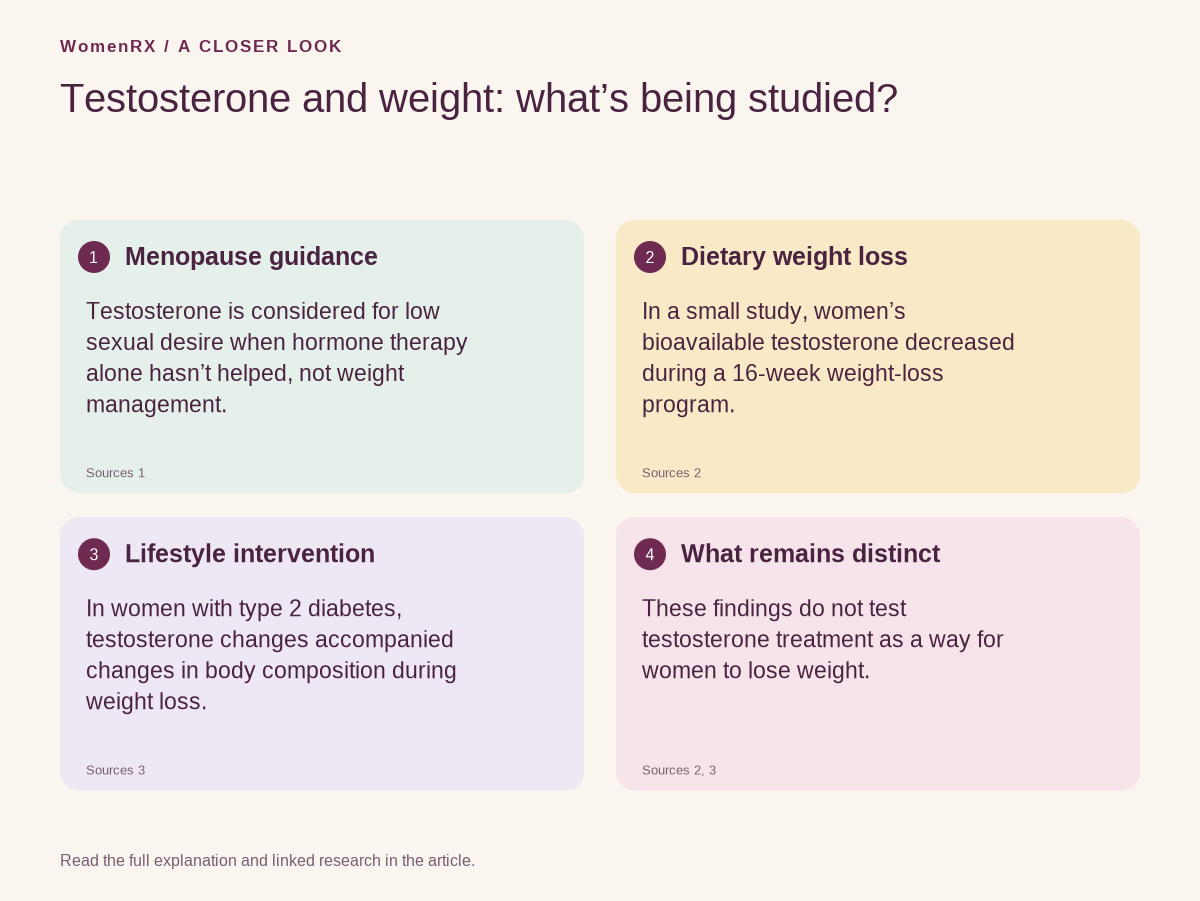
Testosterone and weight: what’s being studied?
Menopause guidance: Testosterone is considered for low sexual desire when hormone therapy alone hasn’t helped, not weight management.1
Dietary weight loss: In a small study, women’s bioavailable testosterone decreased during a 16-week weight-loss program.2
Lifestyle intervention: In women with type 2 diabetes, testosterone changes accompanied changes in body composition during weight loss.3
What remains distinct: These findings do not test testosterone treatment as a way for women to lose weight.23
Read the figure as text
These distinctions show why a hormone change during weight loss is not evidence that testosterone treatment causes weight loss.- Menopause guidance: Testosterone is considered for low sexual desire when hormone therapy alone hasn’t helped, not weight management.1
- Dietary weight loss: In a small study, women’s bioavailable testosterone decreased during a 16-week weight-loss program.2
- Lifestyle intervention: In women with type 2 diabetes, testosterone changes accompanied changes in body composition during weight loss.3
- What remains distinct: These findings do not test testosterone treatment as a way for women to lose weight.23
More questions, answered
Does a change in testosterone during weight loss mean testosterone caused the weight change?
No. These studies looked at hormone changes alongside weight-loss interventions; they did not test testosterone treatment as the cause of weight loss in women. 2 3
What menopause-related use does the guidance discuss?
NICE says to consider testosterone for low sexual desire associated with menopause when hormone therapy alone hasn’t been effective. That is a different goal from weight management. 1
Sources you can check
- Recommendations | Menopause: identification and management | Guidance | NICEAccessed 2026-09-25Return to first citation
- Effects of weight loss on testosterone, sex hormone-binding globulin, adiposity, and insulin sensitivity in women and men.Mucinski JM, Kelley DE, Winters SJ, Goodpaster BH. · Obesity (Silver Spring, Md.) · 2025Return to first citation
- Role of Sex Hormones in Mediating Adiposity Changes From Weight Loss in People With Type 2 Diabetes: Look AHEAD Sex Hormone Study.Oyeka CP, He JH, Ma J, Michos ED, Kalyani RR, Woodward M, Vaidya D, Bennett WL. · The Journal of clinical endocrinology and metabolism · 2025Return to first citation