How Flibanserin Works: Use, Limits, and Safety
Flibanserin is a daily brain-acting medicine for a specific pattern of distressing low desire, not a general treatment for low libido or a hormone deficiency.
Flibanserin (Addyi) is indicated for women under 65 with acquired, generalized hypoactive sexual desire disorder (HSDD): low desire that causes significant distress or relationship difficulty. It acts on serotonin receptors, but exactly how that might improve desire isn’t established. Its average benefit has been modest, and safety depends on bedtime use and checking alcohol and medication interactions. 2 5 6
What it’s intended to treat
Flibanserin is intended for women under 65 with acquired, generalized HSDD. The desire change must also cause marked distress or interpersonal difficulty. A lower level of desire by itself doesn’t establish this diagnosis. 2
That distinction matters because health conditions and medicines can affect sexual health. A diagnosis and suitability assessment are more useful than assuming low desire means a hormone deficiency. 1 2
The brain theory, and what has actually been shown
Flibanserin acts on serotonin receptors. One proposed explanation is that its receptor activity shifts the balance of brain chemical signaling involved in sexual desire, including serotonin, dopamine, and norepinephrine. This is a hypothesis about how the medicine could work, not a proven step-by-step explanation of its effects in an individual woman. 6
Clinical studies have found some benefit, but not a guaranteed change in desire. A review of phase 3 trials described improvements over placebo as consistent but marginal, and noted a strong placebo response. That means the medicine’s average added benefit was limited. 5
What taking it involves
The prescribing information describes flibanserin as a once-daily bedtime medicine, and its trial safety results include a 100 mg bedtime regimen. Taking it while awake can raise the risk of sleepiness, sedation, or other central nervous system effects. If it’s prescribed, clarify the exact instructions and what improvement would count as worthwhile before starting. 2 3
Ask when you and your prescriber will review whether it’s helping. A review of earlier prescribing guidance recommended stopping at eight weeks if there was no benefit; confirm the current plan for your own prescription rather than continuing without a reassessment. 5
Side effects and interactions to review
Sleepiness, sedation, or fatigue were reported in 21% of premenopausal women taking flibanserin in five 24-week trials, compared with 8% taking placebo. In two similar trials of naturally postmenopausal women under 65, the figures were 10% and 6%. Dizziness, nausea, and fatigue were also among the more common adverse effects in a review of phase 3 trials. 2 5
A key safety concern is low blood pressure, sometimes with fainting, as well as sedation. Alcohol can increase these risks. The US prescribing information says to wait at least two hours after one or two standard alcoholic drinks before taking the bedtime dose; if you’ve had three or more drinks that evening, skip that dose. 2
Some medicines raise flibanserin levels and can increase the chance of low blood pressure or fainting. Taking it with moderate or strong CYP3A4 inhibitors is contraindicated. Examples in the prescribing information include certain antibiotics and antifungals, some antiviral medicines, diltiazem, verapamil, and grapefruit juice. Other central nervous system depressants, including opioids, benzodiazepines, sleep medicines, and diphenhydramine, can increase sedation. 2
Other interactions need a medication-by-medication check. The label warns about strong CYP2C19 inhibitors, says CYP3A4 inducers such as carbamazepine, rifampin, and St. John’s wort are not recommended, and notes a possible increase in digoxin levels. Bring a complete list of prescription medicines, over-the-counter products, and supplements so the prescriber or pharmacist can check the exact combination. 2
If you take an antidepressant, don’t assume the combination is either safe or unsafe for every drug in that class. A small randomized trial in premenopausal women with mild or remitted depression on stable SSRI or SNRI treatment found no increased risks during the study, but it ended early and included only 111 participants. That limited result can’t settle safety for every antidepressant or combination. 4
Questions that help make the decision
Before starting, ask: Does my pattern meet the acquired, generalized HSDD indication, and what else could be affecting desire? Which of my medicines, supplements, or usual alcohol habits matter for safety? What change should I look for, and when will we decide whether the benefit is enough to continue? These questions keep the conversation focused on your experience, the specific risks, and a clear plan to reassess.
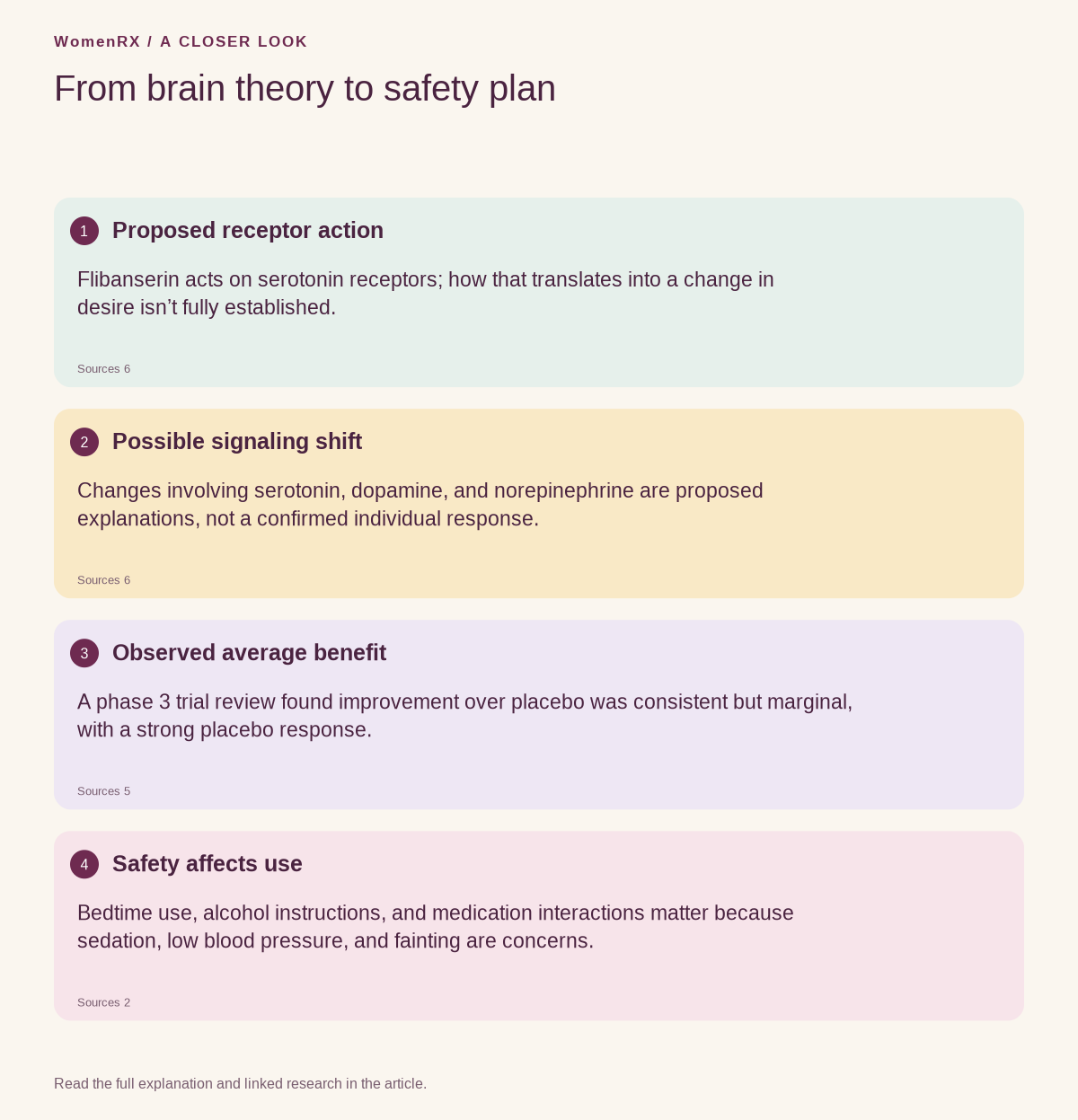
From brain theory to safety plan
Proposed receptor action: Flibanserin acts on serotonin receptors; how that translates into a change in desire isn’t fully established.6
Possible signaling shift: Changes involving serotonin, dopamine, and norepinephrine are proposed explanations, not a confirmed individual response.6
Observed average benefit: A phase 3 trial review found improvement over placebo was consistent but marginal, with a strong placebo response.5
Safety affects use: Bedtime use, alcohol instructions, and medication interactions matter because sedation, low blood pressure, and fainting are concerns.2
Read the figure as text
This figure separates the proposed brain explanation from observed clinical benefit and the practical checks that affect safe use.- Proposed receptor action: Flibanserin acts on serotonin receptors; how that translates into a change in desire isn’t fully established.6
- Possible signaling shift: Changes involving serotonin, dopamine, and norepinephrine are proposed explanations, not a confirmed individual response.6
- Observed average benefit: A phase 3 trial review found improvement over placebo was consistent but marginal, with a strong placebo response.5
- Safety affects use: Bedtime use, alcohol instructions, and medication interactions matter because sedation, low blood pressure, and fainting are concerns.2
More questions, answered
Does flibanserin work by correcting a hormone imbalance?
The proposed mechanism involves serotonin receptors and brain signaling, not a demonstrated correction of a hormone deficiency. The exact way flibanserin might affect desire remains uncertain. 6
Can I take flibanserin with an antidepressant?
It depends on the specific medicine and the rest of your medication list. A small trial found no increased risks when flibanserin was added to stable SSRI or SNRI treatment in a selected group, but the study ended early and cannot establish safety for every combination. Have the exact drugs checked. 2 4
Sources you can check
- Sexual Health | MedlinePlusAccessed 2026-09-25Return to first citation
- ADDYI (FLIBANSERIN) TABLET, FILM COATED [SPROUT PHARMACEUTICALS, INC.] | US prescribing information and patient instructionsAccessed 2026-09-25Return to first citation
- Flibanserin Therapy and CYP2C19 GenotypeDean L. · 2012Return to first citation
- Safety of Flibanserin in Women Treated With Antidepressants: A Randomized, Placebo-Controlled Study.Clayton AH, Croft HA, Yuan J, Brown L, Kissling R. · The journal of sexual medicine · 2018Return to first citation
- First Pharmacological Therapy for Hypoactive Sexual Desire Disorder in Premenopausal Women: Flibanserin.Robinson K, Cutler JB, Carris NW. · The Annals of pharmacotherapy · 2016Return to first citation
- Multifunctional pharmacology of flibanserin: possible mechanism of therapeutic action in hypoactive sexual desire disorder.Stahl SM, Sommer B, Allers KA. · The journal of sexual medicine · 2011Return to first citation