Testosterone Dosing for Women: Why Formulation and Oversight Matter
A testosterone plan should identify the exact product, the amount intended for you, and how your prescriber will follow your response and testosterone levels.
For postmenopausal women, the clearest evidence-backed use is testosterone for hypoactive sexual desire disorder (HSDD), after assessing the concern in context. A product’s strength, the amount applied, and the dose intended for you are different parts of the prescription. Ask your prescriber to specify each one and explain how testosterone levels and signs of excess will be monitored. 1 2
Start with the reason for treatment
The best-supported use of testosterone therapy in women is HSDD after menopause. The decision should follow a broader assessment of the sexual concern, including potentially modifiable factors and other health or relationship concerns, rather than a testosterone test result alone. In the United States, testosterone use for postmenopausal HSDD is off-label. 1 2
A total testosterone test can provide a baseline for monitoring, but it should not be used to diagnose HSDD. A result by itself doesn’t establish why desire has changed or whether testosterone is the right option. 1
Three different things a dose can mean
When you hear a proposed dose, clarify what the number describes. Product strength describes the testosterone in a given amount of product. Amount used describes how much product the directions tell you to apply. Intended dose is the amount of testosterone your prescriber means you to receive. These details are related, but they aren’t interchangeable across products.
The women’s guideline recommends systemic transdermal testosterone for appropriate women with HSDD. It says a government-approved transdermal product designed for men can be used cautiously, with dosing appropriate for women. That does not make the product’s male directions a dose to copy. Ask the prescriber to state the exact product and women-specific directions rather than trying to convert a dose yourself. 1
The guideline does not recommend compounded products because efficacy and safety data are lacking. If one is proposed, ask what product is being used and what evidence supports that choice. 1
Questions that make the plan concrete
Before starting, ask your prescriber:
- What is the exact product and formulation? Confirm the name, whether it is transdermal, and its strength. If it is a product designed for men, ask how the directions have been set for your use.
- What amount should I use? Ask for clear directions using that product’s own units. Don’t borrow directions from another product or another person’s prescription.
- What is the treatment goal? Confirm that the plan is for HSDD and that the relevant factors have been considered, not simply to change a lab result.
- What monitoring will we do? The guideline describes a baseline total testosterone level, follow-up monitoring to keep levels in the physiologic premenopausal range, and assessment for signs of androgen excess. Ask when you’ll review your response and when repeat testing is planned. 1
- How will we decide whether to continue? Agree on when you’ll discuss whether treatment is helping and what findings would prompt a change in the plan.
The guideline describes moderate therapeutic benefit for the studied use. It also says long-term safety has not been established, so the discussion should include potential benefits, risks, and the off-label nature of treatment. 1 2
Keep life stage in view
The clearest guideline support is for postmenopausal women with HSDD. It describes evidence in late reproductive-age premenopausal women as limited, so the postmenopausal findings should not be treated as proof for every life stage. 1
A clear proposal should leave you knowing the reason for treatment, the exact formulation, the amount intended for you, and how your response and testosterone levels will be followed. If any part is vague, ask for the directions to be clarified before using the product.
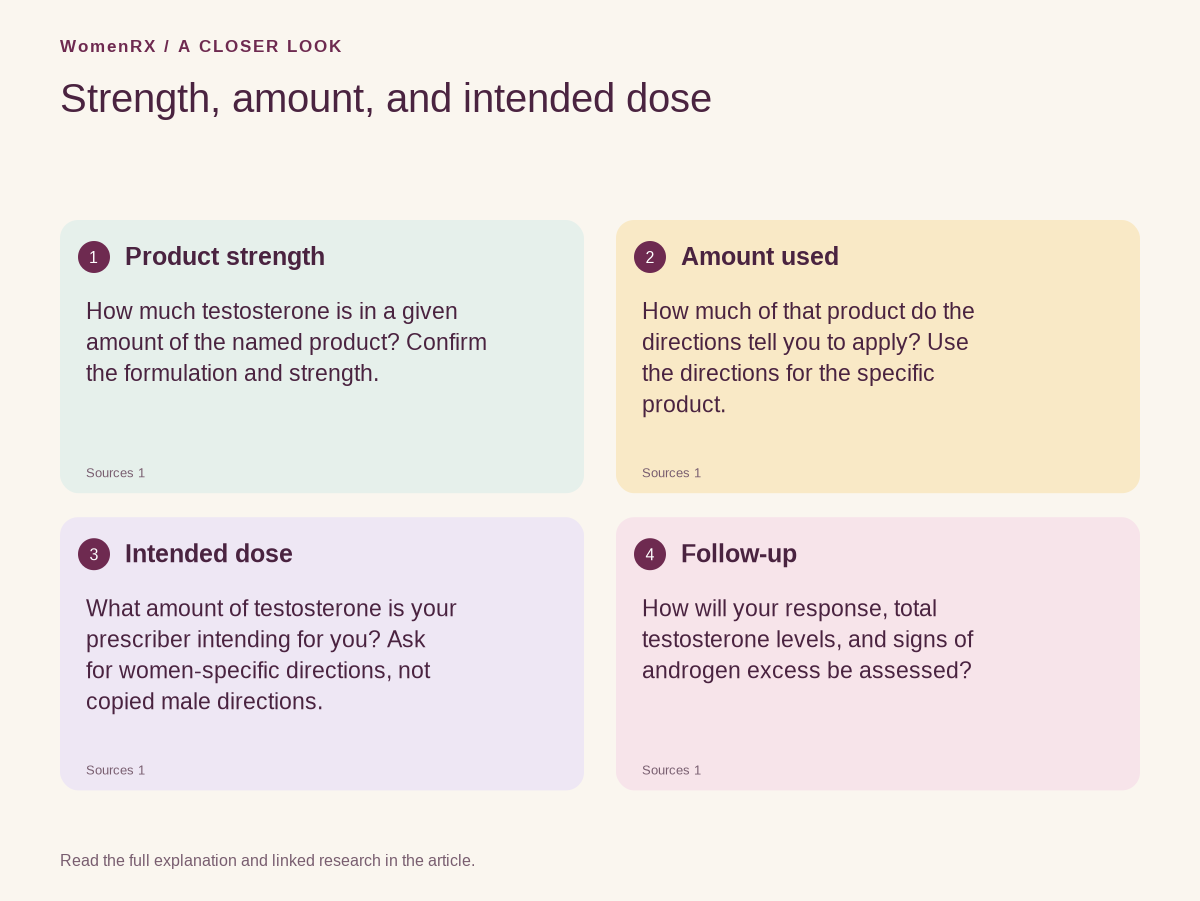
Strength, amount, and intended dose
Product strength: How much testosterone is in a given amount of the named product? Confirm the formulation and strength.1
Amount used: How much of that product do the directions tell you to apply? Use the directions for the specific product.1
Intended dose: What amount of testosterone is your prescriber intending for you? Ask for women-specific directions, not copied male directions.1
Follow-up: How will your response, total testosterone levels, and signs of androgen excess be assessed?1
Read the figure as text
These prescription details answer different questions. Clarifying each one helps prevent directions from one formulation being treated as interchangeable with another.- Product strength: How much testosterone is in a given amount of the named product? Confirm the formulation and strength.1
- Amount used: How much of that product do the directions tell you to apply? Use the directions for the specific product.1
- Intended dose: What amount of testosterone is your prescriber intending for you? Ask for women-specific directions, not copied male directions.1
- Follow-up: How will your response, total testosterone levels, and signs of androgen excess be assessed?1
More questions, answered
Does a low testosterone result mean I need testosterone?
No. A total testosterone level is not used to diagnose HSDD. The guideline describes it as a baseline for monitoring, while the treatment decision follows assessment of the sexual concern and its context. 1
Can I use a compounded testosterone product?
The guideline does not recommend compounded products because efficacy and safety data are lacking. Ask your prescriber to explain the specific formulation being proposed and the evidence behind it. 1
Sources you can check
- International Society for the Study of Women's Sexual Health Clinical Practice Guideline for the Use of Systemic Testosterone for Hypoactive Sexual Desire Disorder in Women.Parish SJ, Simon JA, Davis SR, Giraldi A, Goldstein I, Goldstein SW, Kim NN, Kingsberg SA, Morgentaler A, Nappi RE, Park K, Stuenkel CA, Traish AM, Vignozzi L. · The journal of sexual medicine · 2021Return to first citation
- The International Society for the Study of Women's Sexual Health Process of Care for Management of Hypoactive Sexual Desire Disorder in Women.Clayton AH, Goldstein I, Kim NN, Althof SE, Faubion SS, Faught BM, Parish SJ, Simon JA, Vignozzi L, Christiansen K, Davis SR, Freedman MA, Kingsberg SA, Kirana PS, Larkin L, McCabe... · Mayo Clinic proceedings · 2018Return to first citation