Which Self-Care Practices Help, and With What?
The best-supported choice depends on your goal: research on mood, stress, sleep, and digital self-help answers different questions.
If your goal is mood, research supports some combinations of physical activity and dietary changes for reducing depression symptoms in adults, though it can’t tell which component made the difference. Evidence for anxiety is weaker. Activity has also been linked with lower stress, but that finding doesn’t prove it treats stress. Choose a feasible habit as support, not as a test you must pass before getting care. 2 3 1
Self-care is more useful when it starts with a specific goal than with a shopping list. Are you hoping to ease low mood, feel less stressed, sleep better, or manage daily life? Those aren’t interchangeable outcomes, and a study that supports one claim may say little about the others.
For low mood, look at what was tested together
A 2026 systematic review and meta-analysis examined interventions combining physical activity with dietary changes in adults with varied health circumstances. It found moderate-quality evidence that several combinations likely reduce depression symptoms. Evidence for reduced anxiety was rated low quality. Because participants changed both activity and diet, the review can’t show how much benefit came from either one alone. Its abstract didn’t report a women-specific result. 2
There’s also more focused exercise research. A review of 46 randomized trials involving 4,358 people with heart failure reported improvements in depression and anxiety symptoms with physical activity. That’s useful evidence for people with heart failure, not a promise that the same results apply to everyone or to every kind of activity. 4
If you want to try movement for mood, feasibility matters. A walk, movement at home, and a class are examples of options with different demands on time, mobility, money, and transportation. Pick something that fits your circumstances rather than assuming the most elaborate option will work best. These studies don’t establish that any one of those choices will treat depression.
For stress, separate a link from an effect
A review of observational studies conducted during the COVID-19 pandemic found that adults who were more physically active tended to report less depression and stress, but not less anxiety. The studies varied considerably. Because researchers observed people’s activity rather than assigning an activity intervention, the findings can’t establish that being active caused the difference. 3
That doesn’t make a personally helpful activity worthless. It means a claim such as “exercise treats stress” goes further than this research does. If stress is tied to demands you can’t simply rearrange, such as caregiving or money problems, adding another task may not be the most helpful first move. Those pressures can themselves affect mental health. 1
For sleep, know what a routine claim can and can’t say
In a qualitative study in urban India, older adults, caregivers, and experts described regular sleep routines as part of healthy aging. Researchers gathered perspectives to help design a digital self-help intervention; they didn’t test whether a particular sleep routine improved sleep, mood, or stress. 6
If a regular bedtime fits your life and feels useful, it doesn’t need to be a proven mental-health treatment to be worth considering. But a sleep change can also be a sign that something else needs attention, especially alongside withdrawal from activities you enjoy or difficulty handling everyday tasks. 1
For online self-help, completion changes the picture
A randomized trial of a self-guided online resilience program enrolled 216 university students in Germany. The analysis including participants as assigned found no significant benefit. A separate analysis of 150 participants who followed the study protocol found improvements in mental distress and self-compassion after the program, but adherence was low overall. Results among people who complete a program may not describe what happens when it’s offered to everyone. This trial also doesn’t establish that other apps or courses work. 5
A digital option may avoid a trip across town, yet still require reliable internet, privacy, attention, and time. Those are practical questions, not proof of effectiveness. Before paying for a program, check whether its claims are backed by research on that program and the outcome you care about; a general claim about “resilience” isn’t the same as evidence that it helps you sleep or function better.
When the goal is getting through the day
A habit can support you without becoming your whole care plan. Changes in eating or sleeping, pulling away from people and activities you enjoy, and trouble doing daily tasks are among the signs that a mental-health problem may need attention. Talk therapy and medication are treatments for mental disorders; if you’re unsure where to start, primary care is one possible starting point. You don’t have to exhaust your self-care options before asking for help. 1
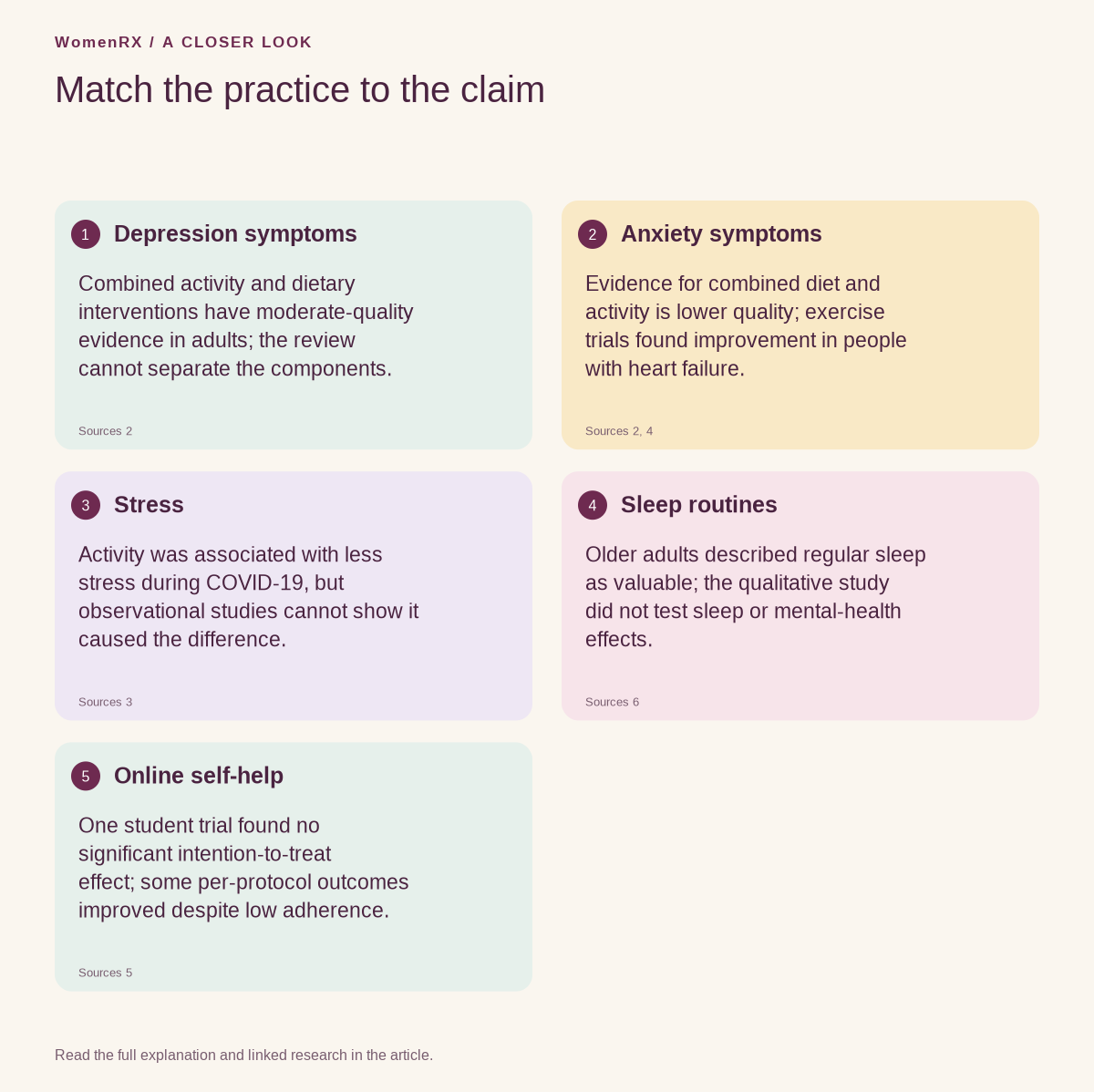
Match the practice to the claim
Depression symptoms: Combined activity and dietary interventions have moderate-quality evidence in adults; the review cannot separate the components.2
Anxiety symptoms: Evidence for combined diet and activity is lower quality; exercise trials found improvement in people with heart failure.24
Stress: Activity was associated with less stress during COVID-19, but observational studies cannot show it caused the difference.3
Sleep routines: Older adults described regular sleep as valuable; the qualitative study did not test sleep or mental-health effects.6
Online self-help: One student trial found no significant intention-to-treat effect; some per-protocol outcomes improved despite low adherence.5
Read the figure as text
The type of research matters as much as the self-care practice: a tested symptom change, an observed link, and a valued routine support different conclusions.- Depression symptoms: Combined activity and dietary interventions have moderate-quality evidence in adults; the review cannot separate the components.2
- Anxiety symptoms: Evidence for combined diet and activity is lower quality; exercise trials found improvement in people with heart failure.24
- Stress: Activity was associated with less stress during COVID-19, but observational studies cannot show it caused the difference.3
- Sleep routines: Older adults described regular sleep as valuable; the qualitative study did not test sleep or mental-health effects.6
- Online self-help: One student trial found no significant intention-to-treat effect; some per-protocol outcomes improved despite low adherence.5
More questions, answered
Do these findings apply differently during pregnancy, postpartum, or menopause?
The adult review of combined diet and activity interventions didn’t report results separately for women or by life stage in its abstract. It can’t establish whether benefits differ during pregnancy, postpartum, perimenopause, or postmenopause. 2
Sources you can check
- Mental Health: MedlinePlusAccessed 2026-09-25Return to first citation
- Combined Effects of Diet and Physical Activity Interventions on Depression and Anxiety. A Systematic Review and Meta-Analysis.Dinas PC, 5104 Research Group, Zalagkitis C, Karaventza M, Ntelis N, Papagianni M, Veskoukis AS, Metsios GS. · American journal of lifestyle medicine · 2026Return to first citation
- Mental health outcomes and physical activity during the COVID-19 pandemic: A systematic review and meta-analysis of observational studies.Pizarro Andrade RLN, Enriquez Canto Y, Angulo Salas RJ, Cahui Ramirez CR, Díaz Gervasi GM. · Journal of health psychology · 2026Return to first citation
- Effects of physical activity on anxiety and depression symptoms in patients with heart failure: A systematic review and meta-analysis of randomized controlled trials.An X, Cao Y, Fan J, Gao M, Du S. · Journal of health psychology · 2026Return to first citation
- Efficacy of a self-guided online resilience intervention for improving mental health among university students: A randomized controlled trial.Bartelt S, Werner T, von Boros L, Schäfer SK, Koehler F, Wirth BE, Lieb K, Tüscher O, Wessa M. · Scientific reports · 2026Return to first citation
- Stakeholder perspectives informing the design and development of a digital self-help intervention for healthy aging and mental well-being among older adults in urban India: a qualitative study.Saha I, Das D, Dutta S, Hoda S, Khasnobis M, Sharma S, J J, Sajan TL, Das S, Dahiya N, Saha A, Sethuraman L, Kandasamy A, Agahi N, Jayaram-Lindström N, Kraepelien M, Sundström C, C... · BMC geriatrics · 2026Return to first citation