What Happens When You Seek Menopause Hormone Therapy Online?
An online menopause visit can lead to a treatment plan, a prescription if you and the clinician agree it’s appropriate, or a request for more assessment.
An online menopause visit usually starts with questions about your symptoms and health history, followed by a conversation about possible treatments and their benefits and risks. If hormone therapy is appropriate and you agree on a plan, the clinician may prescribe it and arrange follow-up. You may instead be offered another treatment or asked to get more assessment first; a remote visit doesn’t guarantee a prescription.
First, check what the service actually offers
Online menopause care isn’t one standardized pathway. Services can differ in who provides care and what they can assess remotely, so before you book, check whether the visit includes a clinician consultation, how follow-up works, and what happens if the clinician thinks you need an in-person exam or further evaluation.
Telehealth has been used in specialist menopause care: in one Australian clinic, 95.4% of consultations were delivered remotely during the COVID-19 period. In a later survey of 94 patients from that clinic, 70% said they were satisfied with telehealth. Those findings describe one specialist service, not every online service or U.S. care pathway. 2
The path from intake to a decision
1. You describe what’s bothering you
An intake form or consultation may ask about symptoms, when they began, menstrual changes, and how they affect daily life. Be specific. For example, “I wake up drenched several nights a week” gives a clearer picture than “I feel off.” Note whether your main concern is hot flashes or night sweats, vaginal or urinary symptoms, or something else.
It can help to have your health history and current medicines in front of you. Mention previous treatments, relevant diagnoses, and any unexpected bleeding after menopause. That bleeding should be checked to find its cause; it shouldn’t be treated as just another menopause symptom. 1
2. The clinician reviews your situation
The consultation is a chance to connect your symptoms with your health history and talk through what matters most to you. Menopausal hormone therapy (MHT) isn’t a single treatment with the same balance of benefits and risks for everyone. Those risks can vary with the type of hormone, dose, route, timing, duration, and whether a progestogen is used. Age and time since menopause also inform the benefit-risk discussion. 3
This is also a good time to ask what the service can decide from a remote visit and what might need another kind of evaluation. If a concern such as unexplained bleeding needs assessment, the next step may be to address that first rather than make an immediate treatment decision. 1
3. You discuss possible options, including not using hormones
If symptoms and health history point toward MHT as a reasonable option, the clinician can discuss its possible benefits and risks for you. You can ask what symptom the proposed treatment is meant to address, what alternatives are available, and when you’ll revisit whether it’s helping.
Hormone therapy is not the only possible outcome. For bothersome hot flashes or night sweats, evidence-based nonhormonal options include certain prescription medicines and cognitive behavioral therapy, among other choices. For vaginal or urinary symptoms, the treatment discussion may differ from one about whole-body symptoms; guidance includes low-dose vaginal estrogen for bothersome genitourinary symptoms not relieved by over-the-counter treatments when systemic hormone therapy isn’t indicated. 3 4
If the clinician needs more information before weighing options, the visit may end with a request for additional assessment or a different kind of appointment. That’s a possible branch in care, not a sign that treatment has been ruled out.
4. A prescription may follow a shared decision
If you and the clinician decide hormone therapy is suitable, the clinician may prescribe a treatment and explain the plan. A prescription is conditional on that decision; it isn’t an automatic result of completing an online intake. The precise product and plan depend on the clinical discussion, and this article can’t predict what a particular service will offer. MHT should be individualized to balance benefits and risks. 3
If hormones aren’t a fit, you can ask which nonhormonal options are supported for your symptoms and whether more assessment is needed before choosing one. For vasomotor symptoms, the Menopause Society’s position statement identifies several evidence-supported nonhormonal options, including some prescription treatments and cognitive behavioral therapy. 4
5. Follow-up checks how the plan is working
A treatment decision isn’t necessarily the end of the process. Ask when and how the service will review your symptoms, any unwanted effects, and whether the balance of benefits and risks still makes sense. Periodic reevaluation is part of individualized hormone-therapy care. 3
Before you finish the visit, make sure you understand the agreed plan, what to do if symptoms don’t improve, and how to reach the service with questions. If the service doesn’t explain follow-up, ask who is responsible for it and whether the next visit is included or arranged separately.
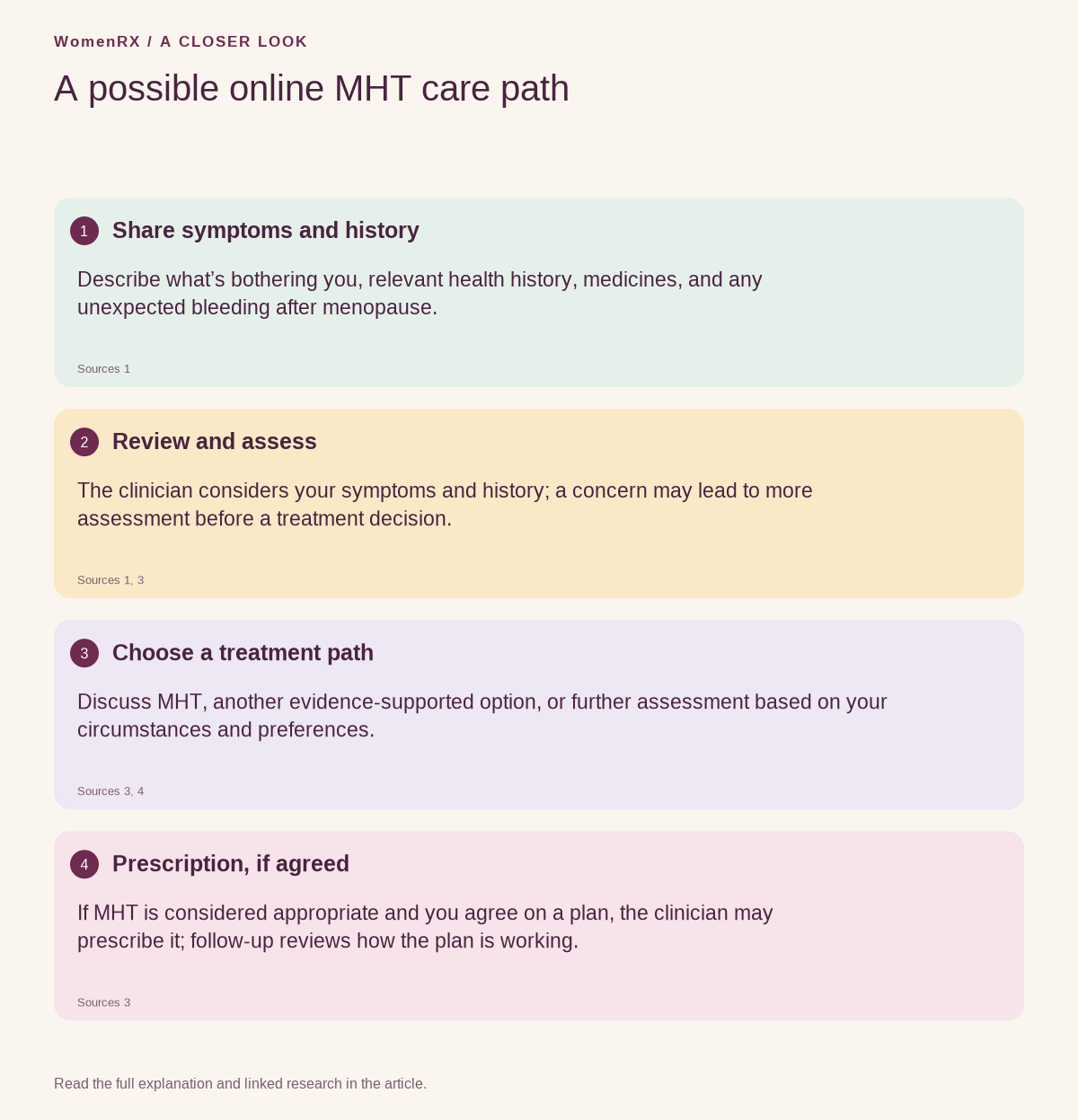
A possible online MHT care path
Share symptoms and history: Describe what’s bothering you, relevant health history, medicines, and any unexpected bleeding after menopause.1
Review and assess: The clinician considers your symptoms and history; a concern may lead to more assessment before a treatment decision.13
Choose a treatment path: Discuss MHT, another evidence-supported option, or further assessment based on your circumstances and preferences.34
Prescription, if agreed: If MHT is considered appropriate and you agree on a plan, the clinician may prescribe it; follow-up reviews how the plan is working.3
Read the figure as text
An online visit may move through these stages, but the treatment decision and next step depend on the individual assessment.- Share symptoms and history: Describe what’s bothering you, relevant health history, medicines, and any unexpected bleeding after menopause.1
- Review and assess: The clinician considers your symptoms and history; a concern may lead to more assessment before a treatment decision.13
- Choose a treatment path: Discuss MHT, another evidence-supported option, or further assessment based on your circumstances and preferences.34
- Prescription, if agreed: If MHT is considered appropriate and you agree on a plan, the clinician may prescribe it; follow-up reviews how the plan is working.3
More questions, answered
Does an online menopause consultation guarantee an HRT prescription?
No. A prescription may follow if the clinician considers hormone therapy appropriate and you agree on a plan. The visit could instead lead to another treatment discussion or a request for more assessment.
What should I ask about follow-up?
Ask when your symptoms and treatment plan will be reviewed, how to contact the service between visits, and what happens if the treatment isn’t helping. Hormone therapy guidance recommends periodic reevaluation of benefits and risks. 3
Sources you can check
- BIJUVA (ESTRADIOL AND PROGESTERONE) CAPSULE [MAYNE PHARMA] | US prescribing information and patient instructionsAccessed 2026-09-25Return to first citation
- The impact of COVID-19 on a specialised menopause clinic: Changes in practice and women's experiences.Kozica-Olenski SL, Ghelani DP, Boyle JA, Vincent AJ. · The Australian & New Zealand journal of obstetrics & gynaecology · 2023Return to first citation
- The 2022 hormone therapy position statement of The North American Menopause Society.“The 2022 Hormone Therapy Position Statement of The North American Menopause Society” Advisory Panel. · Menopause (New York, N.Y.) · 2022Return to first citation
- The 2023 nonhormone therapy position statement of The North American Menopause Society.Menopause (New York, N.Y.) · 2023Return to first citation