How Can You Evaluate an Online Menopause Clinician?
Check who will care for you, what the visit includes, and what you’ll pay before you book.
Before booking, verify who provides care, whether they can see you where you’ll be, what the visit covers, and how follow-up works. Compare fees by what’s included: on September 25, 2026, Midi listed a $250 self-pay first visit, while Alloy listed a $49 consultation plus separately priced medication. 5 6 A virtual visit doesn’t guarantee a prescription or replace an assessment you need in person.
Virtual care can make it easier to reach a menopause-focused clinician, but the platform’s description won’t tell you exactly who you’ll see or what the appointment includes. Before paying, check the clinician, the visit’s scope, the cost, and how care continues if your needs go beyond a video call.
In one survey at an Australian specialist menopause service, 94 women responded: 70% were satisfied with telehealth, 69% preferred an in-person first visit, and 65% preferred telehealth for review visits. Those preferences describe one service, not a rule for every woman. They’re a good reminder to ask whether you can choose a different format if your needs change. 3
Verify the person providing care
Ask for the name and credentials of the clinician who will evaluate you. Find out how to verify their license with the relevant state licensing board, and ask the service to confirm that the clinician can provide care where you’ll be during the appointment. If the platform won’t say who you’ll see until after you book, ask what you’ll be able to verify beforehand.
A label such as “menopause specialist” doesn’t tell you what the clinician’s training or experience is. Ask whether they regularly care for people in perimenopause and after menopause, and whether they address the symptoms or treatment questions you have. Also ask whether the same clinician will handle follow-up or whether care may be handed to someone else.
Match the appointment to your question
Before booking, describe what you want help with. Ask whether the clinician can discuss your symptoms and medical history in a virtual appointment, and what they do if your concern calls for an examination, testing, or another kind of assessment.
In an audit of an Australian specialist clinic, fewer investigations were performed during the period when most consultations were by telehealth than during the earlier, in-person period. That comparison doesn’t show that telehealth caused the difference or that virtual care is unsuitable. It does make it reasonable to ask how a service handles questions that can’t be resolved remotely. 3
A separate interview study at a specialist menopause service included 18 women and six clinicians. Participants described convenience and improved access as benefits, as well as challenges involving personalization, logistics, and how the service was organized. The researchers supported a flexible model with both virtual and in-person care. 4
Ask how treatment decisions are made
If you’re considering menopausal hormone therapy, ask how the clinician will weigh your symptoms, preferences, and medical history, and whether they’ll discuss benefits, risks, and alternatives. The North American Menopause Society says hormone therapy risks vary with the type, dose, duration, route, timing, and use of a progestogen. Its position statement recommends individualized treatment and periodic review. 1
Ask what options the clinician can discuss if hormone therapy isn’t suitable for you or isn’t your preference. The North American Menopause Society identifies several evidence-supported nonhormonal approaches for vasomotor symptoms, including certain prescription treatments and cognitive behavioral therapy. You can ask which options are within the clinician’s practice and what referral is available if you need another kind of care. 2
A platform’s mention of prescriptions isn’t a promise that a clinician will prescribe a particular medication. Ask whether treatment decisions follow an evaluation of your history and a conversation about options, and what follow-up is offered if treatment is started.
Get the full cost and follow-up details
Posted prices show why it helps to separate the visit from the treatment. On September 25, 2026, Midi listed a self-pay price of $250 for a 30-minute first visit and $150 for a 15-minute returning visit; its pricing information said additional costs may apply. Those are visit prices, not a total that includes medication or tests. 5
On the same date, Alloy listed a $49 one-time doctor consultation fee. Its estradiol pill started at $39.99 per month, while its estradiol patch was listed at $100 per month. Those monthly figures are medication prices, not a complete treatment cost or a specified dose or package quantity for your prescription. The medication depends on what’s prescribed, and the price information doesn’t state a progesterone cost. Alloy also says subscriptions usually bill every three months, with some exceptions, so a per-month price may not be what you’re charged at checkout. These are examples of posted prices, not comparable quotes for your care or a reason to choose a treatment. 6 7
Ask for the total expected cost before booking. Find out whether there’s a membership fee and whether the visit fee covers only the initial appointment or also follow-ups, messages, or refills. Ask whether medication, tests, or other services are billed separately, whether insurance is accepted, and what the cancellation or refund terms are. Verify these details with the service rather than relying on a general price description.
Before you commit, ask how you’ll receive visit notes and recommendations, how to contact the care team after the appointment, and who to reach if the clinician is unavailable. If you might need an in-person evaluation, ask whether the service can arrange or refer you for one, or whether you’ll need to find that care separately.
A useful pre-booking check is whether you can get clear answers to five things: who the clinician is, whether the visit fits your concern, how treatment choices are made, what you’ll pay, and how follow-up or in-person care works. If the service’s limits don’t fit what you need, look for a different format or care option.
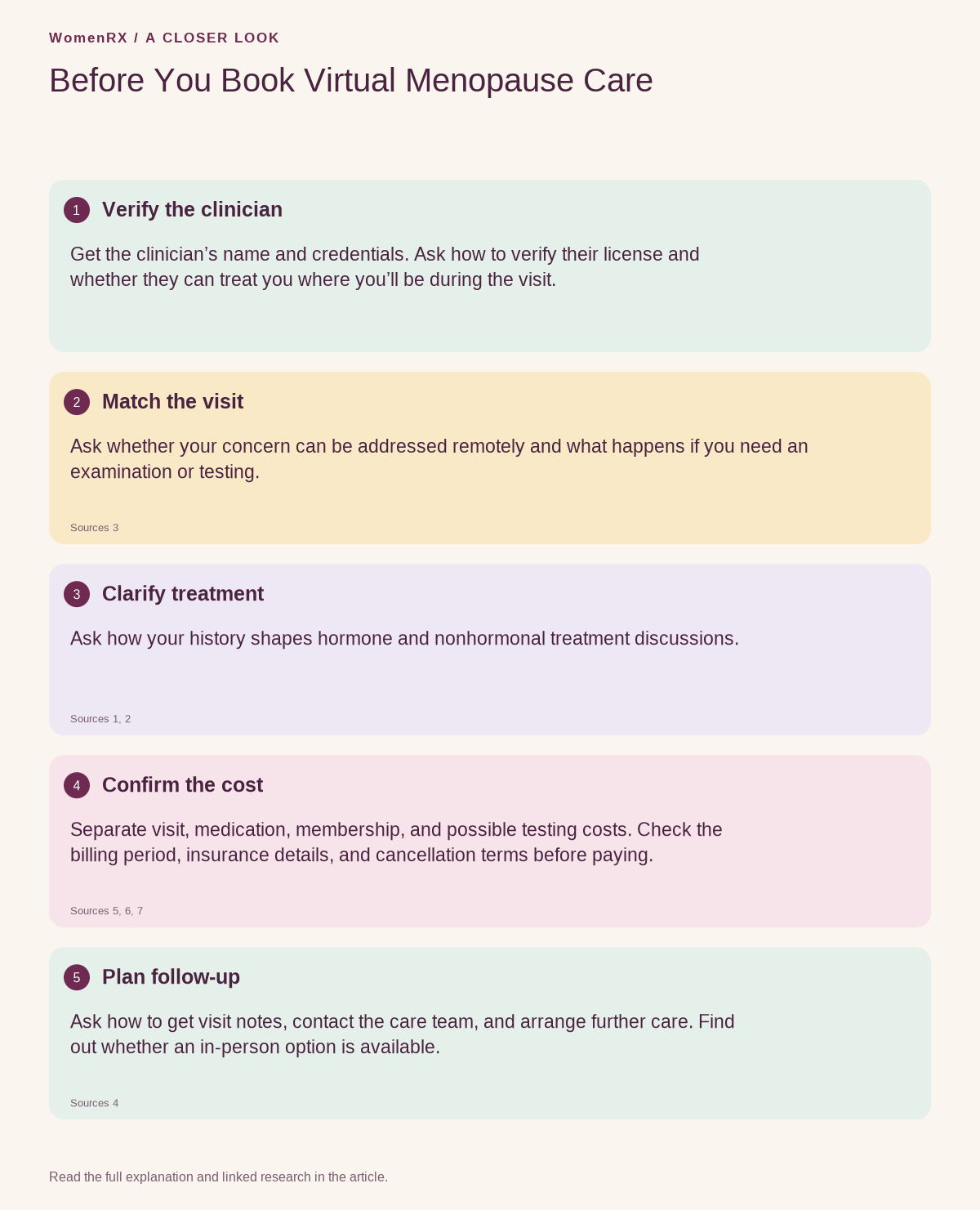
Before You Book Virtual Menopause Care
Verify the clinician: Get the clinician’s name and credentials. Ask how to verify their license and whether they can treat you where you’ll be during the visit.
Match the visit: Ask whether your concern can be addressed remotely and what happens if you need an examination or testing.3
Clarify treatment: Ask how your history shapes hormone and nonhormonal treatment discussions.12
Confirm the cost: Separate visit, medication, membership, and possible testing costs. Check the billing period, insurance details, and cancellation terms before paying.567
Plan follow-up: Ask how to get visit notes, contact the care team, and arrange further care. Find out whether an in-person option is available.4
Read the figure as text
Check the clinician and service, then make sure the visit and follow-up plan fit your needs. Preferences for virtual and in-person visits can differ between first appointments and reviews. 3- Verify the clinician: Get the clinician’s name and credentials. Ask how to verify their license and whether they can treat you where you’ll be during the visit.
- Match the visit: Ask whether your concern can be addressed remotely and what happens if you need an examination or testing.3
- Clarify treatment: Ask how your history shapes hormone and nonhormonal treatment discussions.12
- Confirm the cost: Separate visit, medication, membership, and possible testing costs. Check the billing period, insurance details, and cancellation terms before paying.567
- Plan follow-up: Ask how to get visit notes, contact the care team, and arrange further care. Find out whether an in-person option is available.4
More questions, answered
Does booking an online menopause visit mean I’ll get hormone therapy?
No. Menopausal hormone therapy should be individualized, and a clinician may recommend another option based on your symptoms, medical history, and preferences. Ask how treatment decisions are made before booking. 1
Sources you can check
- The 2022 hormone therapy position statement of The North American Menopause Society.“The 2022 Hormone Therapy Position Statement of The North American Menopause Society” Advisory Panel. · Menopause (New York, N.Y.) · 2022Return to first citation
- The 2023 nonhormone therapy position statement of The North American Menopause Society.Menopause (New York, N.Y.) · 2023Return to first citation
- The impact of COVID-19 on a specialised menopause clinic: Changes in practice and women's experiences.Kozica-Olenski SL, Ghelani DP, Boyle JA, Vincent AJ. · The Australian & New Zealand journal of obstetrics & gynaecology · 2023Return to first citation
- Menopause care delivery in the time of COVID-19: evaluating the acceptability of telehealth services for women with early and usual age menopause.Kozica-Olenski SL, Garth B, Boyle JA, Vincent AJ. · Climacteric : the journal of the International Menopause Society · 2023Return to first citation
- Midi menopause telehealth visit pricesAccessed 2026-09-25Return to first citation
- Alloy menopause hormone consultation and medication pricesAccessed 2026-09-25Return to first citation
- Alloy menopause hormone subscription billing cadenceAccessed 2026-09-25Return to first citation