What Happens When You Seek UTI Care Online?
An online UTI assessment can lead to a treatment discussion, a urine test, or a recommendation to be seen in person, depending on your symptoms and history.
Expect questions about burning when you pee, urgency, frequency, lower-belly pain, and whether the symptoms are new. You may also be asked about fever, back or side pain, pregnancy, and previous UTIs. For a nonpregnant woman with classic bladder symptoms and no added risks, treatment may be considered without a urine test. Other answers can change that plan. 4
The questions have a purpose
When you describe urinary symptoms online, the central question is whether they fit a straightforward bladder infection or point to something that needs testing or an examination. A 2026 expert triage guide considered symptoms, medical history, urine testing, and whether a virtual or in-person visit was appropriate for adults with suspected UTIs. Its recommendations for women apply to nonpregnant adults. They describe clinical options, not a promise that every online service follows the same process. 4
Be ready to say what has changed: Does it burn when you pee? Are you going more often, feeling a sudden urge, or having pain or pressure low in your belly? The guide identifies these as classic bladder-infection symptoms when they’re new. It also says a change in urine color or appearance on its own, without other bladder symptoms, is not a reason for urine testing or antibiotics. 4 Dark or strong-smelling urine alone can sometimes reflect not drinking enough water. 1
The next questions help sort out which route makes sense. Mention fever or chills, pain in your back or side below the ribs, blood in your urine, and any symptoms beyond the urinary tract, such as genital discharge. Say if you’re pregnant, have diabetes or a urinary catheter, have had repeated UTIs, or were recently treated with antibiotics for one. These details can affect the need for a visit or urine testing; they’re not just form-filling. 14
Why one person may get a treatment discussion and another needs a test
For a nonpregnant woman with new, classic bladder symptoms and no identified risk for antibiotic resistance, the expert triage guide rates treatment without a urine test or visit as an appropriate option. That helps explain why an online assessment can end with an antibiotic treatment discussion. It does not mean symptoms guarantee a prescription. 4
The tradeoff changes if you’ve had recurrent UTIs or recently taken antibiotics for a UTI. In those situations, the guide recommends urinalysis with a culture, ideally collected before the first antibiotic dose, because resistance is a greater concern. A remote conversation can identify the need for that sample, but it cannot collect it. If you keep getting UTIs, a visit also gives you room to discuss why they’re returning rather than repeating the same short-term decision each time. 41
Symptoms outside the usual bladder pattern can change the route too. The triage guide recommends a visit when symptoms such as genital discharge are present. If you notice blood in your urine, arrange a prompt medical assessment even if you also have familiar UTI symptoms: blood can have causes other than infection and may need investigation. 42
When to move beyond an online-only assessment
Fever or shivering with back or side pain can raise concern for a kidney infection rather than an infection limited to the bladder. The expert triage guide recommends same-day in-person evaluation when symptoms suggest kidney infection, a complicated bladder infection, or a urinary blockage. If you’re rapidly getting worse, don’t wait for an online questionnaire to resolve it. 14 Confusion, marked drowsiness, or difficulty speaking alongside suspected infection calls for emergency care. 1
Pregnancy deserves a separate decision. The nonpregnant-women recommendations above do not apply to you, and pregnancy is a higher-risk situation when kidney infection is suspected. If you’re pregnant and think you have a UTI, seek prompt assessment through your pregnancy care team or another clinician rather than assuming an online-only treatment route will be enough. They can decide what testing and care you need. 134
If symptoms worsen quickly or haven’t improved within two days of starting treatment, seek reassessment. A first plan may need to change, whether it began online or in person. 1
Online care is most useful when it helps you reach the right next step. Sometimes that’s a treatment discussion without testing. Sometimes it’s a urine sample or a visit that can answer a question a symptom form cannot. 4
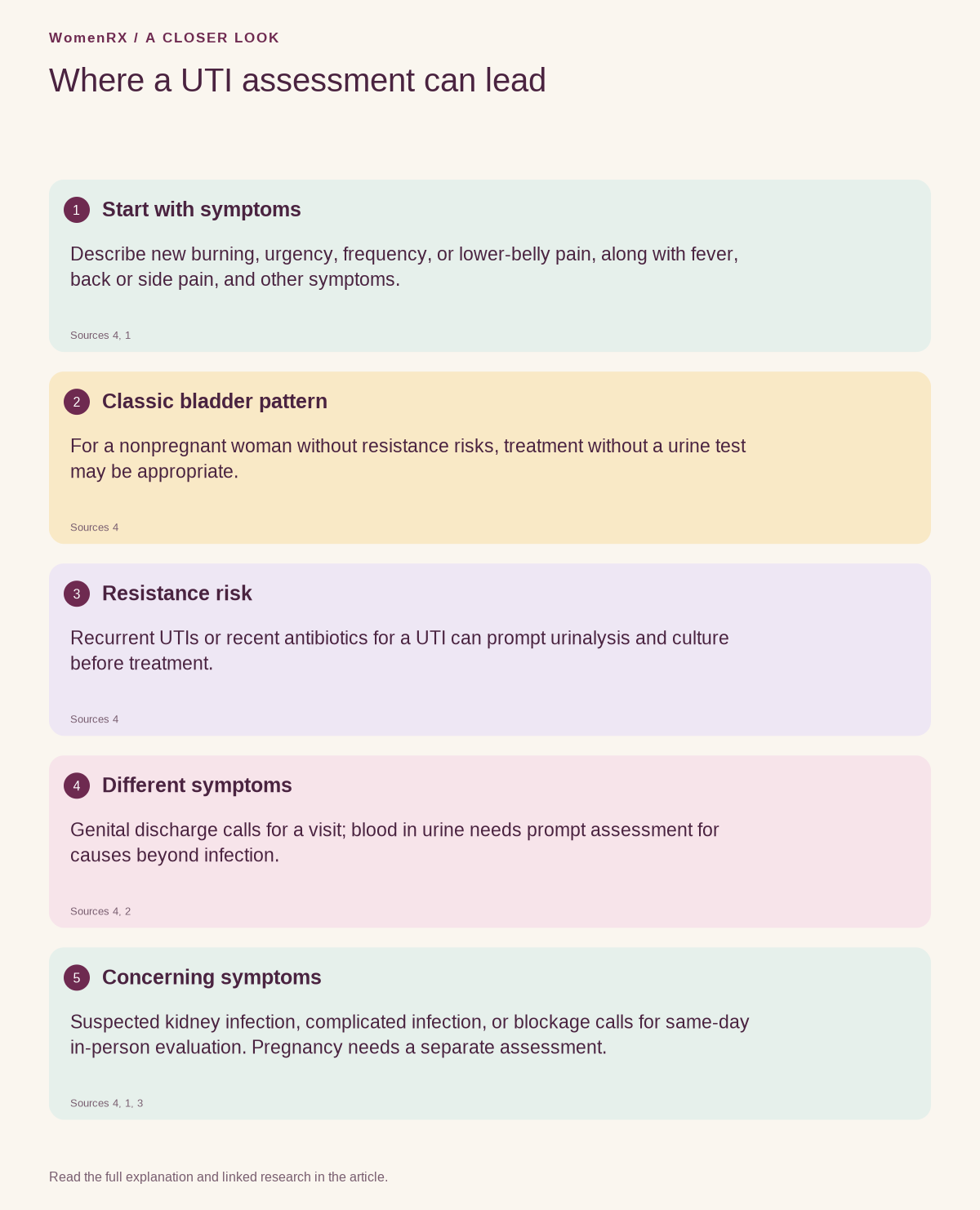
Where a UTI assessment can lead
Start with symptoms: Describe new burning, urgency, frequency, or lower-belly pain, along with fever, back or side pain, and other symptoms.41
Classic bladder pattern: For a nonpregnant woman without resistance risks, treatment without a urine test may be appropriate.4
Resistance risk: Recurrent UTIs or recent antibiotics for a UTI can prompt urinalysis and culture before treatment.4
Different symptoms: Genital discharge calls for a visit; blood in urine needs prompt assessment for causes beyond infection.42
Concerning symptoms: Suspected kidney infection, complicated infection, or blockage calls for same-day in-person evaluation. Pregnancy needs a separate assessment.413
Read the figure as text
The symptom review branches according to what you report; these are possible next steps, not a fixed sequence or a guaranteed prescription.- Start with symptoms: Describe new burning, urgency, frequency, or lower-belly pain, along with fever, back or side pain, and other symptoms.41
- Classic bladder pattern: For a nonpregnant woman without resistance risks, treatment without a urine test may be appropriate.4
- Resistance risk: Recurrent UTIs or recent antibiotics for a UTI can prompt urinalysis and culture before treatment.4
- Different symptoms: Genital discharge calls for a visit; blood in urine needs prompt assessment for causes beyond infection.42
- Concerning symptoms: Suspected kidney infection, complicated infection, or blockage calls for same-day in-person evaluation. Pregnancy needs a separate assessment.413
More questions, answered
Will I always need to give a urine sample?
No. For a nonpregnant woman with new, classic bladder symptoms and no identified resistance risk, treatment without a test can be appropriate. Recurrent UTIs or recent antibiotics for a UTI make urinalysis and culture more useful. 4
Sources you can check
- Urinary tract infections (UTIs) - NHSAccessed 2026-09-25Return to first citation
- Blood in urine - NHSAccessed 2026-09-25Return to first citation
- ACR Appropriateness Criteria® Acute Pyelonephritis: 2022 Update.Expert Panel on Urological Imaging, Smith AD, Nikolaidis P, Khatri G, Chong ST, De Leon AD, Ganeshan D, Gore JL, Gupta RT, Kwun R, Lyshchik A, Nicola R, Purysko AS, Savage SJ, Taff... · Journal of the American College of Radiology : JACR · 2022Return to first citation
- Ann Arbor Guide to Triaging Adults With Suspected Urinary Tract Infection for In-Person and Telehealth Settings.Meddings J, Chrouser K, Fowler KE, Ameling J, Engle JM, Saint S, Bernstein SJ. · JAMA network open · 2026Return to first citation