Online Lab Testing: What Happens After You Request a Test
The useful question isn’t just how to order a test online, but who handles the sample, sends the result, and helps you act on it.
When you request a lab test online, you may be selecting a direct-to-consumer test yourself; do not assume the request includes a clinician order. 4 If a service offers clinician-arranged testing, check what the clinician actually does. Depending on the test, you may give a sample at a collection site or collect one yourself for laboratory analysis. Before paying, find out where the sample goes, how you’ll receive results, and who will explain them and arrange follow-up if needed. 1345

First, find out what kind of order you’re making
With direct-to-consumer testing, you select the test yourself. It may involve a test used at home or a self-collected sample analyzed by a laboratory. 4 If an online service says a clinician arranges testing, check what that clinician does. An online request alone does not mean someone has selected the test for you, agreed to interpret the result, or planned what happens next.
Start with the reason you want the test. Screening looks for disease before symptoms appear, and the right screening tests depend on factors such as age, family history, and other risks. If you have symptoms, the useful test may be different from a screening test. 3 For example, a chlamydia assessment may involve a urine sample or a swab, and the areas tested can depend on which areas may be affected. A broad “women’s health” panel isn’t a substitute for working out which question needs answering. 2
Follow the sample, not just the order
After a test is selected, check the collection instructions for that particular test. A lab test may use blood, urine, or body tissue. Some screening requires a visit to a clinic or another collection location; some tests allow self-collection. 134 For example, UK NHS guidance describes a chlamydia self-test collected at home and sent to a lab. This does not establish that the same route is available in the US. In a US study of HPV screening, participants self-collected samples privately at a clinic for laboratory analysis. Neither example means every online service offers that collection option. 25
This is the practical handoff to settle before you pay: Where will I collect the sample, and how does it reach the laboratory? If there’s a kit, check what you must collect and where to send it. If there’s a collection visit, check where it takes place and whether the online order is available there. Follow the instructions you receive: how a sample is collected and how well you follow pre-test directions can affect the result. 1
For reproductive-health questions, give the ordering clinician or service the context behind your request rather than choosing by a panel name alone. Screening before symptoms and assessment of symptoms are different questions. 3 If you’re considering a progesterone test, for example, ask whether collection should be timed to your cycle. Progesterone changes over the cycle, and cycle lengths vary, so one calendar day won’t represent the same phase for everyone. This timing question does not apply to every lab test. 6 If pregnancy is possible, mention it when discussing testing and follow-up. For example, untreated chlamydia during pregnancy can be passed to a baby during birth. 2 Testing conditions and previous results can also matter when a result is interpreted. 1
A result needs a route back to you
The laboratory analyzes the sample and reports a result. A result may be compared with a reference range, but that range isn’t a diagnosis on its own: normal values differ between people, and previous results or testing conditions may matter. 1 The way you receive the report, and whether anyone explains it, depends on the service. Ask before testing: Will I get the full laboratory report? Who receives it besides me? Will someone contact me about a result that needs attention, or do I need to arrange that conversation? MedlinePlus specifically advises asking when screening results will arrive and whom to talk to about them. 3
Follow-up is a separate step, not an automatic feature of sample collection. In one US clinic study, patients self-collected HPV samples, a laboratory tested them, and clinic staff helped those with positive results connect to gynecologic care. That was a clinic-run program with staff tracking follow-up, not a model you should assume an online testing company provides. 5 If a service offers testing but not care afterward, decide who can review the result in the context of your symptoms and history before you order. A direct-to-consumer testing review warns that relying on those tests for healthcare decisions can pose risks. 4
A short check before checkout can prevent an awkward gap later: Who decides which test to run? Where is the sample collected? Which laboratory analyzes it? How do I get the complete result? And who takes responsibility for explaining the next step? The answers may differ from one test and service to another.
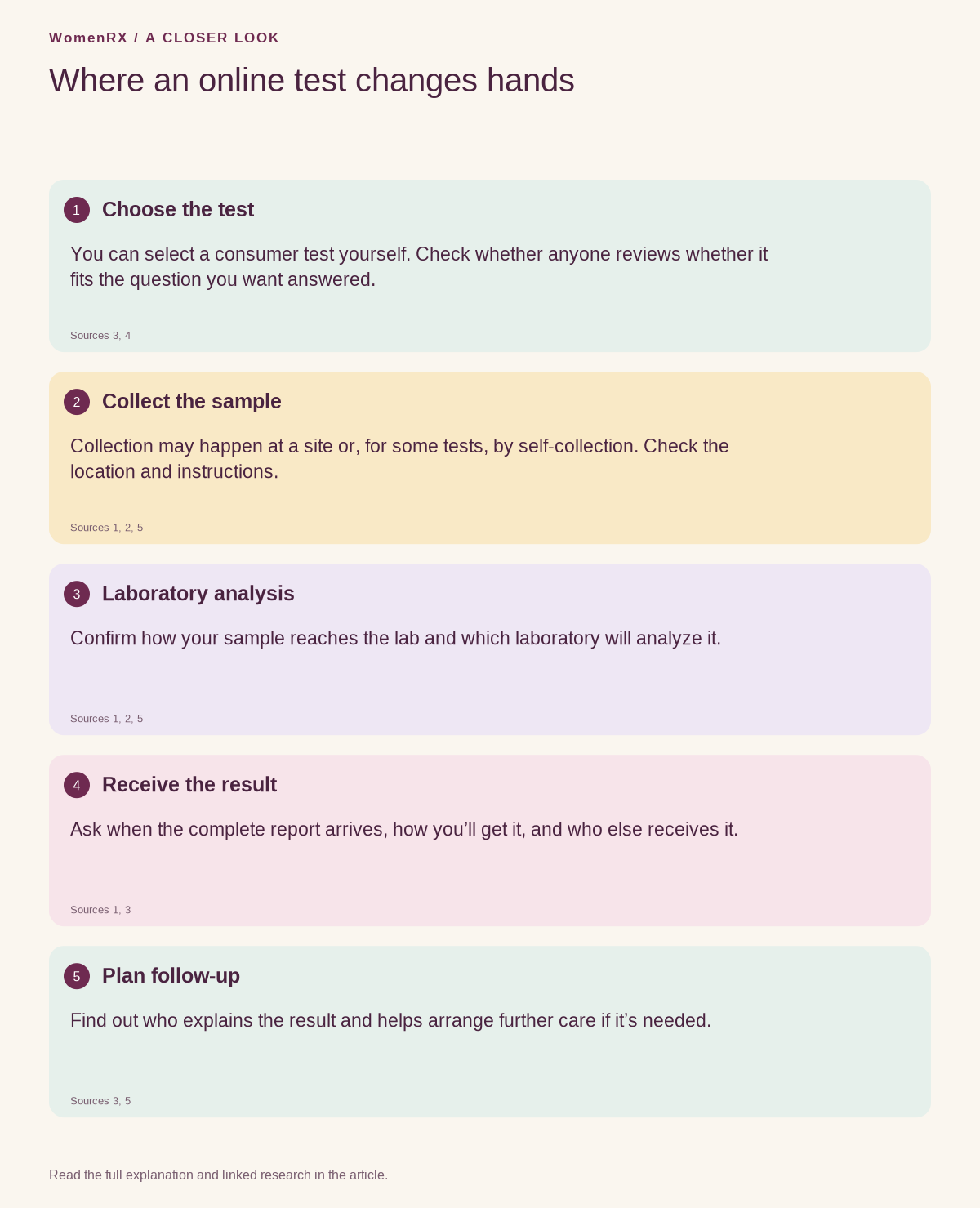
Where an online test changes hands
Choose the test: You can select a consumer test yourself. Check whether anyone reviews whether it fits the question you want answered.34
Collect the sample: Collection may happen at a site or, for some tests, by self-collection. Check the location and instructions.125
Laboratory analysis: Confirm how your sample reaches the lab and which laboratory will analyze it.125
Receive the result: Ask when the complete report arrives, how you’ll get it, and who else receives it.13
Plan follow-up: Find out who explains the result and helps arrange further care if it’s needed.35
Read the figure as text
A possible route from request to follow-up. Confirm each handoff because services and tests differ.- Choose the test: You can select a consumer test yourself. Check whether anyone reviews whether it fits the question you want answered.34
- Collect the sample: Collection may happen at a site or, for some tests, by self-collection. Check the location and instructions.125
- Laboratory analysis: Confirm how your sample reaches the lab and which laboratory will analyze it.125
- Receive the result: Ask when the complete report arrives, how you’ll get it, and who else receives it.13
- Plan follow-up: Find out who explains the result and helps arrange further care if it’s needed.35
More questions, answered
Does an online result tell me what diagnosis I have?
Not necessarily. Laboratory tests can help diagnose or monitor conditions, but a reference-range flag alone doesn’t account for factors such as how you followed pre-test instructions or how the result compares with previous tests. Ask who can review the result with you before relying on the number alone. 1
Sources you can check
- Laboratory Tests: MedlinePlusAccessed 2026-09-25Return to first citation
- Chlamydia - NHSAccessed 2026-09-25Return to first citation
- Health Screening: MedlinePlusAccessed 2026-09-25Return to first citation
- Direct-to-consumer laboratory testing (DTCT): challenges and implications for specialists in laboratory medicine.Orth M, Vollebregt E, Trenti T, Shih P, Tollanes M, Sandberg S. · Clinical chemistry and laboratory medicine · 2023Return to first citation
- Cervical Cancer Screening With Human Papillomavirus Self-Collection Testing in an Opioid Treatment Program.Swisher EM, Davis M, Rubin-Saika M, Manhardt E, Oshima E, Urban RR, Cherne SL, Lin J, Winer RL, Huang EC, Hutch T. · JAMA network open · 2026Return to first citation
- Periods and fertility in the menstrual cycle - NHSAccessed 2026-09-25Return to first citation