Fezolinetant Interactions: What to Bring for a Medication Review
Before taking fezolinetant for menopausal hot flashes, have a pharmacist or prescriber check every medicine and supplement you use for potential interactions.
Fezolinetant, sold as Veozah, treats moderate to severe hot flashes due to menopause. It must not be used with medicines that inhibit CYP1A2, an enzyme that helps break it down. Before starting fezolinetant or adding another product, bring a complete list of prescriptions, over-the-counter medicines, vitamins, and supplements for a check against current U.S. labeling. 1
Why the interaction check matters
Fezolinetant is a nonhormonal prescription treatment for moderate to severe hot flashes due to menopause. It’s mainly broken down by a liver enzyme called CYP1A2. When another medicine inhibits that enzyme, more fezolinetant can remain in the body. The U.S. prescribing information says fezolinetant must not be used with CYP1A2 inhibitors, whether they’re classified as weak, moderate, or strong. 1
You can’t reliably spot an inhibitor from what a medicine treats. The prescribing information describes interaction studies involving fluvoxamine, mexiletine, and cimetidine, examples of strong, moderate, and weak CYP1A2 inhibitors, respectively. They are examples, not the full list of medicines that need checking. 1
Ciprofloxacin is another useful example of why a current, product-specific check matters: a 2025 pharmacokinetic analysis modeled its potential interaction with fezolinetant as a moderate CYP1A2 inhibitor. Those estimates came from a model, not a clinical trial testing the two medicines together. 2
Build a list that answers the pharmacist’s questions
Bring together what you actually use, not just what appears in one prescriber’s records. The Veozah patient information asks you to report prescription medicines, over-the-counter medicines, vitamins, and herbal supplements, and to show your medicine list to your healthcare provider and pharmacist when you get a new medicine. 1
For each product, write down its name, its ingredients if you can find them, and how you use it, including whether it’s occasional. Include prescriptions from different prescribers; nonprescription products you pick up for issues such as heartburn, allergies, or a short-term illness; and supplements you use during midlife. These are examples of things to put on the list, not claims that every product in those categories interacts. If a box contains several ingredients, or you don’t know exactly what’s in a supplement, bring the package or a clear photo of its label.
How you use a product is worth recording, too. In the pharmacokinetic analysis, predicted increases in fezolinetant exposure varied with the regimen of the CYP1A2 inhibitor being modeled. That doesn’t give you a way to judge an interaction yourself, but it does help explain why “I take something for heartburn sometimes” is less useful than the product name and how you take it. 2
Make the review specific
Ask your pharmacist or prescriber: “Does anything on this list inhibit CYP1A2 under the current U.S. fezolinetant labeling?” Point out anything you’re about to start, including a short-course prescription, a new over-the-counter medicine, or a supplement. Don’t assume that a supplement is harmless or that it interacts simply because it’s a supplement. The labeling asks you to disclose these products so they can be reviewed individually. 1
If the review identifies a CYP1A2 inhibitor, ask what the plan is before taking it with fezolinetant. Keep the list handy for the next new product, too: a check done when you first started fezolinetant won’t account for something you add later. 1
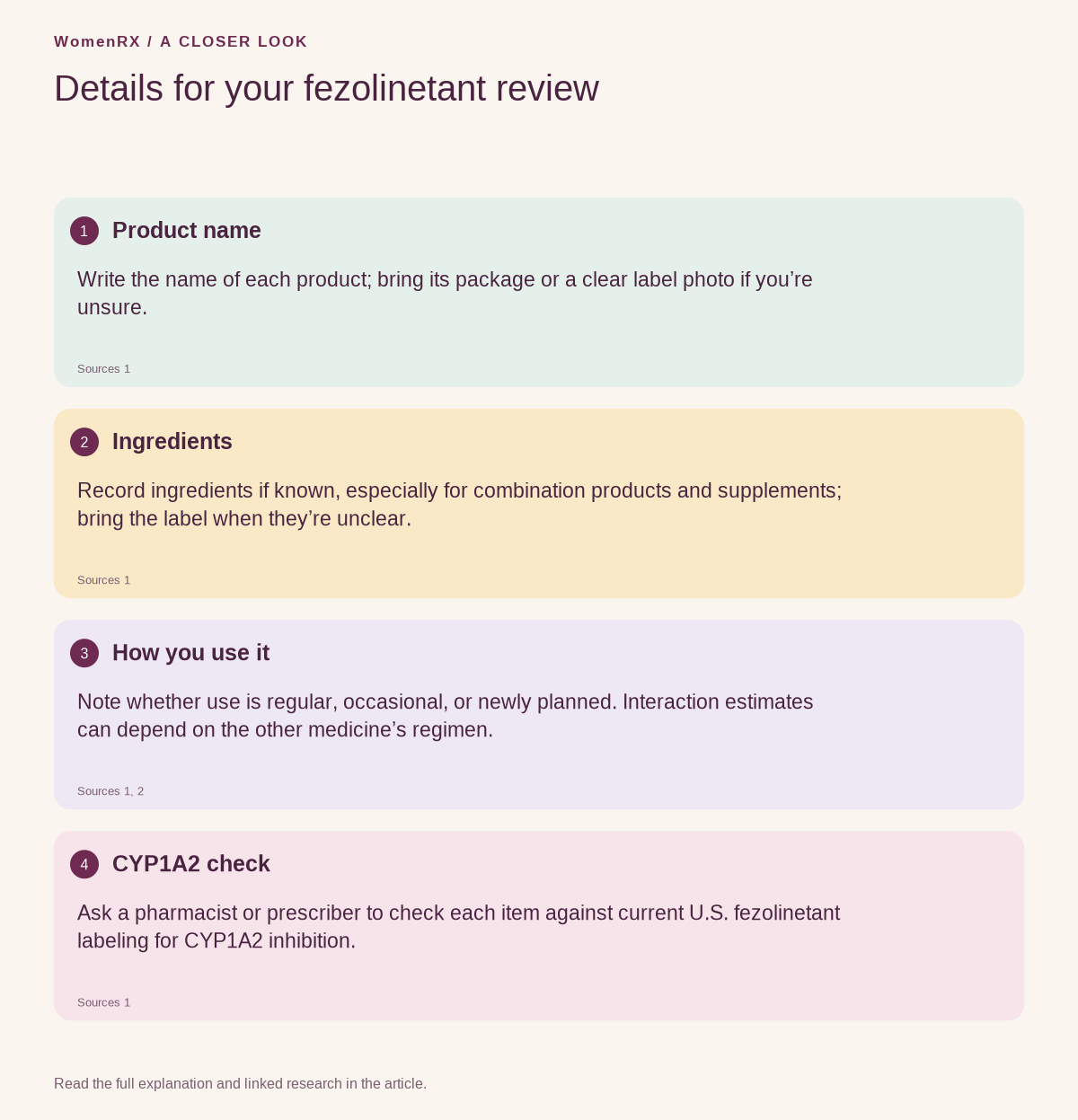
Details for your fezolinetant review
Product name: Write the name of each product; bring its package or a clear label photo if you’re unsure.1
Ingredients: Record ingredients if known, especially for combination products and supplements; bring the label when they’re unclear.1
How you use it: Note whether use is regular, occasional, or newly planned. Interaction estimates can depend on the other medicine’s regimen.12
CYP1A2 check: Ask a pharmacist or prescriber to check each item against current U.S. fezolinetant labeling for CYP1A2 inhibition.1
Read the figure as text
Use these prompts for every prescription, over-the-counter product, vitamin, and supplement you take, including occasional ones. 1- Product name: Write the name of each product; bring its package or a clear label photo if you’re unsure.1
- Ingredients: Record ingredients if known, especially for combination products and supplements; bring the label when they’re unclear.1
- How you use it: Note whether use is regular, occasional, or newly planned. Interaction estimates can depend on the other medicine’s regimen.12
- CYP1A2 check: Ask a pharmacist or prescriber to check each item against current U.S. fezolinetant labeling for CYP1A2 inhibition.1
Sources you can check
- VEOZAH (FEZOLINETANT) TABLET, FILM COATED [ASTELLAS PHARMA US, INC.] | US prescribing information and patient instructionsAccessed 2026-09-25Return to first citation
- Physiologically Based Pharmacokinetic (PBPK) Model to Predict the Magnitude of Drug-Drug Interaction Between Fezolinetant and CYP1A2 Inhibitors.Choules MP, Otsuka Y, Nielsen JC, Iwai M, Bonate PL. · Journal of clinical pharmacology · 2025Return to first citation