Fezolinetant Follow-Up: What to Track and Review
A simple record of hot flashes, daily impact, and side effects can make it easier to judge whether fezolinetant is helping you.
Track how often moderate or severe hot flashes and night sweats happen, how disruptive they are, whether you’ve taken fezolinetant as prescribed, and any side effects. Trials measured response at weeks 4 and 12, but those checkpoints don’t promise a personal result or set your appointment schedule. Follow your prescriber’s plan and the medicine’s liver-test schedule. 1 2
Make your follow-up about more than a hot-flash count
Fezolinetant is used for moderate to severe menopause-related vasomotor symptoms, including hot flashes and night sweats. To review whether it’s a good fit for you, keep a brief record of what happens and how much it affects your day. A symptom diary is not a test you need to pass. It gives you and your prescriber a clearer before-and-after comparison.
For example, note the number of moderate or severe episodes each day, whether they happened during the day or night, and how much they interrupted sleep, work, or another activity that matters to you. Also jot down side effects and whether you took the medicine as prescribed. Daily symptom records were used in fezolinetant trials, and a separate trial analysis examined the effect of symptoms on daily life. 2 3
If you can, begin with a snapshot of your symptoms before treatment or use any record you already have. You don’t need a perfect diary. A consistent, quick note is more useful than trying to remember several weeks of symptoms at a visit.
What the research checkpoints can, and can’t, tell you
In phase 3 trials, researchers compared symptoms at weeks 4 and 12. The U.S. prescribing information reports reductions in average symptom frequency with fezolinetant compared with placebo at both time points. A pooled analysis of two phase 3 trials reported improvement versus placebo as early as day 1. Those are findings across study groups; they can’t predict exactly when, or how much, one person will improve. 1 2
Use those trial checkpoints as context, not as a required personal deadline. Your prescriber can set the timing of a symptom review based on your situation. If symptoms are still disrupting your life, have changed little, or have become harder to manage, bring your notes to that discussion rather than changing or stopping treatment on your own.
At the review, it may help to compare:
- Frequency: Are moderate or severe episodes happening less often?
- Severity and impact: Are they less intense, or less disruptive to sleep and daily activities?
- Use: Have you been able to take the medicine as prescribed? If not, what got in the way?
- Tolerability: Have you noticed side effects or anything else that makes treatment difficult?
If the symptoms you want help with aren’t improving, say what you hoped would change. If they are improving but a side effect is making treatment hard to continue, describe that tradeoff plainly. These details help focus a conversation about treatment fit without assuming that frequency alone tells the whole story.
Keep liver testing on a separate track
Symptom review and liver-safety monitoring are related to your treatment, but they answer different questions. The U.S. prescribing information calls for liver tests before starting fezolinetant, then monthly for the first three months, and at months 6 and 9 after starting. Keep track of whether those tests have been arranged, and ask your prescriber’s office about any test you think you may have missed. 1
The label also says to stop fezolinetant immediately and seek medical attention, including liver testing, if you develop possible signs of liver injury. These include new fatigue, decreased appetite, nausea, vomiting, itching, yellowing of the skin or eyes, pale stools, dark urine, or abdominal pain. 1
For other side effects, or if the routine feels difficult to manage, contact your prescriber to discuss what you’re experiencing. The useful question isn’t only “Are the hot flashes better?” It’s whether the change is meaningful to you and whether the overall treatment plan remains manageable.
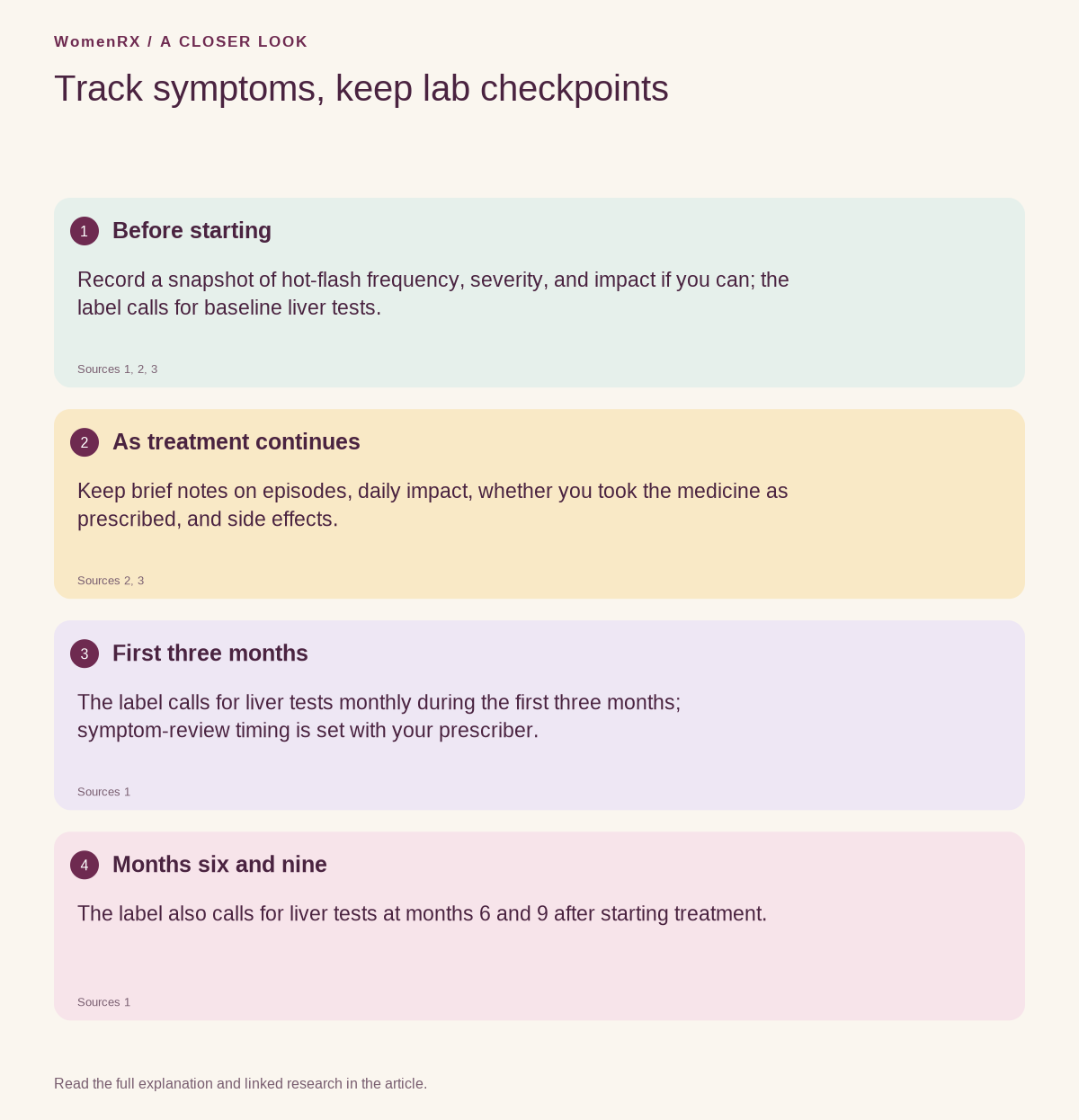
Track symptoms, keep lab checkpoints
Before starting: Record a snapshot of hot-flash frequency, severity, and impact if you can; the label calls for baseline liver tests.123
As treatment continues: Keep brief notes on episodes, daily impact, whether you took the medicine as prescribed, and side effects.23
First three months: The label calls for liver tests monthly during the first three months; symptom-review timing is set with your prescriber.1
Months six and nine: The label also calls for liver tests at months 6 and 9 after starting treatment.1
Read the figure as text
A flexible sequence for comparing how you feel with the separate liver-testing schedule in the U.S. prescribing information. Your prescriber sets the timing of your symptom review.- Before starting: Record a snapshot of hot-flash frequency, severity, and impact if you can; the label calls for baseline liver tests.123
- As treatment continues: Keep brief notes on episodes, daily impact, whether you took the medicine as prescribed, and side effects.23
- First three months: The label calls for liver tests monthly during the first three months; symptom-review timing is set with your prescriber.1
- Months six and nine: The label also calls for liver tests at months 6 and 9 after starting treatment.1
More questions, answered
Does improvement in the first few days mean fezolinetant will keep working?
A pooled phase 3 analysis reported improvement versus placebo from day 1, and the prescribing information reports benefits at weeks 4 and 12. Those group results don’t guarantee an individual response or show how your symptoms will change over time, so keep tracking and review your experience with your prescriber. 1 2
Sources you can check
- VEOZAH (FEZOLINETANT) TABLET, FILM COATED [ASTELLAS PHARMA US, INC.] | US prescribing information and patient instructionsAccessed 2026-09-25Return to first citation
- Early onset, maintenance of effect, and day-/night-time findings following fezolinetant treatment for moderate to severe vasomotor symptoms associated with menopause: A pooled phase 3 analysis.Shapiro C M M, Neal-Perry G, Stute P, Thurston RC, Wolfman W, English M, Wu X, Ottery FD. · Maturitas · 2025Return to first citation
- Effect of the neurokinin 3 receptor antagonist fezolinetant on patient-reported outcomes in postmenopausal women with vasomotor symptoms: results of a randomized, placebo-controlled, double-blind, dose-ranging study (VESTA).Santoro N, Waldbaum A, Lederman S, Kroll R, Fraser GL, Lademacher C, Skillern L, Young J, Ramael S. · Menopause (New York, N.Y.) · 2020Return to first citation