Gonorrhea Testing, Treatment, and Follow-Up: What to Expect
Gonorrhea can cause no symptoms, and the site of infection helps determine which tests and follow-up you need.
Gonorrhea is usually tested with a lab test on a sample from the relevant body site. For women, a vaginal swab is the preferred sample for genital screening; oral or anal exposure may call for a throat or rectal swab. Treatment generally involves an antibiotic injection. After treatment, throat infections need a test of cure, while everyone treated for gonorrhea should be retested for reinfection at three months. 23
A possible exposure is worth discussing even if you feel fine. Gonorrhea can infect the genital tract, throat, or rectum, and it doesn’t always cause symptoms. When symptoms do occur in women, they can include burning with urination, more vaginal discharge, or bleeding between periods. 2
The test depends on where infection might be
Gonorrhea is diagnosed with a laboratory test, most often a nucleic acid amplification test, or NAAT. For genital screening in women, the CDC identifies a vaginal swab as the preferred NAAT sample. A urine sample is another available option. Depending on the test, a vaginal swab may be collected by you or by a clinician after you’ve been given instructions. 3
Tell the person arranging your test about oral or anal sex, too. Gonorrhea at the throat or rectum calls for a sample from that site; a genital sample alone does not test those areas. For example, if you’re being tested after oral sex, ask whether a throat swab belongs in the plan. The CDC specifically recommends throat testing when someone with genital or rectal gonorrhea reports oral sexual exposure. 23
Symptoms aren’t a reliable way to choose which site to test. Most throat infections cause no symptoms, according to the CDC. And if you have vaginal irritation or discharge, a positive test for another cause of vaginitis doesn’t by itself answer whether gonorrhea is present. A U.S. study of women with symptomatic vaginitis detected gonorrhea using NAATs on vaginal swabs. 13
What treatment and partner care involve
Gonorrhea is treated with antibiotics. The CDC’s recommended treatment for uncomplicated infection centers on an injection of ceftriaxone. The clinician treating you will need to consider the site of infection and whether you also need testing or treatment for another STI. The CDC recommends that anyone diagnosed with gonorrhea be tested for chlamydia, syphilis, and HIV. 23
Let the treating clinician know if you’re pregnant. Gonorrhea can pass to a baby during childbirth, so a positive result needs a treatment discussion rather than a wait-and-see approach. 2 Untreated gonorrhea can lead to pelvic inflammatory disease (PID), which can affect fertility and future pregnancies. 2 If you have lower-abdominal pain, fever, or unusual vaginal discharge, get examined rather than waiting for a routine testing or follow-up visit. These can be symptoms of PID. 4
Partner care matters because treatment doesn’t prevent reinfection. The CDC recommends that recent sex partners, generally those from the 60 days before symptoms began or the diagnosis was made, be referred for evaluation, testing, and presumptive treatment. If your last possible exposure was earlier than that, its guidance still calls for the most recent partner to be treated. Ask the treating clinic how to help partners get care; partner-delivered treatment is an option only in certain circumstances and where permitted by law. 3
The CDC advises avoiding sex until at least seven days after your treatment and seven days after each partner’s treatment, and until any symptoms have resolved. This gives you a concrete question to settle before resuming sex if you or a partner has an uncertain treatment date. 3
Follow-up: clearing an infection versus catching a new one
Two kinds of repeat testing serve different purposes. A test of cure checks whether treatment cleared the infection. It isn’t routinely needed after recommended treatment for uncomplicated genital or rectal gonorrhea. Throat gonorrhea is different: the CDC recommends a test of cure 7 to 14 days after treatment, using a culture or NAAT. Testing at seven days can be more likely to produce a false-positive result. 3
Retesting for reinfection applies even when treatment worked. The CDC recommends another gonorrhea test three months after treatment, whether or not you believe your partners were treated. If that visit isn’t possible, its guidance calls for retesting the next time you seek care within 12 months. This is not the same as a test of cure. 3
Don’t wait for a scheduled retest if symptoms continue after treatment. The CDC recommends evaluation with a gonorrhea culture and antibiotic-susceptibility testing when symptoms persist. A new exposure can also cause reinfection, so tell the clinician about any sex since treatment. 3
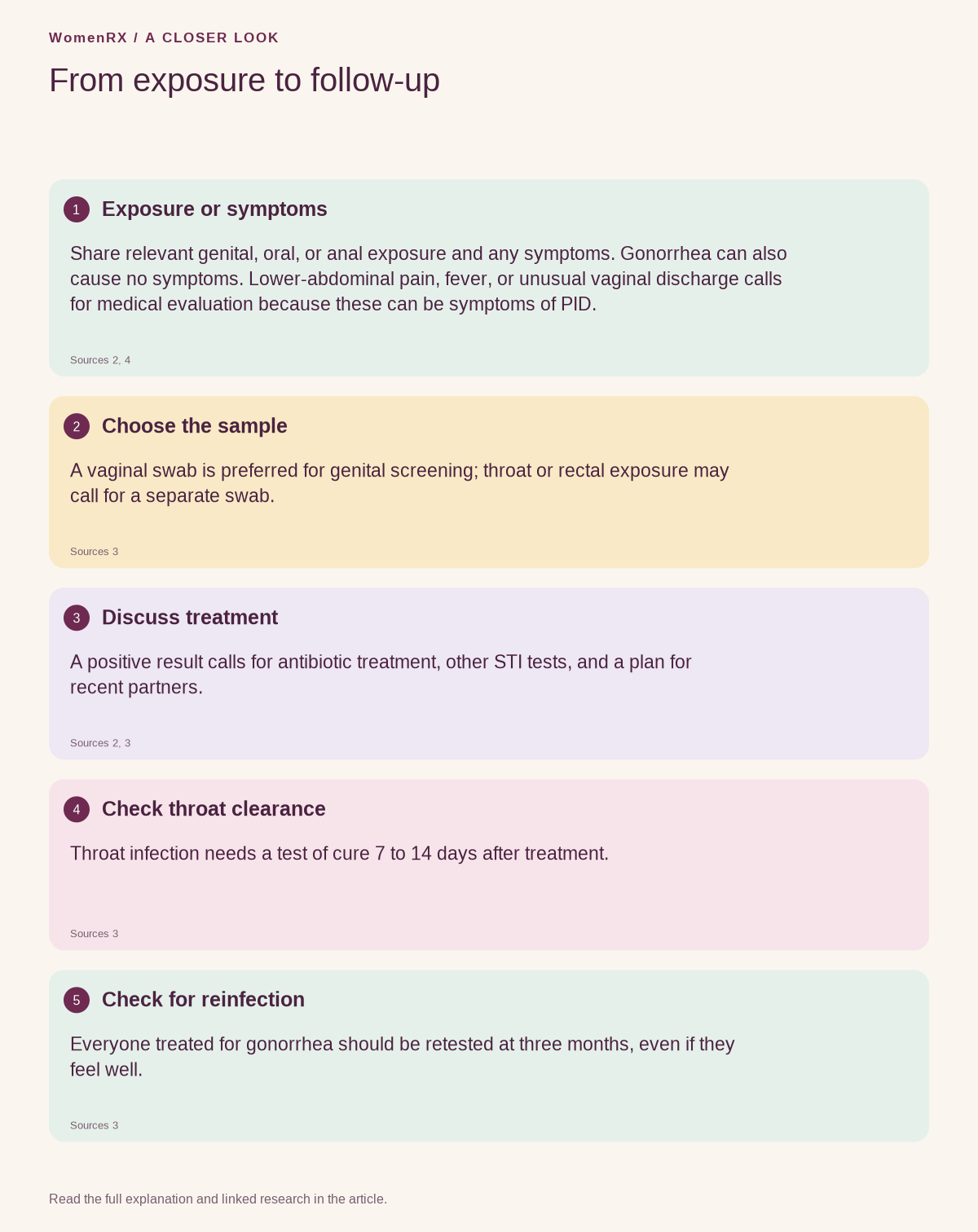
From exposure to follow-up
Exposure or symptoms: Share relevant genital, oral, or anal exposure and any symptoms. Gonorrhea can also cause no symptoms. Lower-abdominal pain, fever, or unusual vaginal discharge calls for medical evaluation because these can be symptoms of PID.24
Choose the sample: A vaginal swab is preferred for genital screening; throat or rectal exposure may call for a separate swab.3
Discuss treatment: A positive result calls for antibiotic treatment, other STI tests, and a plan for recent partners.23
Check throat clearance: Throat infection needs a test of cure 7 to 14 days after treatment.3
Check for reinfection: Everyone treated for gonorrhea should be retested at three months, even if they feel well.3
Read the figure as text
The site of possible infection and the test result shape what happens next.- Exposure or symptoms: Share relevant genital, oral, or anal exposure and any symptoms. Gonorrhea can also cause no symptoms. Lower-abdominal pain, fever, or unusual vaginal discharge calls for medical evaluation because these can be symptoms of PID.24
- Choose the sample: A vaginal swab is preferred for genital screening; throat or rectal exposure may call for a separate swab.3
- Discuss treatment: A positive result calls for antibiotic treatment, other STI tests, and a plan for recent partners.23
- Check throat clearance: Throat infection needs a test of cure 7 to 14 days after treatment.3
- Check for reinfection: Everyone treated for gonorrhea should be retested at three months, even if they feel well.3
More questions, answered
Can I collect my own swab?
Often, yes. In a clinical setting, the CDC considers patient-collected vaginal, rectal, and throat swabs reasonable alternatives to clinician-collected swabs for gonorrhea NAAT testing when collection instructions are provided. Ask which samples the clinic’s test accepts. 3
Does a negative genital test rule out throat gonorrhea?
No. A genital sample tests the genital site, not the throat. If oral exposure is relevant, ask whether you need a separate throat swab. 3
Sources you can check
- Clinical utility of nucleic acid amplification testing for detection of sexually transmitted infections in women with symptomatic bacterial vaginosis and vulvovaginal candidiasis identified by conventional versus molecular diagnoses.Getman D, Seña AC, Nenninger A, Schwebke JR. · Journal of clinical microbiology · 2026Return to first citation
- Gonorrhea | The Clap | MedlinePlusAccessed 2026-09-25Return to first citation
- Gonococcal Infections Among Adolescents and Adults - STI Treatment GuidelinesAccessed 2026-09-25Return to first citation
- About Pelvic Inflammatory Disease (PID) | Pelvic Inflammatory Disease (PID) | CDCAccessed 2026-09-25Return to first citation