Magnesium Glycinate or Citrate: Match the Form to Your Goal
Citrate has been studied in a sodium picosulfate bowel-preparation combination, but a human comparison doesn’t establish which form is better for everyday supplementation.
Neither form is established as the better choice overall. Magnesium citrate has been studied in combination bowel-preparation products, but that doesn’t show that a citrate supplement is a better routine constipation treatment. A human study measured magnesium after several forms, including citrate and bisglycinate, but didn’t establish a clinical advantage of one over the other. Compare the elemental magnesium on the label and consider your reason for taking it. 1 3 4
Start with what you want it to do
If you’re choosing between magnesium glycinate (also called bisglycinate on some labels) and magnesium citrate, start with the outcome you care about. Citrate has been studied as part of a sodium picosulfate bowel-preparation combination. A human comparison that included citrate and bisglycinate measured magnesium levels, not sleep, stress, or other symptom outcomes. 3 4
That’s not proof the forms work identically. The human comparison doesn’t establish a practical health advantage for one form over the other. 4
Citrate and bowel effects: context matters
Magnesium can have a laxative effect: unabsorbed magnesium salts draw water into the bowel, and higher supplemental or medication amounts can cause diarrhea, nausea, or abdominal cramping. Those effects are not proof that a particular supplement form will reliably treat constipation, or that citrate will work better than glycinate for you. 1
One randomized study tested sodium picosulfate plus magnesium citrate as a colonoscopy preparation. It compared two schedules for that combination, not citrate with glycinate or citrate alone as an everyday constipation treatment. Its results therefore can’t answer which supplement form to choose for routine bowel regularity. 3
If constipation is your goal, don’t assume that a product labeled “magnesium citrate” is interchangeable with a bowel-preparation product or that a supplement is the right fix. General measures such as eating more fiber-rich fruits, vegetables, and grains, exercising, and making time to use the bathroom when you feel the urge may help. 2 If your bowel habits change, or constipation continues, the cause and the right approach may need attention beyond choosing a magnesium form. 2
What the absorption research does, and doesn’t, tell you
NIH’s magnesium fact sheet says citrate is among the forms that tend to be more bioavailable than magnesium oxide. That is not a comparison with glycinate, and absorption findings alone don’t show that a form improves a symptom or health outcome more. 1
A human crossover study gave healthy participants several magnesium formulations, including citrate and bisglycinate, and measured magnesium in blood, urine, and red blood cells over a short period. The reported findings did not establish that citrate produced better clinical results than bisglycinate, or vice versa. The abstract also doesn’t report sex-specific results, so it can’t tell you whether the comparison differs for women. 4
There is one more directly relevant but limited women-specific finding: a study in 20 postmenopausal women with osteoporosis found that citrate, compared with placebo, affected a marker of bone turnover over 30 days. It did not compare citrate with glycinate, and a change in that marker does not establish that citrate prevents or treats osteoporosis. 1
Read the label before comparing forms
Look at the amount of elemental magnesium in the Supplement Facts panel. That is the magnesium amount declared on the label, not the total weight of the citrate or glycinate compound. Comparing a product’s compound weight with another product’s elemental-magnesium amount can make the servings look more alike than they are. 1
Also remember that digestive effects can depend on how much magnesium you get from supplements and medicines, not simply on whether the label says citrate or glycinate. For adults, the established upper limit of 350 mg per day applies to magnesium from supplements and medications, not magnesium naturally present in food. The NIH fact sheet notes that high supplemental or medication amounts can cause diarrhea and cramping; people with impaired kidney function are at greater risk of magnesium toxicity because their bodies may not clear excess magnesium as well. 1
A practical choice
If you’re considering magnesium for a specific symptom, don’t treat a form’s name as proof that it works for that symptom. The human comparison measured magnesium levels, not sleep, stress, or other symptom outcomes, so it can’t tell you which form is better for those goals. 4 If bowel regularity is the goal, distinguish an ordinary supplement from a magnesium-containing medicine or a colonoscopy-preparation product, and consider the cause of constipation rather than relying on form alone. 1 2 3
For a straightforward comparison, check elemental magnesium, other ingredients, and how the product fits your intended use. If you take medicines, magnesium can reduce absorption of oral bisphosphonates and some antibiotics; diuretics and long-term proton pump inhibitors can also affect magnesium status. 1
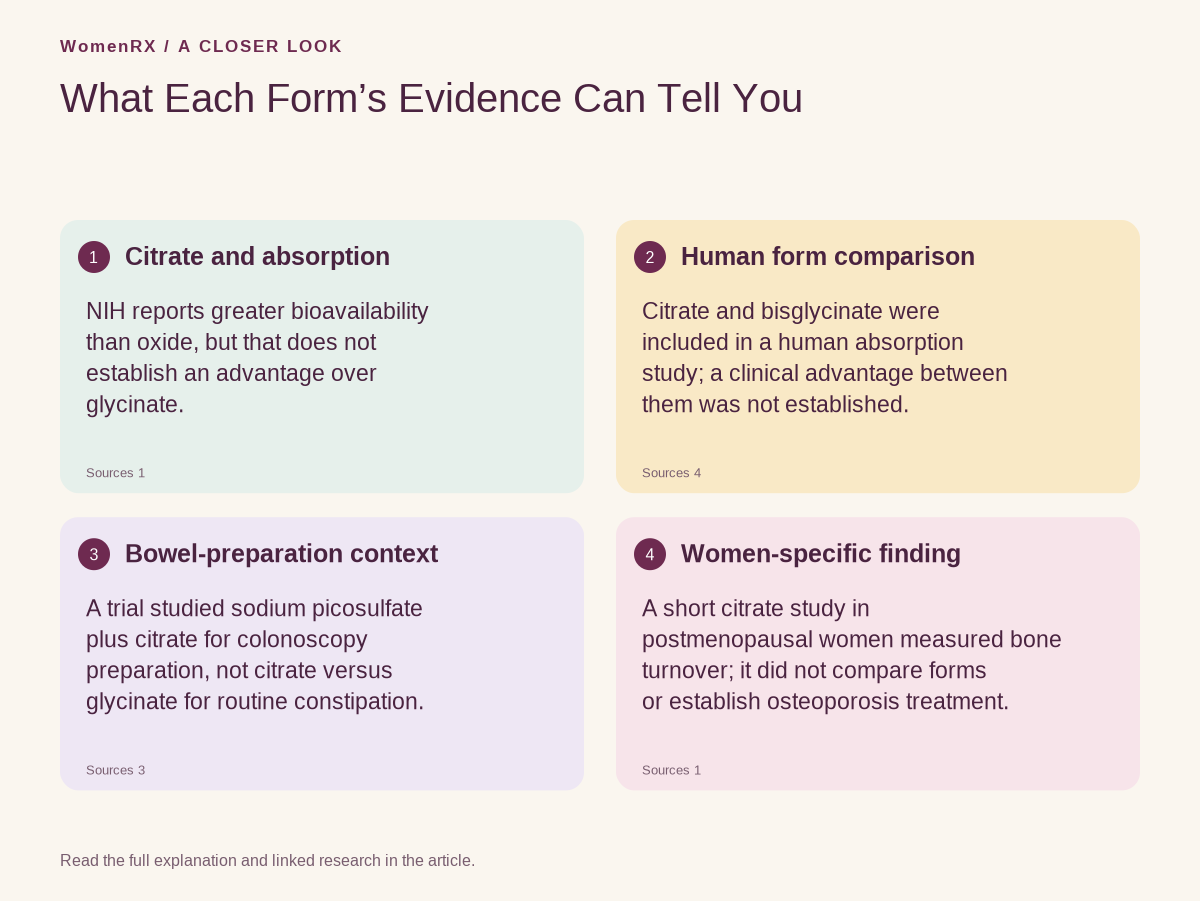
What Each Form’s Evidence Can Tell You
Citrate and absorption: NIH reports greater bioavailability than oxide, but that does not establish an advantage over glycinate.1
Human form comparison: Citrate and bisglycinate were included in a human absorption study; a clinical advantage between them was not established.4
Bowel-preparation context: A trial studied sodium picosulfate plus citrate for colonoscopy preparation, not citrate versus glycinate for routine constipation.3
Women-specific finding: A short citrate study in postmenopausal women measured bone turnover; it did not compare forms or establish osteoporosis treatment.1
Read the figure as text
This comparison separates the evidence for absorption, bowel-preparation use, and women-specific outcomes from questions the cited studies did not answer.- Citrate and absorption: NIH reports greater bioavailability than oxide, but that does not establish an advantage over glycinate.1
- Human form comparison: Citrate and bisglycinate were included in a human absorption study; a clinical advantage between them was not established.4
- Bowel-preparation context: A trial studied sodium picosulfate plus citrate for colonoscopy preparation, not citrate versus glycinate for routine constipation.3
- Women-specific finding: A short citrate study in postmenopausal women measured bone turnover; it did not compare forms or establish osteoporosis treatment.1
More questions, answered
Does magnesium glycinate have proven benefits for sleep?
A human comparison of several magnesium formulations included bisglycinate but didn’t test sleep outcomes. It therefore doesn’t establish that glycinate improves sleep or that it works better than citrate for that purpose. 4
Does the magnesium upper limit include food?
No. The adult upper limit of 350 mg per day applies to magnesium from supplements and medications, not magnesium naturally found in food. 1
Sources you can check
- Magnesium - Health Professional Fact SheetAccessed 2026-09-25Return to first citation
- Constipation | MedlinePlusAccessed 2026-09-25Return to first citation
- Randomized controlled trial comparing efficacy and acceptability of split- and standard-dose sodium picosulfate plus magnesium citrate for bowel cleansing prior to colonoscopy.Manes G, Repici A, Repici A, Hassan C, MAGIC-P study group. · Endoscopy · 2014Return to first citation
- Magnesium bioavailability after administration of sucrosomial® magnesium: results of an ex-vivo study and a comparative, double-blinded, cross-over study in healthy subjects.Brilli E, Khadge S, Fabiano A, Zambito Y, Williams T, Tarantino G. · European review for medical and pharmacological sciences · 2018Return to first citation