Selenium Benefits: What Taking Extra Has Shown
Selenium helps the body function, but studies of supplements tell a more limited story.
Selenium is an essential nutrient, but its role in the body doesn’t mean taking extra will improve your health. Trials in women with PCOS have found changes in some laboratory markers, while pregnancy research has not established whether supplementation prevents preterm birth. Studies also haven’t reliably shown whether starting selenium status changes who benefits. Getting enough and taking extra for a specific outcome are different questions. 245
Why selenium’s role doesn’t settle the supplement question
Selenium is part of enzymes involved in antioxidant activity. That’s a reason to study it, particularly in conditions where researchers are interested in oxidative stress. It isn’t, by itself, evidence that more selenium improves health when a person already has enough. 14
Starting status matters to the question. A supplement could have different effects in someone with low selenium status than in someone whose intake is already adequate, but pregnancy trials haven’t reliably sorted outcomes by selenium status at entry. A systematic review identified that measurement as a priority for future studies. So a trial result can’t yet tell you that a benefit applies equally to both groups. 2
PCOS: promising markers, unanswered clinical questions
In a 2025 review of trials involving women with polycystic ovary syndrome (PCOS), selenium supplementation was associated with improvements in certain measures of insulin sensitivity and antioxidant capacity. These were measured markers, not demonstrations that selenium relieves PCOS symptoms, improves fertility, or changes long-term health. The review reported no significant improvement from selenium in lipid markers; across the trace-element interventions it examined, measured sex hormones and weight-related outcomes did not significantly improve. 5
The review’s 25 trials and 1,600 participants covered calcium, chromium, magnesium, and selenium together. Those figures aren’t the size of the selenium-only evidence. Its abstract doesn’t give a selenium-specific participant count, which makes the apparent size of that finding easy to overread. 5
Pregnancy: separate the marker from the outcome
A small randomized trial studied 60 pregnant women identified as high risk for preeclampsia. Compared with placebo, selenium changed selected blood markers, a uterine artery blood-flow measure, and questionnaire scores for mood and sleep after 12 weeks. Those results are interesting, but a change in a blood-flow measure isn’t proof that the supplement prevents preeclampsia. 1
For preterm birth, a broader 2023 review could not determine whether selenium supplementation helps. Its estimate for birth before 37 weeks was compatible with either a lower or a higher risk, and the reviewers rated the evidence very low certainty. They also could not determine the effect on birth before 34 weeks. 2
There is a more favorable finding in a particular group: a randomized trial in Lagos reported a lower risk of preterm delivery with selenium than with placebo among pregnant women with HIV. That finding deserves attention for the population studied, but it doesn’t establish a benefit for pregnant women generally. 3
Pregnancy and postpartum thyroid claims need similar care. A review noted favorable thyroid findings in four studies, including findings about postpartum thyroid dysfunction, yet judged the overall pregnancy-supplementation evidence poor and called for better-designed trials before routine use. 4
What this means if you’re considering a supplement
Start with the outcome you’re hoping for. For PCOS, changes in insulin-related markers aren’t the same as symptom relief. For pregnancy, a finding in a high-risk group or a specific HIV-positive population isn’t a general prevention strategy. And a nutrient’s essential role answers a different question from whether an additional supplement helps someone who already gets enough. 1235
If you’re looking at a product because it promises a particular result, check whether the claim is about a measured marker or a health outcome you would actually notice, and whether the study participants resemble you. The research doesn’t yet give a dependable way to identify which women, if any, benefit from extra selenium based on their starting status. 25
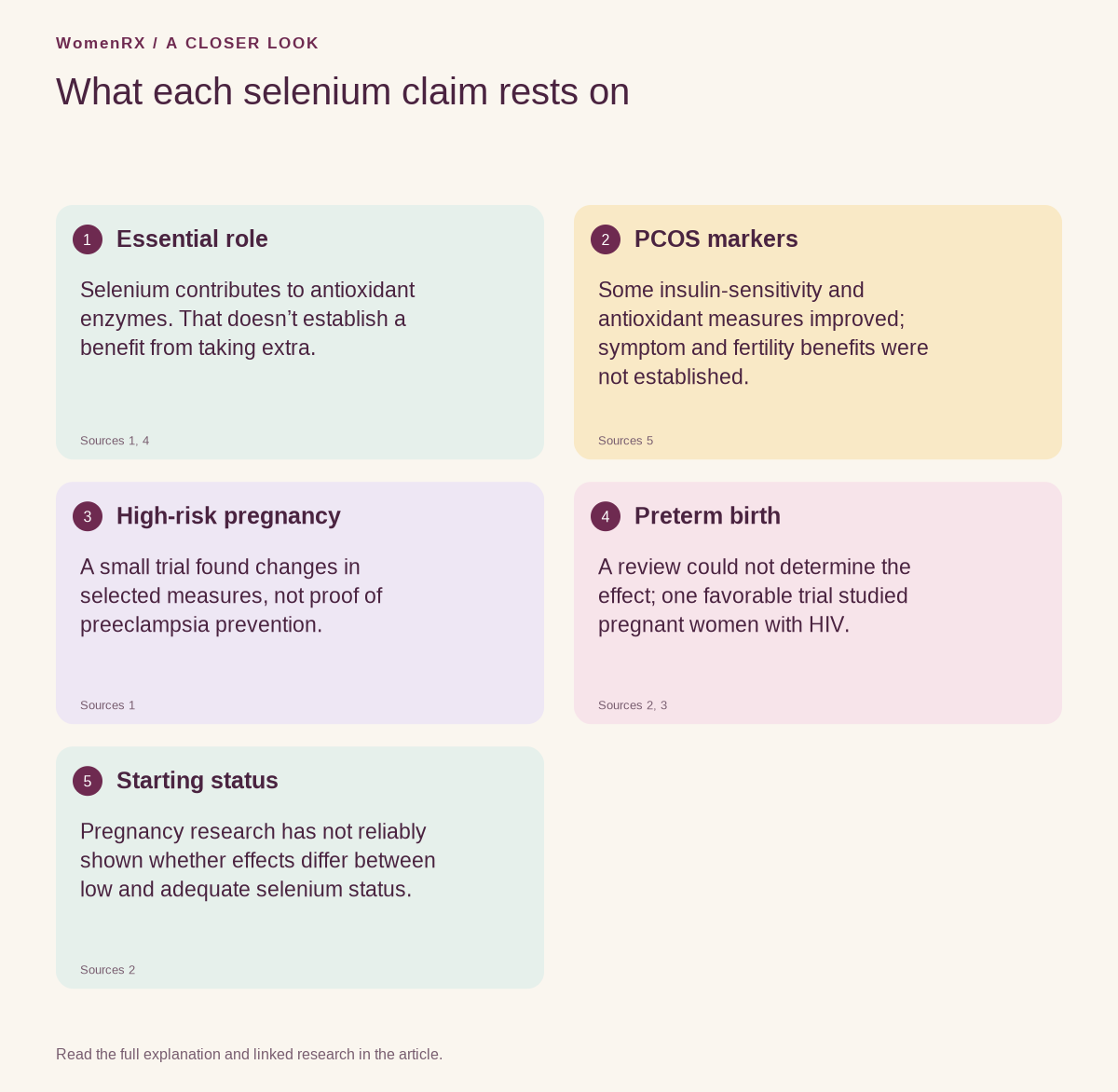
What each selenium claim rests on
Essential role: Selenium contributes to antioxidant enzymes. That doesn’t establish a benefit from taking extra.14
PCOS markers: Some insulin-sensitivity and antioxidant measures improved; symptom and fertility benefits were not established.5
High-risk pregnancy: A small trial found changes in selected measures, not proof of preeclampsia prevention.1
Preterm birth: A review could not determine the effect; one favorable trial studied pregnant women with HIV.23
Starting status: Pregnancy research has not reliably shown whether effects differ between low and adequate selenium status.2
Read the figure as text
These findings answer different questions. A biological role or a changed marker is not the same as a demonstrated health benefit.- Essential role: Selenium contributes to antioxidant enzymes. That doesn’t establish a benefit from taking extra.14
- PCOS markers: Some insulin-sensitivity and antioxidant measures improved; symptom and fertility benefits were not established.5
- High-risk pregnancy: A small trial found changes in selected measures, not proof of preeclampsia prevention.1
- Preterm birth: A review could not determine the effect; one favorable trial studied pregnant women with HIV.23
- Starting status: Pregnancy research has not reliably shown whether effects differ between low and adequate selenium status.2
More questions, answered
Does selenium prevent preterm birth?
That hasn’t been established for pregnant women generally. A systematic review rated the evidence very low certainty and could not determine the effect. One trial found a lower risk among pregnant women with HIV, but its result may not apply to other populations. 23
Does selenium treat PCOS?
A review found changes in some insulin-sensitivity and antioxidant markers, not proof of improved PCOS symptoms or fertility. It did not find a significant improvement from selenium in lipid markers. 5
Sources you can check
- The Effect of Selenium Supplementation on Clinical Outcomes, Metabolic Profiles, and Pulsatility Index of the Uterine Artery in High-Risk Mothers in Terms of Preeclampsia Screening with Quadruple Test: a Randomized, Double-Blind, Placebo-Controlled Clinical Trial : Selenium and preeclampsia.Mesdaghinia E, Shahin F, Ghaderi A, Shahin D, Shariat M, Banafshe H. · Biological trace element research · 2023Return to first citation
- The effect of selenium supplementation in pregnant women on maternal, fetal, and newborn outcomes: a systematic review and meta-analysis.McDougall AR, Dore G, Aboud L, Makama M, Nguyen PY, Mills K, Sanderson B, Hastie R, Ammerdorffer A, Vogel JP. · American journal of obstetrics & gynecology MFM · 2023Return to first citation
- Effects of selenium supplementation on pregnancy outcomes and disease progression in HIV-infected pregnant women in Lagos: A randomized controlled trial.Okunade KS, Olowoselu OF, John-Olabode S, Hassan BO, Akinsola OJ, Nwogu CM, Ugwu AO, Moses OE, Rabiu KA, Ajepe A, Adenekan MA, Adejimi AA, Akanmu SA, Kanki PJ. · International journal of gynaecology and obstetrics: the official organ of the International Federation of Gynaecology and Obstetrics · 2021Return to first citation
- Selenium Supplementation in Pregnancy-Maternal and Newborn Outcomes.Biswas K, McLay J, Campbell FM. · Journal of nutrition and metabolism · 2022Return to first citation
- The effects of trace element supplementation on glycolipid metabolism in PCOS: a systematic review and meta-analysis.Yang L, Gao Y, Zhao W, Qi Y, Duo X, Wang H. · Frontiers in nutrition · 2025Return to first citation