Oral Minoxidil for Hair Loss: What to Share First
Oral minoxidil affects more than your scalp, so your blood-pressure history and the cause of your hair loss matter before treatment.
Before a clinician decides whether oral minoxidil fits, share your blood-pressure and heart history, your current medicines, and whether you’re pregnant, trying to conceive, or breastfeeding. Describe when and how your hair loss started, too. Oral minoxidil acts throughout the body, while different causes of hair loss may call for different treatment decisions. These are screening topics, not an automatic exclusion list. 3 1

Why your blood pressure and heart history matter
Oral minoxidil is a systemic medicine: it reaches the body through the bloodstream rather than being applied to the scalp. It was originally used to treat high blood pressure because it widens blood vessels. That same effect is why a prescriber needs to know about your blood pressure and cardiovascular health when considering it for hair loss. 3
Share any history of high or low blood pressure, heart problems, or treatment for a cardiovascular condition. Mention symptoms such as a racing heartbeat, lightheadedness, or swelling if you’ve experienced them. Oral minoxidil has cardiovascular and fluid-retention concerns, including changes in blood pressure or heart rate, so these details can shape the assessment. They don’t, on their own, tell you whether the medicine is appropriate for you. 3
You may see alarming figures from analyses of adverse-event reports. One analysis found that several cardiovascular events were reported disproportionately with oral rather than topical minoxidil. Those figures compare reports, not the number of people who experienced an event out of everyone who used each treatment. The reports cannot establish how often an event happens or predict your personal risk. 3
Bring the medicines you actually take
Make a list of prescription and over-the-counter medicines and supplements, including anything you use occasionally. In particular, make sure the prescriber knows if you take medicine for blood pressure or a heart condition. Because oral minoxidil affects blood vessels and blood pressure, your existing treatment and health history belong in the same conversation. This is a reason for review, not a claim that every blood-pressure medicine has a proven interaction with oral minoxidil. 3
Don’t stop a medicine you need just to make room for a hair-loss treatment. If pregnancy is part of your situation, general pregnancy guidance likewise recommends discussing medicine decisions before starting or stopping treatment. 2
Say where pregnancy and breastfeeding fit
Tell the prescriber if you’re pregnant, trying to conceive, or breastfeeding before making a treatment decision. General guidance on medicines in pregnancy calls for weighing the benefits and risks of a particular medicine together with a care provider; it does not answer whether oral minoxidil is suitable in pregnancy. 2
Bring up breastfeeding separately. A decision during breastfeeding needn’t be assumed to match a decision during pregnancy. Ask how breastfeeding affects the treatment choice, including whether another approach to your hair loss makes more sense.
Describe the hair loss, not just the amount
A medicine aimed at hair growth isn’t a substitute for understanding why your hair is changing. Hair loss can follow an illness, be temporary, or take an inherited pattern; occasionally it can be a sign of a medical condition. Treatment may help some types, while other types may improve as the underlying situation changes. 1
Explain when you first noticed it and whether you’re seeing gradual thinning or a more sudden change. For example, gradual thinning over several years and shedding that began after an illness give a clinician different starting points. Neither description is a diagnosis by itself. If you don’t yet know the likely cause, ask how it will be assessed before deciding on oral minoxidil. 1
For the visit, you can put the four essentials in one note: your blood-pressure and heart history; medicines and supplements; pregnancy plans or breastfeeding; and when and how the hair loss began. Then ask, “How does each of these affect whether oral minoxidil is a good fit for my kind of hair loss?”
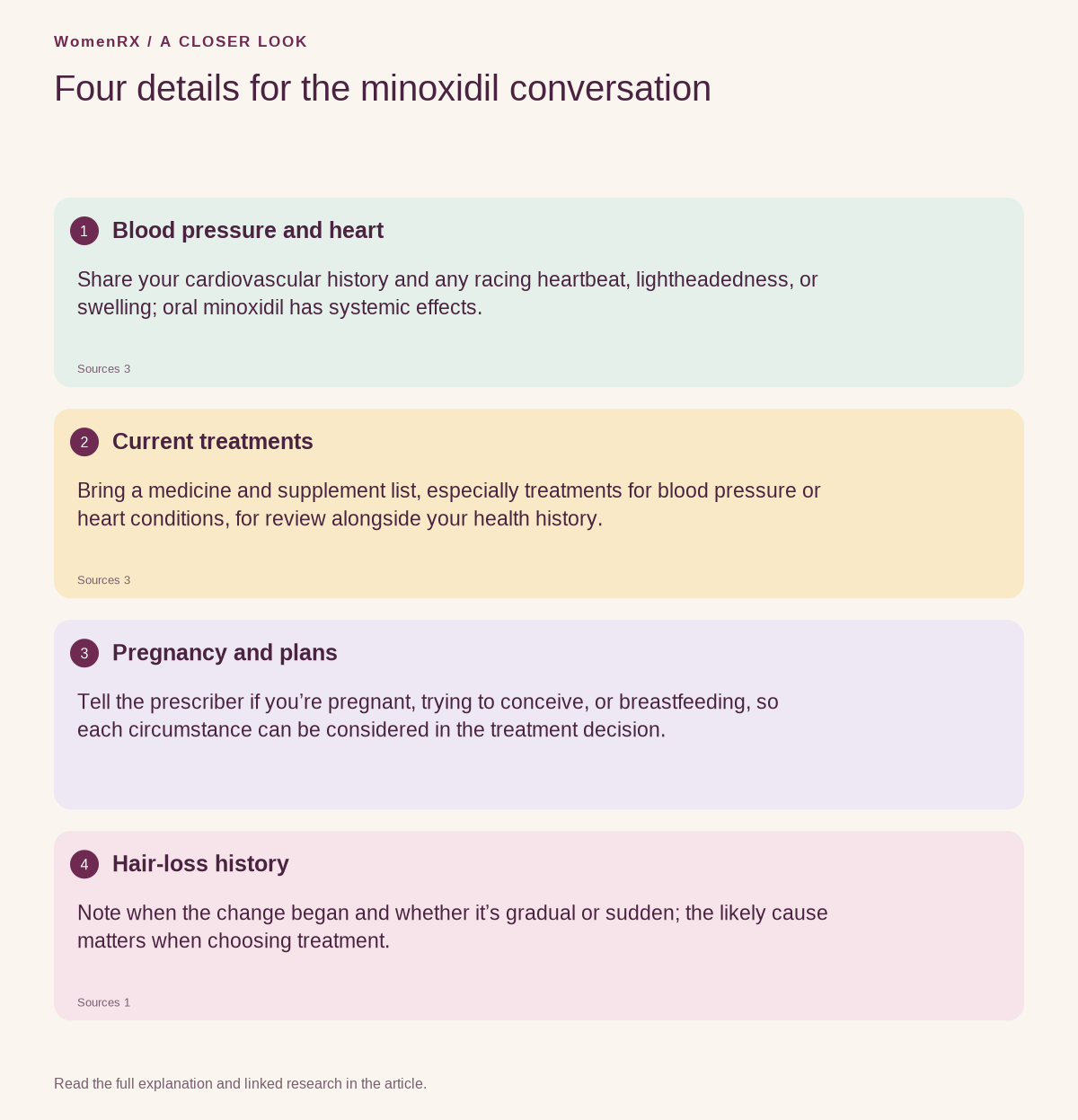
Four details for the minoxidil conversation
Blood pressure and heart: Share your cardiovascular history and any racing heartbeat, lightheadedness, or swelling; oral minoxidil has systemic effects.3
Current treatments: Bring a medicine and supplement list, especially treatments for blood pressure or heart conditions, for review alongside your health history.3
Pregnancy and plans: Tell the prescriber if you’re pregnant, trying to conceive, or breastfeeding, so each circumstance can be considered in the treatment decision.
Hair-loss history: Note when the change began and whether it’s gradual or sudden; the likely cause matters when choosing treatment.1
Read the figure as text
Use this checklist to gather information for the prescribing discussion, not to decide for yourself whether treatment is ruled out.- Blood pressure and heart: Share your cardiovascular history and any racing heartbeat, lightheadedness, or swelling; oral minoxidil has systemic effects.3
- Current treatments: Bring a medicine and supplement list, especially treatments for blood pressure or heart conditions, for review alongside your health history.3
- Pregnancy and plans: Tell the prescriber if you’re pregnant, trying to conceive, or breastfeeding, so each circumstance can be considered in the treatment decision.
- Hair-loss history: Note when the change began and whether it’s gradual or sudden; the likely cause matters when choosing treatment.1
Sources you can check
- Hair loss - NHSAccessed 2026-09-25Return to first citation
- Pregnancy and Medicines | MedlinePlusAccessed 2026-09-25Return to first citation
- Cardiovascular Safety Signals of Oral Versus Topical Minoxidil in FAERS: A Disproportionality Analysis (Analytic Cohort 2012-2025).Makkena HB, Kasu V. · Life (Basel, Switzerland) · 2026Return to first citation