Oral Minoxidil: Medicines and Supplements to Review
If you’re considering oral minoxidil for hair loss, start the medication review with anything that affects your blood pressure.
Before starting oral minoxidil for hair loss, share every prescription, over-the-counter medicine, and supplement you take. Flag blood-pressure-altering medicines, including spironolactone. In a study of women taking oral minoxidil with spironolactone, those taking another blood-pressure-altering medicine had higher odds of dizziness or other symptoms on standing. The finding groups those additional medicines together, so it can’t establish the risk of a particular combination. 1
Why blood-pressure medicines come first
Oral minoxidil was originally developed to lower blood pressure. Prioritizing blood-pressure medicines in your review is a practical starting point, not a finding that every such medicine interacts with minoxidil. 3
The clearest reason to flag blood-pressure-altering medicines comes from a retrospective study of 432 adult women taking low-dose oral minoxidil with spironolactone for hair loss. Fifty-two women, or 12.0%, reported dizziness, lightheadedness, or symptoms on standing. Those taking at least one additional blood-pressure-altering medicine had higher odds of those symptoms than women who weren’t taking an additional one (odds ratio 3.29; 95% confidence interval 1.65-6.58). The reported finding groups additional blood-pressure-altering medicines together, so it can’t establish the risk of a particular combination. 1
If you take spironolactone, name it even if it was prescribed for your skin or hair rather than your blood pressure. Taking it alongside oral minoxidil was the starting point for the women in that study, not proof that the two medicines should never be combined. The finding about higher odds of symptoms applied to women taking another blood-pressure-altering medicine on top of that combination. 1 Ask the prescriber or pharmacist to check your full list before changing any medicine.
Bring the products you take occasionally, too
A useful list includes prescriptions, over-the-counter medicines, vitamins, herbal products, and other supplements. For each one, bring the name and ingredients if you have them, plus how often you take it. A photo of a supplement label is more useful than calling it a “hair vitamin,” since products with similar names can contain different ingredients.
The study described above reports on blood-pressure-altering medicines, not specific supplement combinations. 1 That doesn’t make supplements interaction-free. It means the sensible question is about your exact products and combination, rather than a blanket yes or no. If you’ve recently started, stopped, or changed something, include that detail so the reviewer has an accurate picture of what you’re taking now.
Pregnancy and breastfeeding need their own conversation
A consensus statement for pattern-hair-loss patients in a hair-transplant context recommends avoiding minoxidil during pregnancy and breastfeeding. That’s a question about whether minoxidil is suitable at that time, not a demonstrated interaction with a prenatal vitamin or pregnancy-related medicine. 2
If you’re pregnant, breastfeeding, or planning a pregnancy, say so before starting oral minoxidil. Bring any related prescriptions and supplements into the same review. The goal is to assess the whole plan without assuming that a pregnancy-related product either protects against a risk or creates an interaction.
Make the review easy to act on
You can start with: “I’m considering oral minoxidil for hair loss. Here’s everything I take, including occasional medicines and supplements. Which items affect blood pressure, and does anything on this list change whether oral minoxidil makes sense for me?”
If you’re already taking it and have dizziness or lightheadedness, especially when standing, you can ask whether it could relate to your medication combination and whether any recent changes are relevant. Those were among the symptoms recorded in the study of women taking oral minoxidil with spironolactone. 1
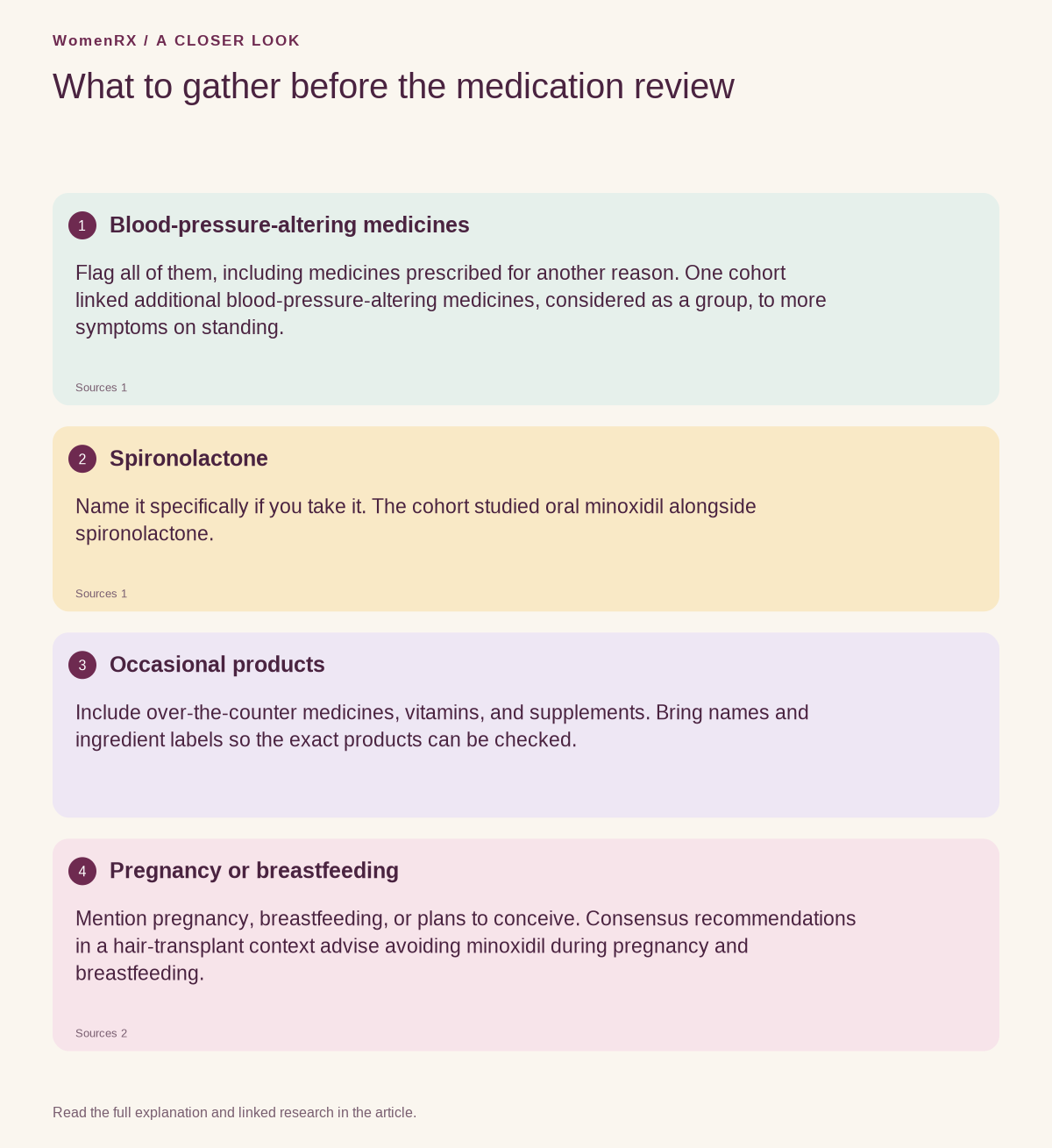
What to gather before the medication review
Blood-pressure-altering medicines: Flag all of them, including medicines prescribed for another reason. One cohort linked additional blood-pressure-altering medicines, considered as a group, to more symptoms on standing.1
Spironolactone: Name it specifically if you take it. The cohort studied oral minoxidil alongside spironolactone.1
Occasional products: Include over-the-counter medicines, vitamins, and supplements. Bring names and ingredient labels so the exact products can be checked.
Pregnancy or breastfeeding: Mention pregnancy, breastfeeding, or plans to conceive. Consensus recommendations in a hair-transplant context advise avoiding minoxidil during pregnancy and breastfeeding.2
Read the figure as text
Use this list to show the prescriber or pharmacist what you actually take. It isn’t an interaction score.- Blood-pressure-altering medicines: Flag all of them, including medicines prescribed for another reason. One cohort linked additional blood-pressure-altering medicines, considered as a group, to more symptoms on standing.1
- Spironolactone: Name it specifically if you take it. The cohort studied oral minoxidil alongside spironolactone.1
- Occasional products: Include over-the-counter medicines, vitamins, and supplements. Bring names and ingredient labels so the exact products can be checked.
- Pregnancy or breastfeeding: Mention pregnancy, breastfeeding, or plans to conceive. Consensus recommendations in a hair-transplant context advise avoiding minoxidil during pregnancy and breastfeeding.2
More questions, answered
Does taking spironolactone mean I can’t take oral minoxidil?
Not on the basis of this study. It examined women who took the two medicines together. Its notable finding was higher odds of symptoms on standing among those also taking at least one additional blood-pressure-altering medicine; the reported result groups those medicines together and cannot establish the risk of every individual combination. 1
Sources you can check
- Safety and tolerability of combination oral spironolactone and low-dose oral minoxidil for hair loss in adult females: A retrospective cohort study.Dewey E, Salloum L, Gregoire S, McIntosh BA, Zhao V, Mostaghimi A. · Journal of the American Academy of Dermatology · 2026Return to first citation
- Low-dose oral minoxidil (LDOM) and topical minoxidil: consensus recommendations for managing male and female pattern hair loss in hair transplant patients using a modified Delphi process.Gupta AK, Talukder M, Williams G, Abdelhamid H, Akiska YM, Alpeter D, Boden SA, Erfan R, Farjo B, Farjo N, Gabel S, Harris JA, Hekimian KJ, Keene S, Krejci-Manwaring J, Leonard RT,... · Expert opinion on pharmacotherapy · 2026Return to first citation
- Oral Minoxidil for Alopecia Treatment: Risks, Benefits, and Recommendations.Ong MM, Li Y, Lipner SR. · American journal of clinical dermatology · 2026Return to first citation